End-of-Life Care
Ethical consideration in the care of the elderly and end-of-life care — dying well, decisions at the end, euthanasia, the elderly, and four cases
Opening
Ethical Consideration in the Care of the Elderly and End-of-Life Care
Medical Ethics · MED 431 · Lecture 5: End-of-life care and elderly patients. First Semester 1448 · 2026 / 2027.
By the end of this lecture you can
Define palliative care and explain its ethical foundations. Describe the ethical distinction between withholding and withdrawing life-sustaining treatment. Explain medical futility and apply it to clinical decisions. Define brain death and describe the Islamic scholarly position on it. Explain DNR (Do Not Resuscitate) orders, advance directives and the principles governing them. Describe the Islamic position on euthanasia and physician-assisted dying. Apply the four principles and the Islamic framework to end-of-life scenarios.
Recognize the ethical obligations in the care of elderly patients.
Dying well
1 · Dying well
The ethics of dying, palliative care, and what treatment is owed.
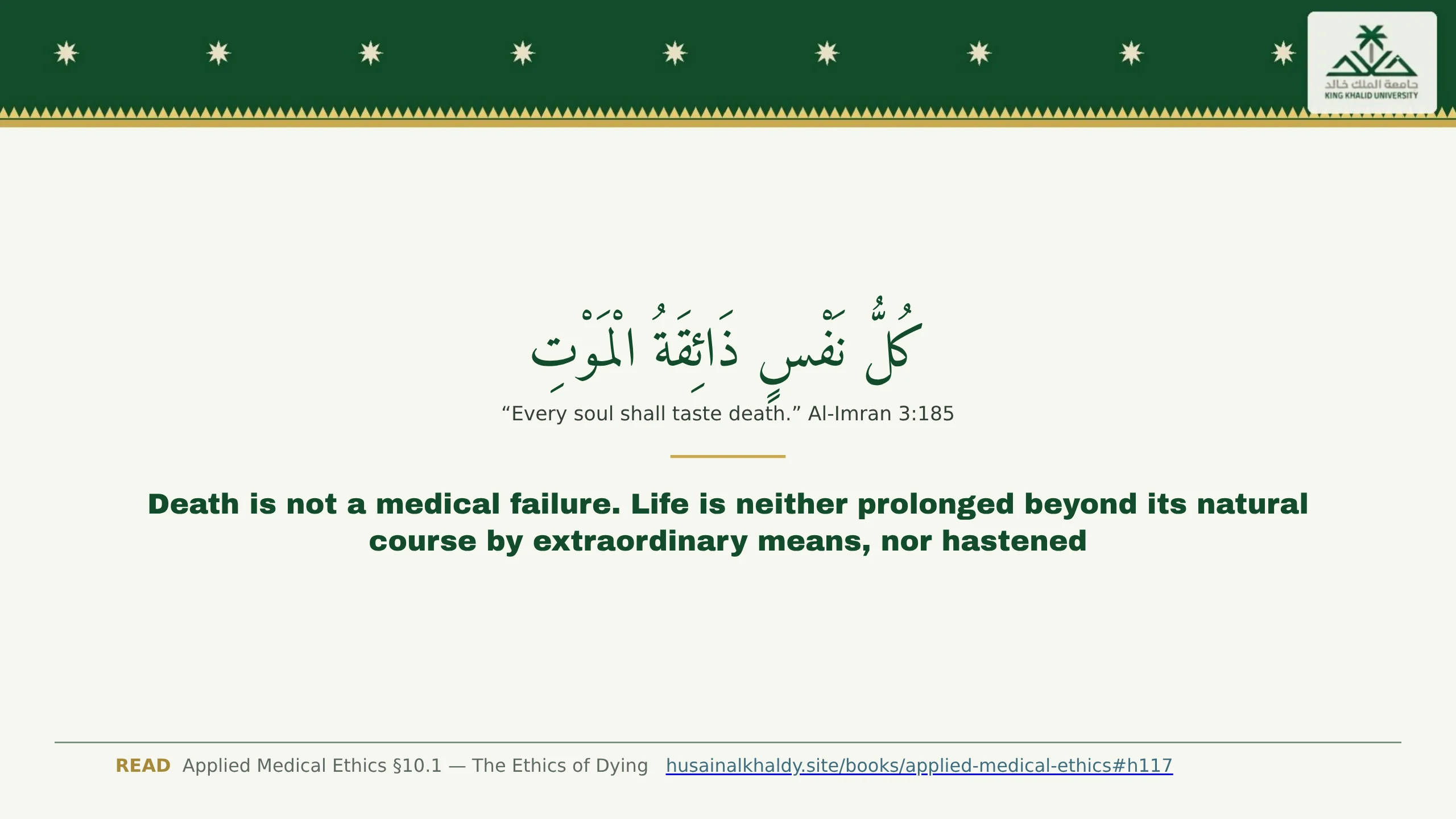
Al-Imran 3:185
“Every soul shall taste death.” Al-Imran 3:185.
Death is not a medical failure. Life is neither prolonged beyond its natural course by extraordinary means, nor hastened.
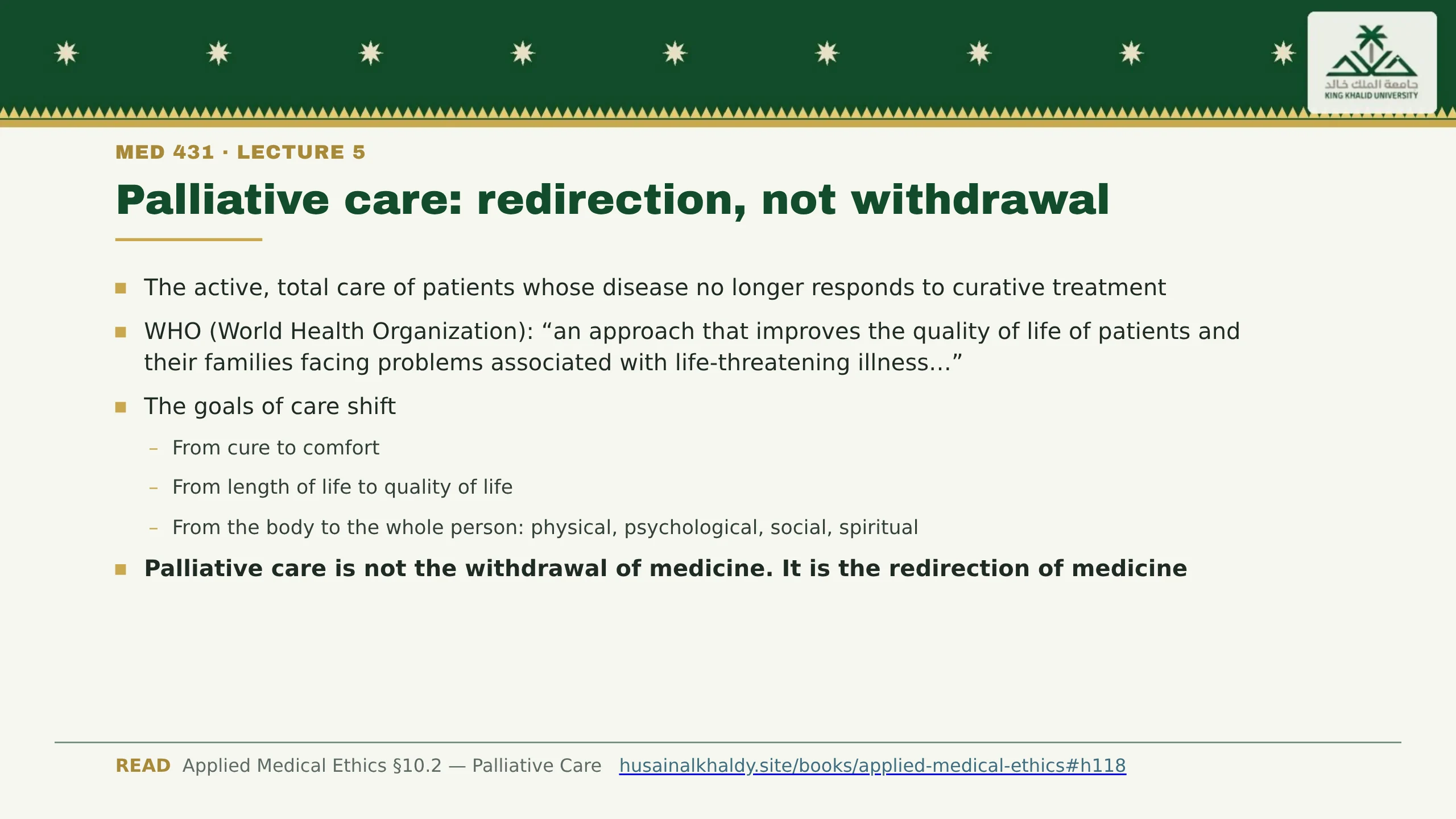
Palliative care: redirection, not withdrawal
The active, total care of patients whose disease no longer responds to curative treatment. WHO (World Health Organization): “an approach that improves the quality of life of patients and their families facing problems associated with life-threatening illness…” The goals of care shift: from cure to comfort; from length of life to quality of life; from the body to the whole person: physical, psychological, social, spiritual.
Palliative care is not the withdrawal of medicine. It is the redirection of medicine.
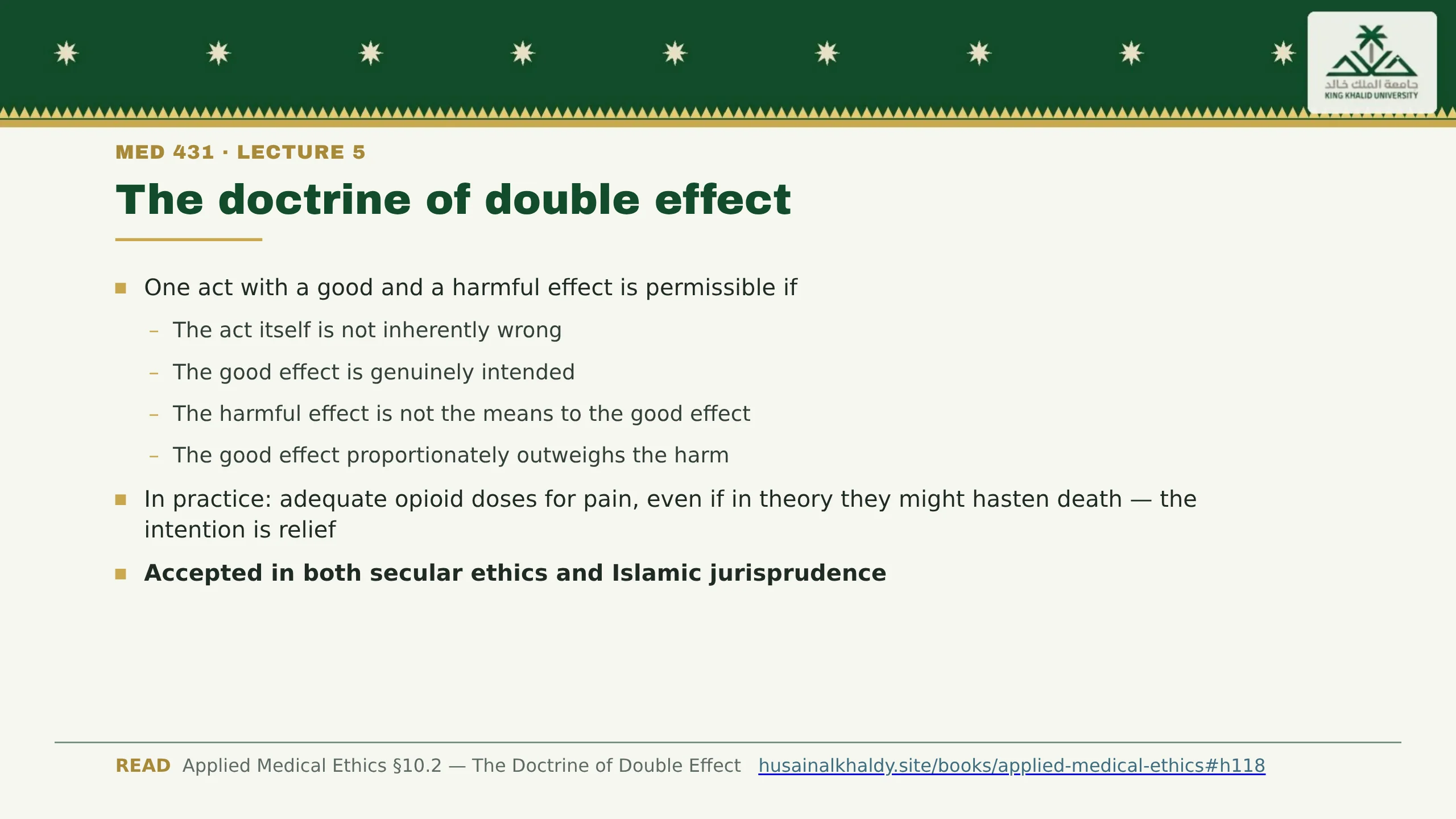
The doctrine of double effect
One act with a good and a harmful effect is permissible if: the act itself is not inherently wrong; the good effect is genuinely intended; the harmful effect is not the means to the good effect; the good effect proportionately outweighs the harm. In practice: adequate opioid doses for pain, even if in theory they might hasten death — the intention is relief.
Accepted in both secular ethics and Islamic jurisprudence.
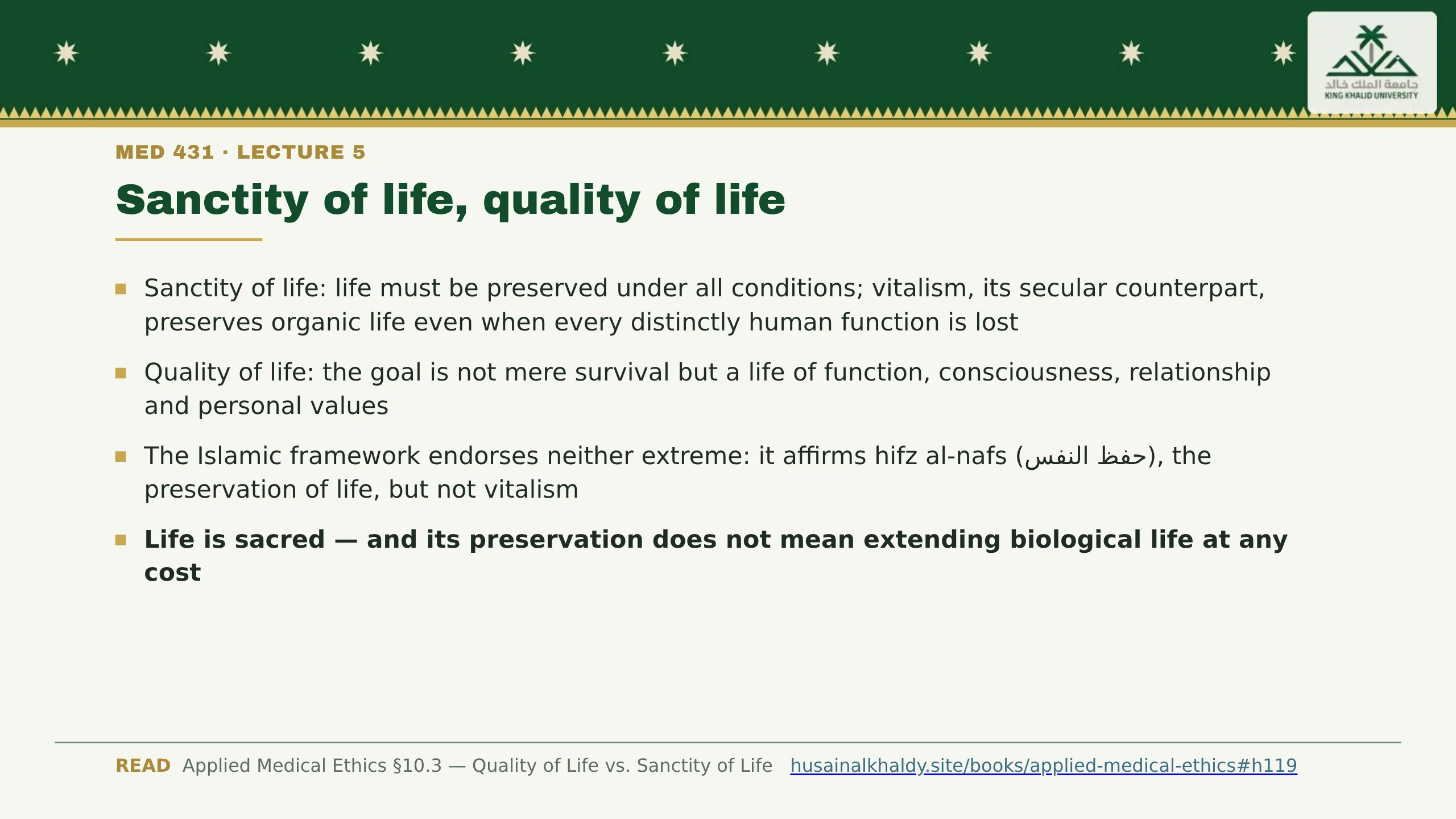
Sanctity of life, quality of life
Sanctity of life: life must be preserved under all conditions; vitalism, its secular counterpart, preserves organic life even when every distinctly human function is lost. Quality of life: the goal is not mere survival but a life of function, consciousness, relationship and personal values. The Islamic framework endorses neither extreme: it affirms hifz al-nafs (حفظ النفس), the preservation of life, but not vitalism.
Life is sacred — and its preservation does not mean extending biological life at any cost.
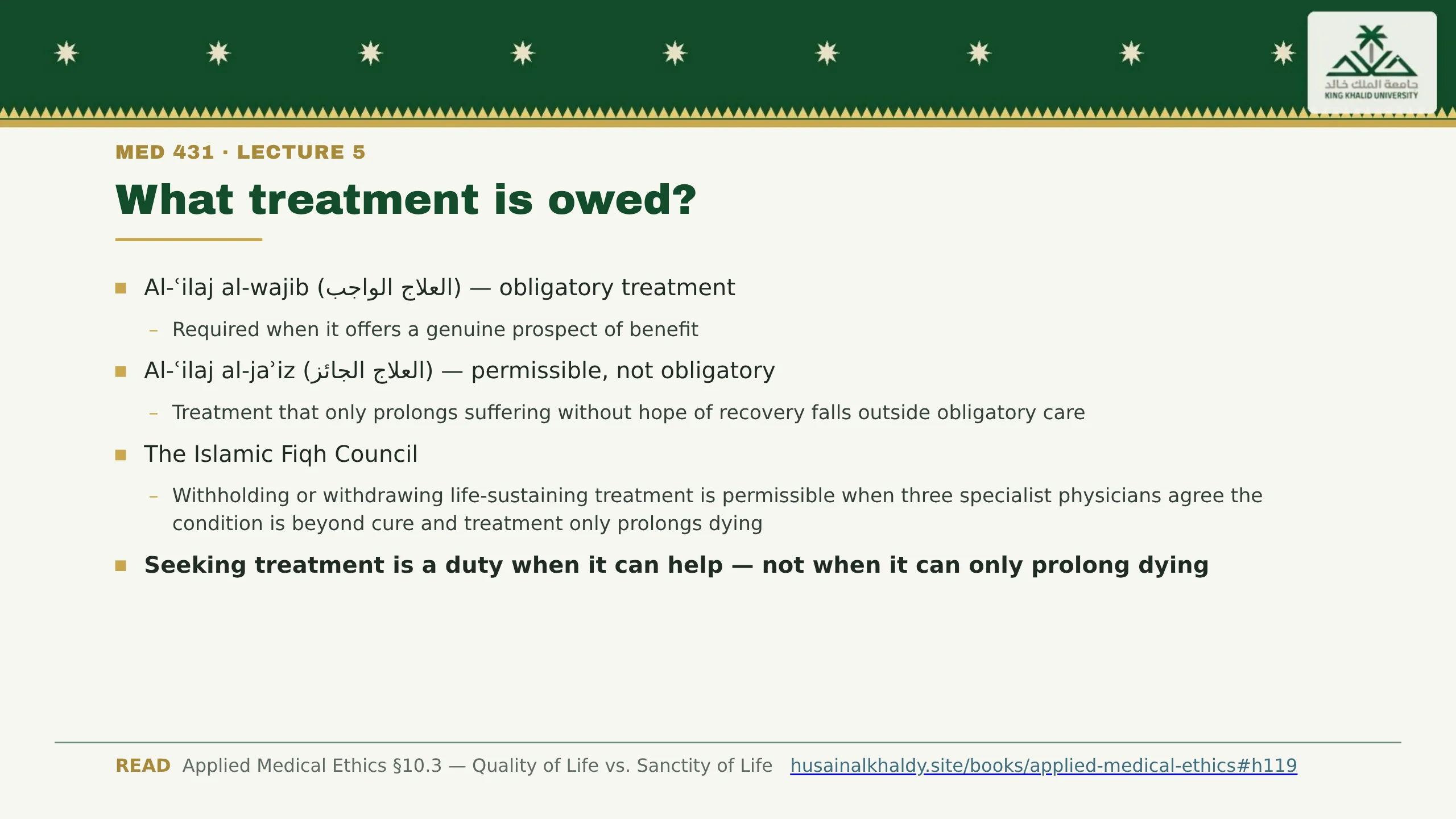
What treatment is owed?
Al-ʿilaj al-wajib (العلاج الواجب) — obligatory treatment: required when it offers a genuine prospect of benefit. Al-ʿilaj al-jaʾiz (العلاج الجائز) — permissible, not obligatory: treatment that only prolongs suffering without hope of recovery falls outside obligatory care. The Islamic Fiqh Council: withholding or withdrawing life-sustaining treatment is permissible when three specialist physicians agree the condition is beyond cure and treatment only prolongs dying.
Seeking treatment is a duty when it can help — not when it can only prolong dying.
Decisions at the end
2 · Decisions at the end
Brain death, withholding and withdrawing, futility, DNR orders and advance directives.
Brain death
Irreversible cessation of all functions of the entire brain, including the brainstem: absent brainstem reflexes; apnoea: no breathing without the ventilator; irreversibility, with no known reversible cause. Blood and breath that continue on a ventilator are the machine’s work, not life. The dominant ruling — Islamic Fiqh Council of the Muslim World League, OIC (Organisation of Islamic Cooperation) Fiqh Academy, Saudi Council of Senior Scholars: life support may be withdrawn, death declared, organs donated. A minority of scholars hold that death comes only when heartbeat and breathing stop.
In the dominant Islamic position, brain death is legal death.
Withholding and withdrawing
Withholding — deciding not to start a life-sustaining intervention. Withdrawing — stopping an intervention that has already started. The dominant position of professional bodies and Islamic scholars: morally equivalent when the clinical circumstances are the same. If starting a treatment created a duty never to stop it, doctors would hesitate to try treatments that might help.
The equivalence protects patients: it makes honest trials of treatment possible.
Medical futility
Quantitative futility — the treatment almost never works: CPR (cardiopulmonary resuscitation) in metastatic cancer with multi-organ failure: survival to discharge approaches zero. Qualitative futility — it works, but not for the person: the physiological goal is met, with no benefit worth having from the patient’s point of view. Decide it with: the multidisciplinary team and clear documentation; communication with the patient and family; the ethics committee when there is disagreement.
Futility is a process, not a verdict one doctor delivers at the bedside.
DNR orders: no CPR, not less care
A DNR order means CPR is not attempted if the heart stops. It is not an instruction to reduce the quality of care in any other way. Islam supports a DNR order when CPR is clearly futile — when it cannot restore life but only prolongs dying. The hadith (Abu Dawud) establishes a duty to seek treatment — treatment, not futile intervention.
A patient with a DNR order is owed every other care, in full.
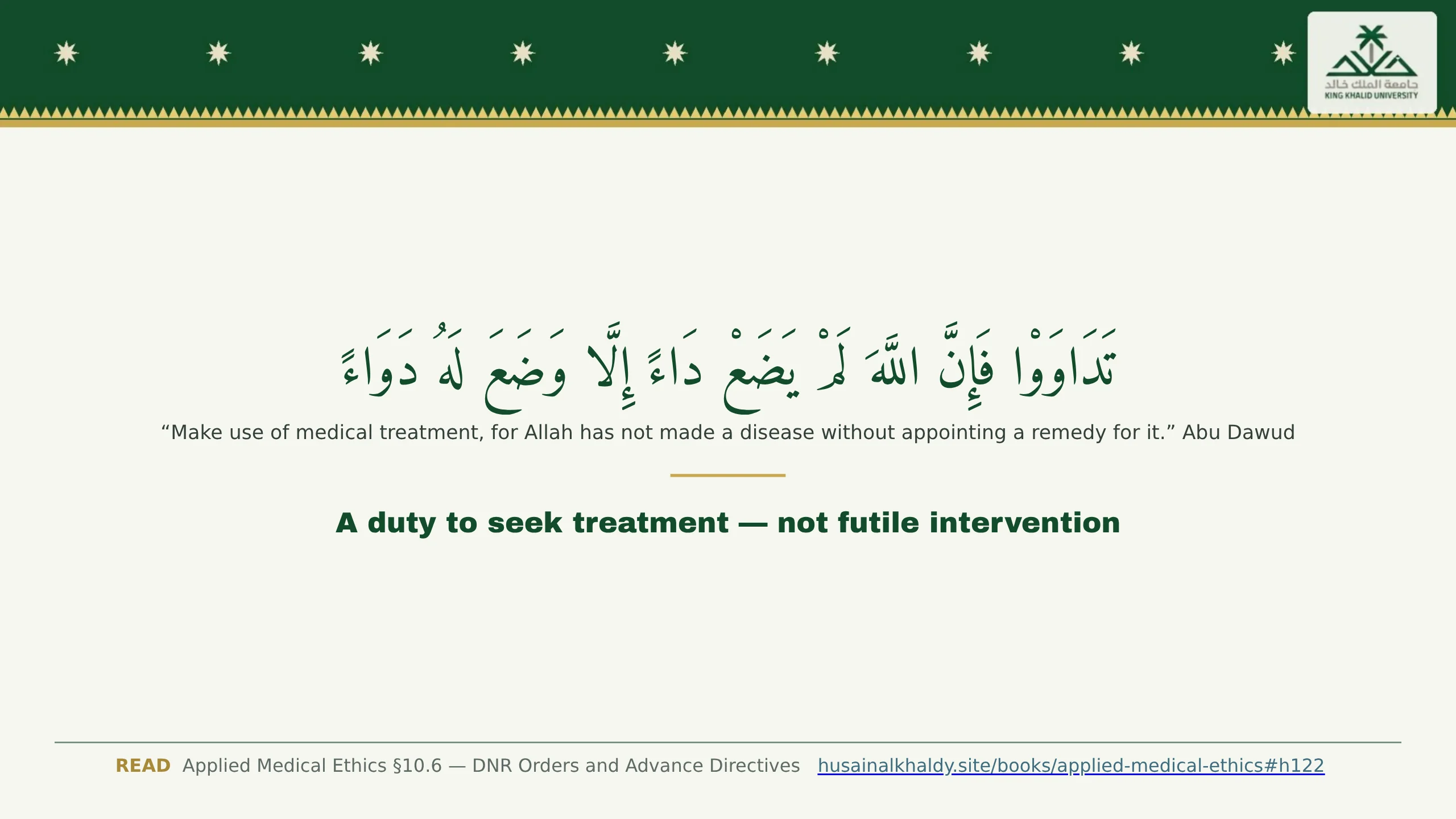
Abu Dawud
“Make use of medical treatment, for Allah has not made a disease without appointing a remedy for it.” Abu Dawud.
A duty to seek treatment — not futile intervention.
Advance directives: autonomy carried forward
An advance directive extends autonomy into a time when the patient can no longer exercise it directly. Discuss it with patients who have serious or progressive illness, before the crisis. Document it clearly in the medical record. Review it as values and circumstances change.
Respect it — even when the team disagrees with the patient’s choices.
Euthanasia, the dying, the elderly
3 · Euthanasia, the dying, the elderly
The Islamic prohibition, care of the dying patient, and the ethics of elderly care.
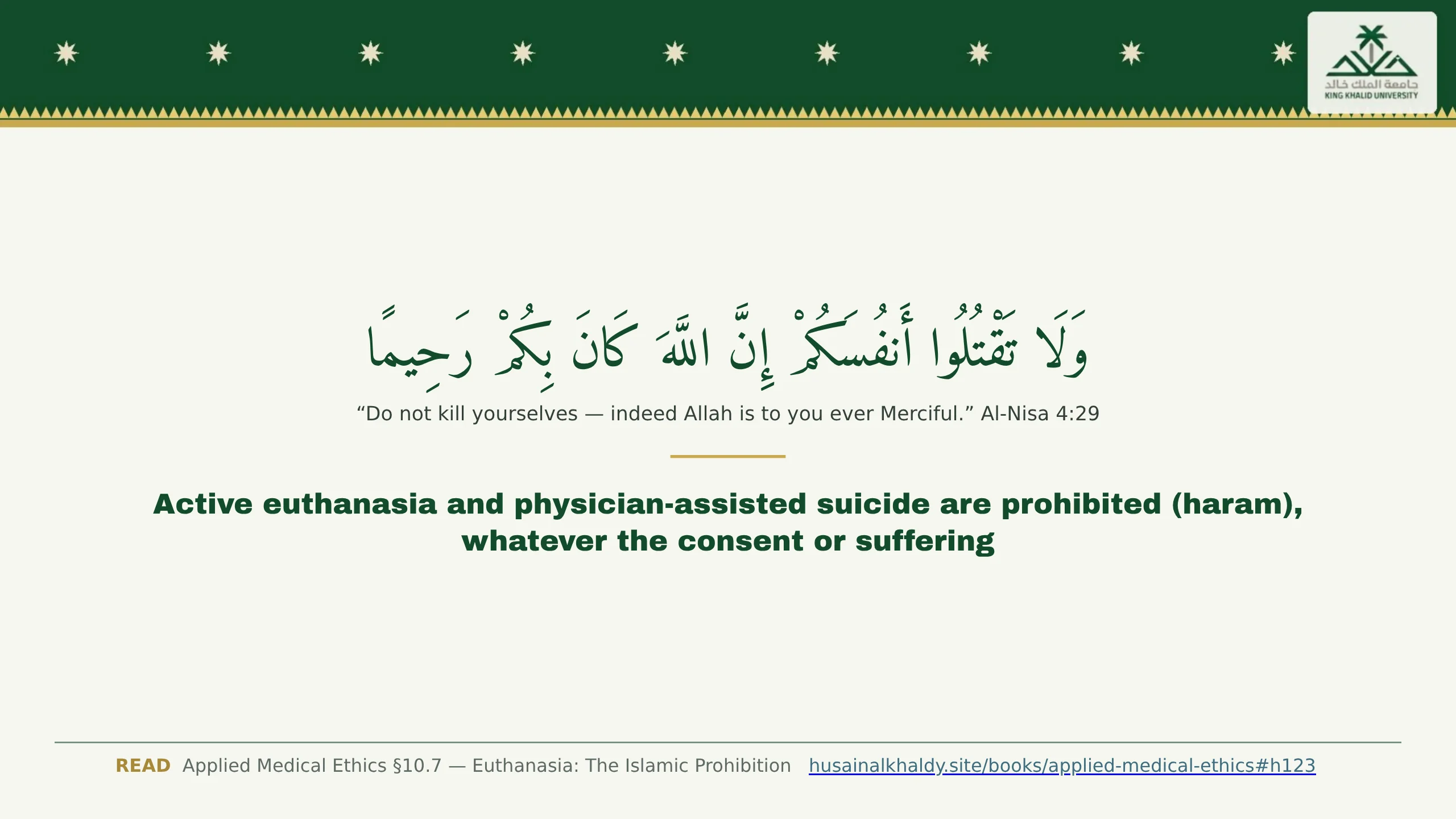
Al-Nisa 4:29
“Do not kill yourselves — indeed Allah is to you ever Merciful.” Al-Nisa 4:29.
Active euthanasia and physician-assisted suicide are prohibited (haram), whatever the consent or suffering.
Why euthanasia is prohibited
The sanctity of life. The prohibition on despair of Allah’s mercy (qunut, قنوط). The sufficiency of palliative care: Islam does not require prolonging suffering, and gives a full toolkit of legitimate end-of-life care. The physician’s role: to heal, to relieve suffering and to accompany the dying — not to kill.
Relieving pain that may shorten life is permitted. Giving a lethal agent to end life is not.
When a patient asks you to end it
Acknowledge the suffering with genuine compassion. Explore what drives the request: pain, fear, depression, isolation, spiritual distress — each is addressable. Make sure comprehensive palliative care is in place. Offer spiritual support. Explain the Islamic position, without judgment.
Do not abandon the patient because of the request.
What the dying patient is owed
Relief — pain, dyspnoea, nausea and distress controlled: a clinical duty and an ethical imperative. The truth — false hope (“we’ll keep trying”) takes away the chance to make peace and prepare. Faith — talqeen (تلقين), prompting the dying person to say the Shahada, and family reciting Quran, especially Surah Yasin. Dignity — the body retains dignity after death.
The death certificate records the true cause. Falsifying it is a serious criminal offence.
Age alone is never the reason
Ageism is documented: elderly patients are less often investigated or referred for surgery, and more often given DNR orders without adequate discussion. Assess each patient’s condition and values individually. When capacity is lost: substituted judgment — decide as the patient would have, from their known values. Elder abuse — physical, psychological, financial: document findings carefully; speak with the patient privately, without the suspected abuser; report to the appropriate authorities.
Age is not a basis for limiting care.
Four cases
4 · Four cases
For each: medical indications, patient preferences, quality of life, contextual features — and the Islamic framework.
The ventilator decision
An 82-year-old man with end-stage COPD (chronic obstructive pulmonary disease) and heart failure arrives in acute respiratory failure, hypoxic and confused. His daughter, who holds power of attorney for health decisions, says he “always said he never wanted to be on machines”; there is no written advance directive. Without intubation he is likely to die within hours; with it, his prognosis is still extremely poor.
Discuss: How do you proceed? What ethical frameworks apply? What role does the daughter’s account play?
The DNR conflict
A 55-year-old woman with metastatic breast cancer has a DNR order, documented after a conversation in which she agreed. Her husband arrives and demands it be removed: “I don’t accept this. We are Muslims — Allah gives life and only Allah takes it. You must do everything.”
Discuss: How do you respond to the husband? What are the ethical obligations? What does the Islamic framework say about the patient’s own expressed wish?
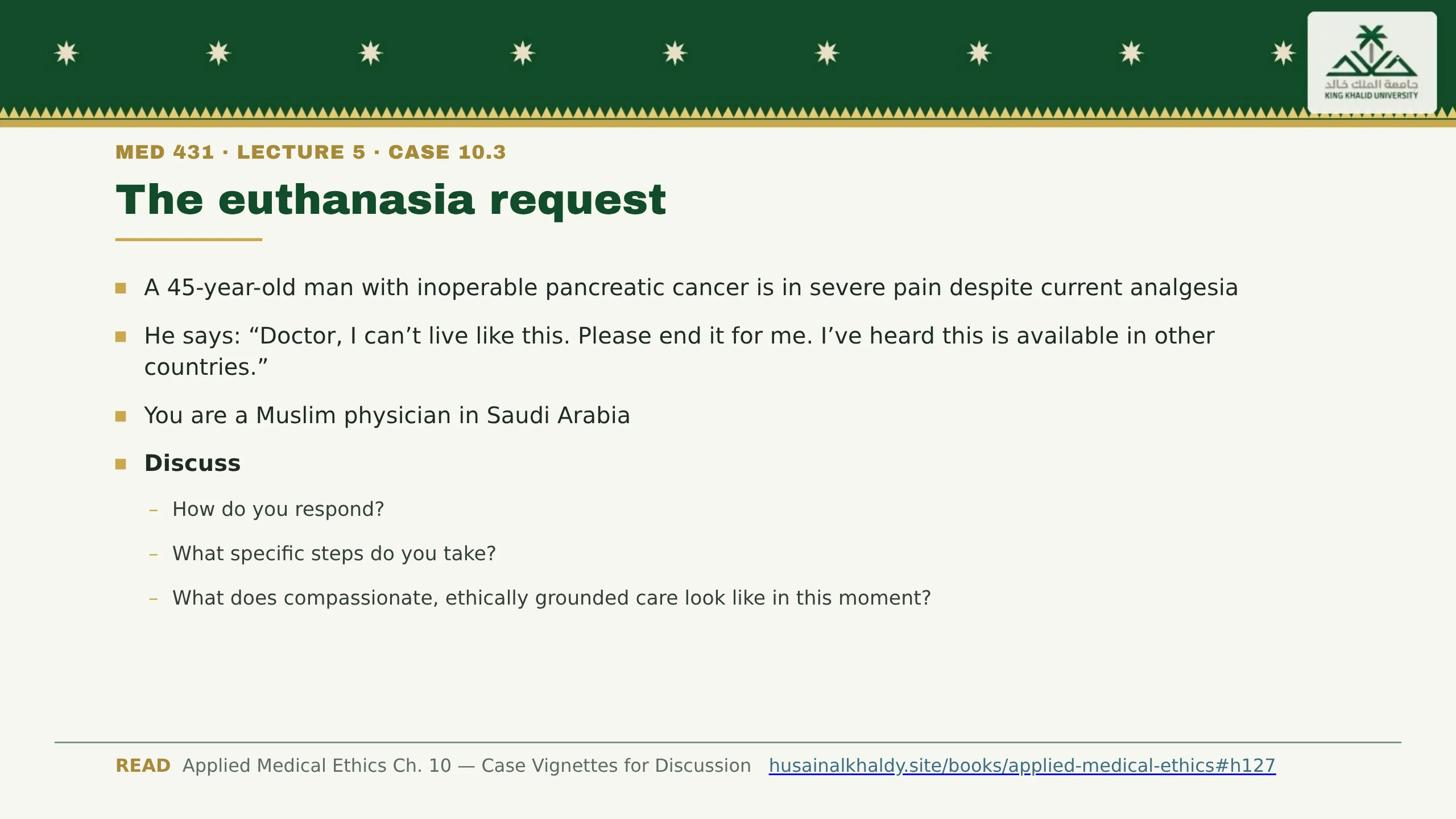
The euthanasia request
A 45-year-old man with inoperable pancreatic cancer is in severe pain despite current analgesia. He says: “Doctor, I can’t live like this. Please end it for me. I’ve heard this is available in other countries.” You are a Muslim physician in Saudi Arabia.
Discuss: How do you respond? What specific steps do you take? What does compassionate, ethically grounded care look like in this moment?
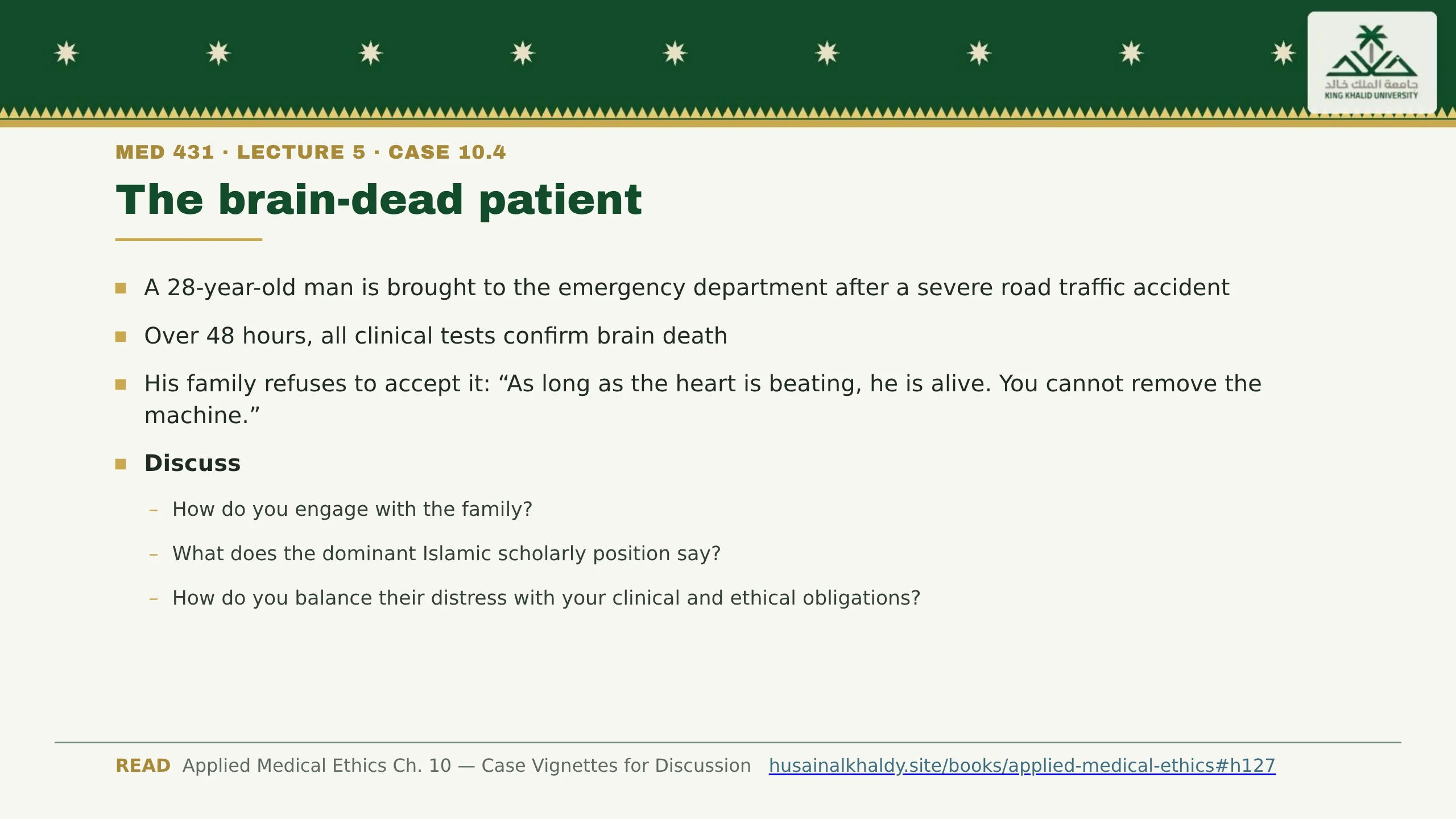
The brain-dead patient
A 28-year-old man is brought to the emergency department after a severe road traffic accident. Over 48 hours, all clinical tests confirm brain death. His family refuses to accept it: “As long as the heart is beating, he is alive. You cannot remove the machine.”
Discuss: How do you engage with the family? What does the dominant Islamic scholarly position say? How do you balance their distress with your clinical and ethical obligations?
To close
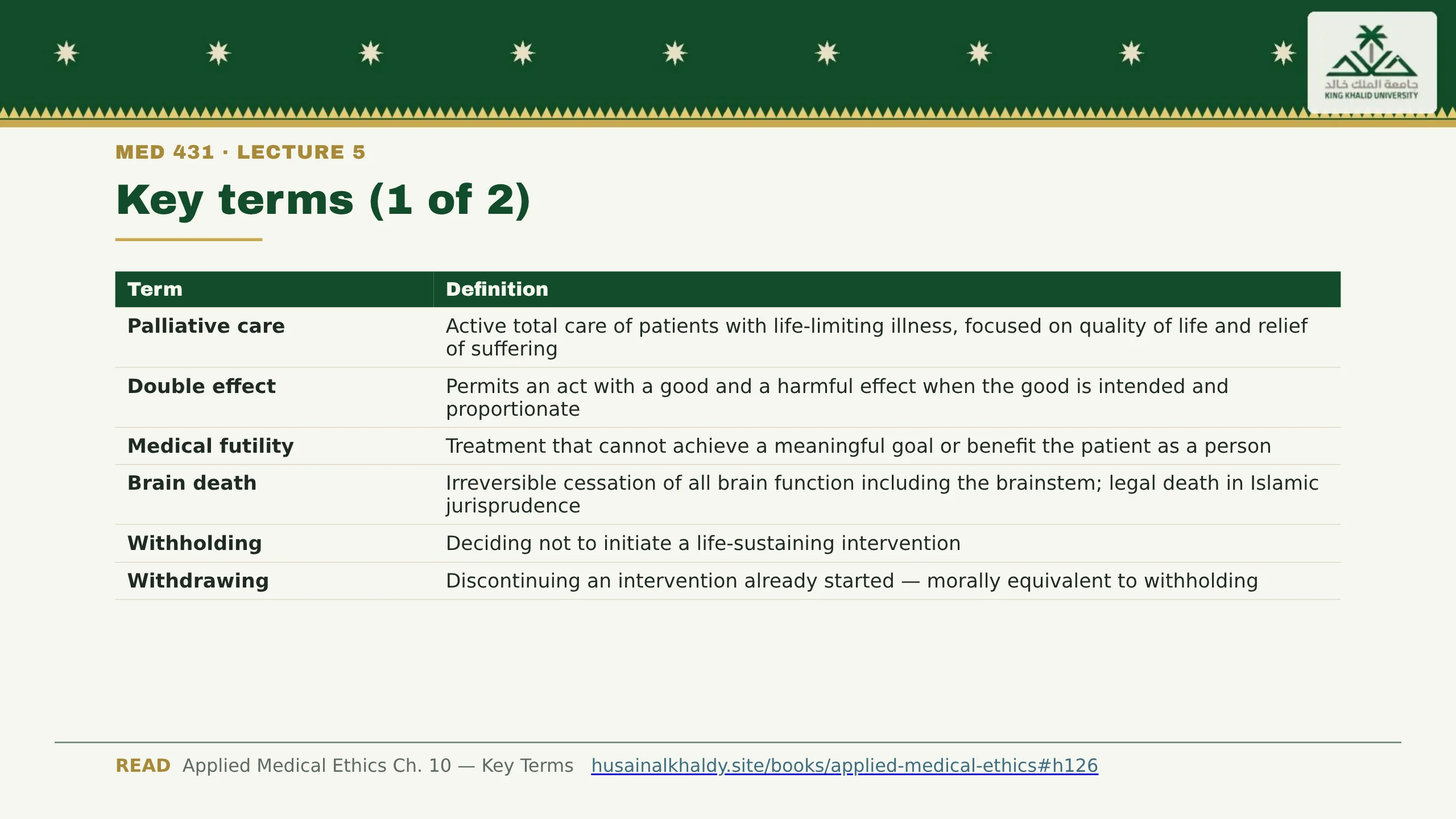
Key terms (1 of 2)
Palliative care: Active total care of patients with life-limiting illness, focused on quality of life and relief of suffering. Double effect: Permits an act with a good and a harmful effect when the good is intended and proportionate. Medical futility: Treatment that cannot achieve a meaningful goal or benefit the patient as a person. Brain death: Irreversible cessation of all brain function including the brainstem; legal death in Islamic jurisprudence. Withholding: Deciding not to initiate a life-sustaining intervention. Withdrawing: Discontinuing an intervention already started — morally equivalent to withholding.
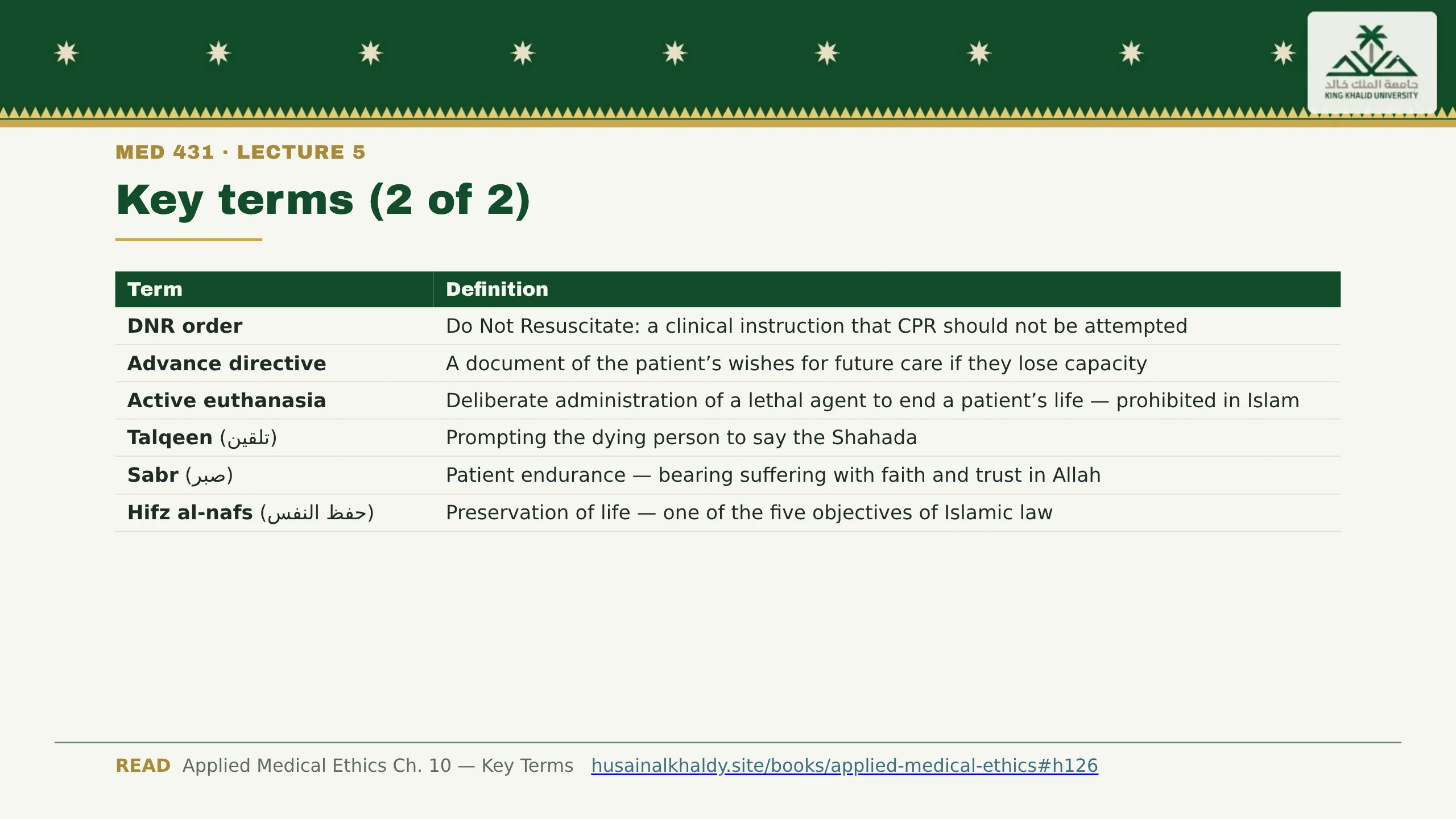
Key terms (2 of 2)
DNR order: Do Not Resuscitate: a clinical instruction that CPR should not be attempted. Advance directive: A document of the patient’s wishes for future care if they lose capacity. Active euthanasia: Deliberate administration of a lethal agent to end a patient’s life — prohibited in Islam. Talqeen (تلقين): Prompting the dying person to say the Shahada. Sabr (صبر): Patient endurance — bearing suffering with faith and trust in Allah. Hifz al-nafs (حفظ النفس): Preservation of life — one of the five objectives of Islamic law.
Six things to take out of the room
Death is not a failure; suffering that could have been relieved is. Treatment is owed when it can benefit; futile treatment is not owed. Withholding and withdrawing are morally the same. A DNR order means no CPR, never less care. Euthanasia is prohibited; the answer to a request is relief and presence.
Age alone is never a reason to limit care.
Further reading
Jonsen AR, Siegler M, Winslade WJ. Clinical Ethics. 9th ed. McGraw-Hill; 2022. Topic Three: Quality of Life. Hussein GM, Alkabba AF, Kasule OH. Professionalism and Ethics Handbook for Residents. SCFHS; 2015. Module 9. Islamic Fiqh Council, Muslim World League. Rulings on Brain Death, Withdrawal of Life Support, and Euthanasia. Al-Bar MA, Chamsi-Pasha H. Contemporary Bioethics: Islamic Perspective. Springer; 2015. World Health Organization. Palliative Care. WHO Fact Sheet; 2020. World Medical Association. Declaration on Euthanasia and Physician-Assisted Suicide. WMA; 2019. Saudi Commission for Health Specialties. Code of Ethics for Healthcare Practitioners. 2014.
Beauchamp TL, Childress JF. Principles of Biomedical Ethics. 8th ed., Chapter 5. Oxford University Press; 2019.
Karen Ann Quinlan
In 1975 a twenty-one-year-old woman stopped breathing long enough to leave her in a permanent coma, kept alive on a ventilator. Her parents asked for it to be switched off; the doctors refused, fearing prosecution. In 1976 the New Jersey Supreme Court ruled that the family could withdraw the ventilator — one of the first times a court recognised a right to let a patient die. Once weaned, she breathed on her own and lived nine more years.
When should treatment stop, and who decides?
Before next time
This lecture was Chapter 10 — End-of-Life Care and Elderly Patients. Work the four cases at the end of the chapter and bring your answers.
The question bank has 113 scenarios with the answers explained, and the Trainee Edition is the shorter version written for the wards.