Academic Integrity and Copyright
Whose work is it? — integrity, and the copyright that protects other people's work
Integrity
What this lecture is about
Lecture 2 asked by what authority you practise. This one asks a question that comes earlier and follows you longer: whose work is it? The essay you submit, the answer you give in an examination, the paragraph you paste into a report, the figure you drop into a presentation, the lecture you photograph and post in the class group. Each one is somebody's work, and academic integrity is the habit of saying honestly whose.
The lecture has five parts. The six values of academic integrity, from the International Center for Academic Integrity, which the course book adopts in Chapter 2. The violations, by name, with the price the university's Conduct Code fixes for each. Copyright, the law that protects other people's work, in the Kingdom's own statute. A short part on writing to your teachers, because it is the professional skill this course sees you fail at most often. And two cases.
Chapter 2 of the book is the text behind it, with §14.3 and §14.4 of Chapter 14 for publication and §15.5 of Chapter 15 for generative AI.
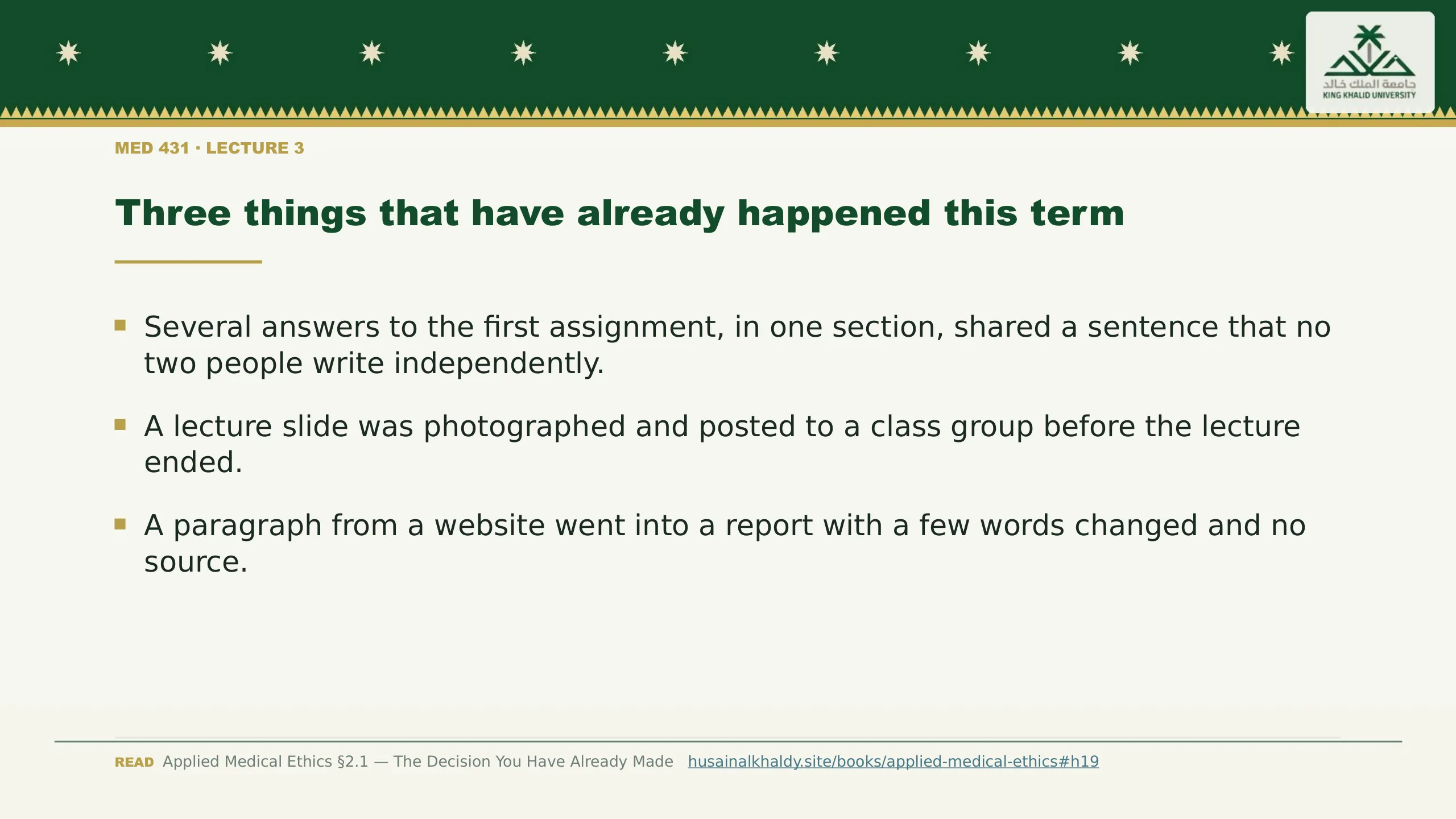
Not hypothetical
None of these is invented. The first is from this course, this term: the assignment 1 scripts in one section converged on the same uncommon phrasing, which is how machine-written answers are recognised, and the note left on those scripts said what this lecture will say at greater length. The other two happen every term in every medical school, and most students who do them would not describe themselves as dishonest.
That is the point of starting here. Academic misconduct is rarely a decision to cheat. It is usually a small convenience taken under time pressure by someone who has not stopped to ask whose work it is. The six values in Part 1 are the habit of asking. The violations in Part 2 are what the answer looks like when nobody did.
The book's definition
Chapter 2 separates honesty from integrity. Honesty is telling the truth: to patients, to supervisors, to yourself, even when it is uncomfortable. Integrity is alignment between the values you say you hold and what you actually do, and the test of it is behaviour that no one will see. An examination with an invigilator tests honesty. A take-home assignment, an open-book quiz, a clinical log that nobody will audit, and later a drug chart at three in the morning, test integrity.
The sentence on the slide is the book's, and the older definition you may have heard in this course says the same thing in more words: honesty, and consistently adhering to the principles of professionalism even when it is not easy to do so. Keep both. The rest of the lecture is about what the principles are, and what it costs when they are not kept.
Three definitions
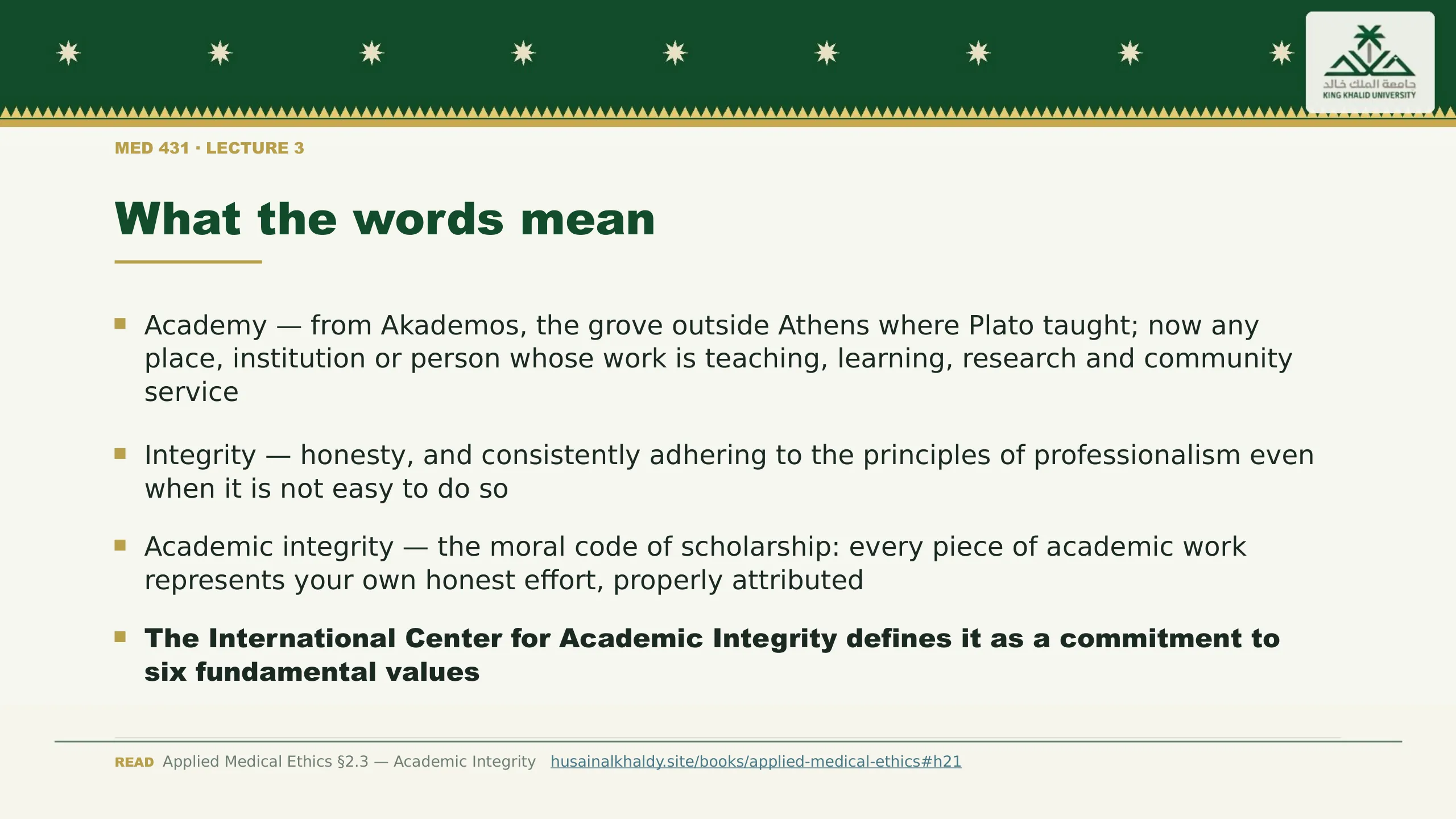
The word academy comes from Akademos, the grove outside Athens where Plato taught, and it has kept its meaning: a place, an institution, a profession and a kind of person, all concerned with the same four activities, teaching, learning, research and service to the community. A medical school is an academy in every one of those senses, and every one of them depends on the same thing: that the work presented is the work that was done.
Integrity, in the definition this course has used for several years, is honesty joined to consistency, adhering to the principles of professionalism even when it is not easy. Academic integrity is the book's term for the moral code of scholarship, and its practical content is one sentence: all academic work, assignments, examinations, research and presentations, represents your own honest effort, properly attributed. The International Center for Academic Integrity, whose short document the book follows, turns that sentence into six values. They are the next part.
The argument from continuity, and the argument from harm
The book makes two arguments for why medicine cannot treat academic integrity as a school rule. The first is continuity. The habits of thought and behaviour you build as a student are the ones you carry into practice, and there is no moment at graduation when they are exchanged for better ones. The sentence quoted on the slide is Chapter 2's, and it is worth reading the other way round as well: the student who reports their own error in a log is practising a version of the doctor who discloses a mistake to a patient.
The second is harm. Chapter 14 opens with the 1998 paper that linked the MMR vaccine to autism on the basis of twelve children. Its effect was measured in outbreaks of diseases that had been controlled. Years of investigation found manipulated data and undisclosed payments; the journal retracted the paper in 2010 and the lead author was struck off the medical register. Every clinical decision you make will rest on published evidence, and contaminated evidence produces unsafe decisions. That is why the book calls publication ethics a patient safety issue, and why this course puts academic integrity before consent and confidentiality rather than after them.
Part one
The International Center for Academic Integrity published its first five values in 1999 and added courage in 2014. The book adopts all six, and gives each a medical example. This part takes them two at a time, with the Center's own “ways to demonstrate” list, because a value that cannot be demonstrated is a slogan.
The first two values
Honesty is the foundation of the other five; the Center calls it the indispensable one. In academic work it means reporting data as collected, citing sources correctly and acknowledging what others contributed. The book's examples are a student who misrepresents clinical log hours or embellishes a case report, and it follows the thread into practice: falsifying a drug administration record, concealing a near-miss, misreporting a finding on examination. The Center's list of ways to demonstrate honesty is plain, and the second item, giving credit to the owner of the work, is the whole of Part 3 of this lecture in six words.
Trust is what honesty produces over time. The Center's definition is assured reliance on the character, ability or truth of someone or something, and it stresses that trust is reciprocal and built on actions more than words. The book's examples of its loss are precise: a student who submits a colleague's notes as their own erodes trust within the cohort; a physician who fabricates consent documentation betrays the patient and exposes the institution. Trust also runs outward. Communities value degrees and research because they trust the institutions that grant and publish them, and every act of dishonesty spends a little of that credit on everyone's behalf.
The second pair
Fairness is impartial treatment, and the Center names its components: predictability, transparency and clear, reasonable expectations. Students engage in fairness by doing their own work and acknowledging borrowed work; institutions engage in it by applying rules consistently. The book's list of violations is worth reading as a list of things students do not always recognise as unfair: sharing examination questions, requesting preferential grading, exploiting a relationship with a faculty member to obtain a better placement. Each gives one student an advantage the others did not have. In the clinic the same value becomes fair allocation of resources and unbiased assessment of patients whatever their background.
Respect has three objects in the book's account: persons, processes and the intellectual work of others. Treating peers, patients and supervisors with dignity; accepting the rules of assessment as legitimate; and attributing properly the work you build on. The Center's ways to demonstrate it include receiving feedback willingly and accepting that others' ideas have validity, which is a description of how a good ward round works. The last line on the slide is the Center's own point: impartial, consistent and just responses to dishonesty are fundamental to educational fairness. The Conduct Code's published tables, which you saw in Lecture 2, are fairness applied to the people who breached it.
The last pair, and the one that was added
Responsibility is the value that removes excuses. The book's sentence is exact: a student who copies another's work cannot blame stress, time pressure or the availability of that work; the choice and its consequences remain their own. The Center adds that responsibility is shared as well as individual, and that responsible students seek out and understand the institution's rules rather than discovering them after the fact, which is what Lecture 2 was for. In clinical work the same value is the antidote to what the book calls the diffusion of accountability that makes systems unsafe: the result nobody followed up because everybody assumed someone else had.
Courage was not in the Center's original five. It was added in 2014 because the others describe knowing what is right and courage describes doing it when it costs something. The Center's definition is careful: courage is not the absence of fear but the capacity to act in accordance with one's values despite it. The book's examples are the situations you will actually meet, reporting a colleague's misconduct, speaking up when you see an error, challenging a senior when a patient is at risk, refusing to take part in dishonesty under pressure from friends. The Center's list of ways to demonstrate it ends with being willing to take risk and to risk failure. That is a description of the medical student in Case 2.3, and of the intern in Lecture 2 who says “I need supervision for this.”
Using the six as a method
Students learn the six values as a list and forget them as a list. They are more useful as six questions to put to one decision, and the decision on the slide is the commonest one in this course. A friend sends a finished assignment the night before the deadline. The honesty question is whether what you submit is your own effort. The trust question is what the person marking it will assume, and whether that assumption is true. The fairness question is about the student who did not get the file. The respect question is whose work it is and whether your submission will say so. The responsibility question removes the excuse that it arrived unasked. The courage question is the one that actually decides the matter, because saying no to a friend costs something and copying costs nothing until it is found.
Run the same six questions on the other situations from slide 2, and on Case 2.1 at the end. You will find that a choice which fails one value usually fails four or five, which is why the Center describes them as interwoven and mutually dependent rather than separate.
The sentence to keep from Part 1
The book's own summary of the six values ends here: without courage, understanding principles is insufficient, and the moral life of a physician requires the willingness to act on them. Everything in this course before this point has been knowledge. This is the first lecture that asks what you will do with it when the doing is uncomfortable, and it will not be the last.
The violations
Part two
The values are positive; the rules are written as prohibitions. This part names the violations as the book and the university name them, because a student who can name what they are about to do is less likely to do it, and because the Conduct Code's penalties attach to the names.
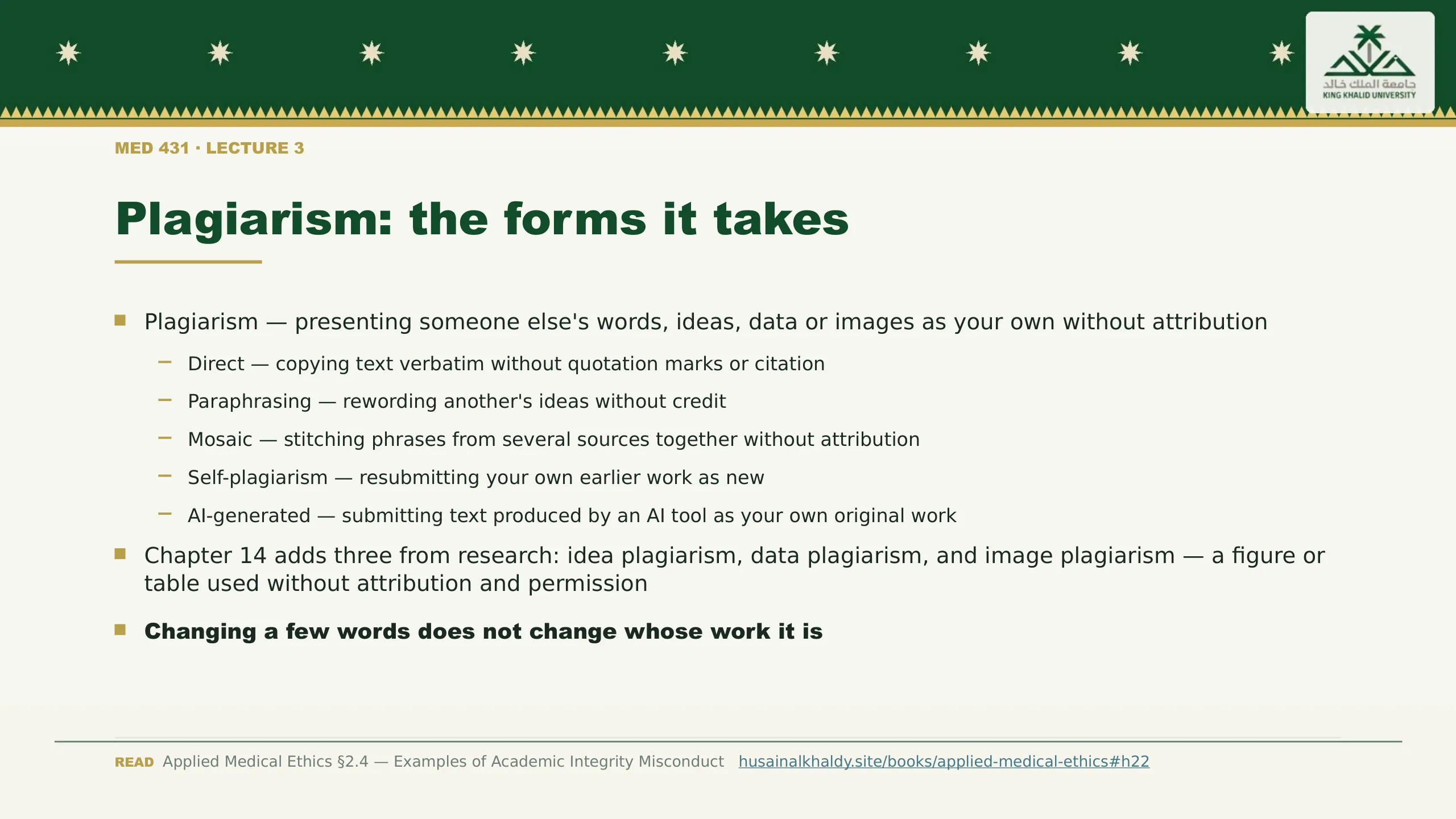
The definition, and the forms students do not recognise
The book's definition is broad on purpose: someone else's words, ideas, data or images, presented as your own, without proper attribution. Most students recognise only the first form, verbatim copying without quotation marks. The other four are where most academic plagiarism actually happens. Paraphrasing plagiarism is the paragraph from slide 2, reworded and unsourced; the ideas are still somebody else's. Mosaic plagiarism is the essay assembled from phrases taken from five websites. Self-plagiarism surprises students, because the work is theirs, but resubmitting it as new misrepresents the effort the new assignment was set to produce. AI-generated plagiarism is the newest form and has its own slide.
Chapter 14 adds three forms from research that reach you as soon as you present a case or make a poster: idea plagiarism, appropriating a conceptual framework without acknowledging where it came from; data plagiarism, using another researcher's unpublished data without authorisation; and image plagiarism, a figure, photograph or table used without attribution and permission. The last one is also a copyright question, and Part 3 returns to it. The rule on the last line is the one to carry: attribution is about whose work it is, not about how many words were changed.
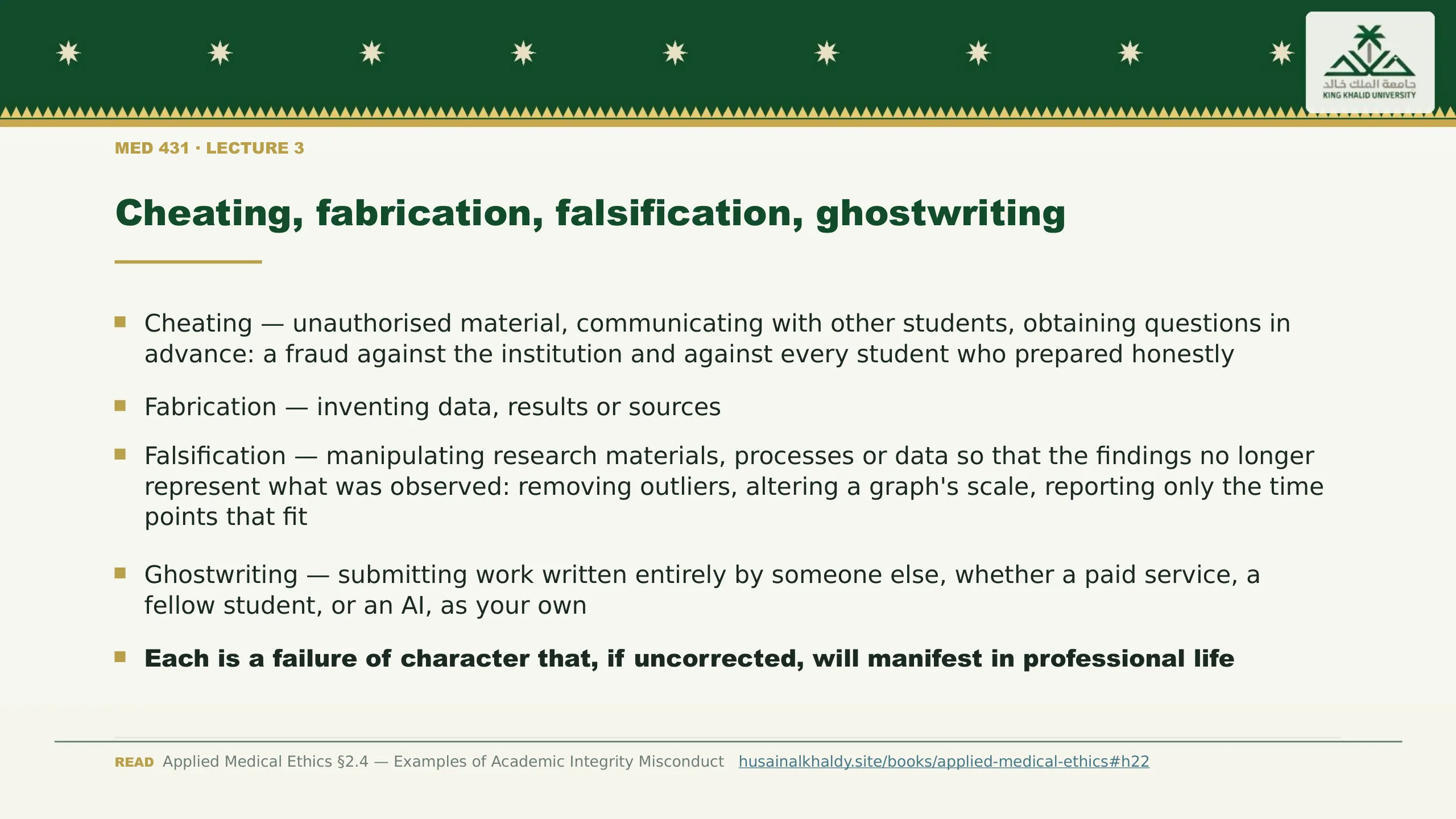
Four more names
Cheating in examinations is the violation everyone recognises, and the book's description of who it wrongs is the useful part: it is a fraud against the institution and against every student who prepared honestly, which is why the Conduct Code's penalty is a fail rather than a mark of zero on the question. Fabrication and falsification are defined in Chapter 13 for research and apply unchanged to coursework: fabrication invents data, results or sources; falsification manipulates real ones so that they no longer represent what was observed. The chapter's examples of falsification are the ones that feel harmless in the moment, dropping an outlier, changing the scale of a graph, reporting only the time points that support the hypothesis.
Ghostwriting is the book's word for submitting work written entirely by someone else, and it names the three sources: a paid service, a fellow student, and an AI. The student in Case 2.1 who put their name on an essay they did not write is a ghostwriting case as much as a plagiarism one. The sentence at the foot of the slide is the book's, and it is the continuity argument from slide 5 again: a failure of character in year four that is not corrected will find its way into a clinical record.
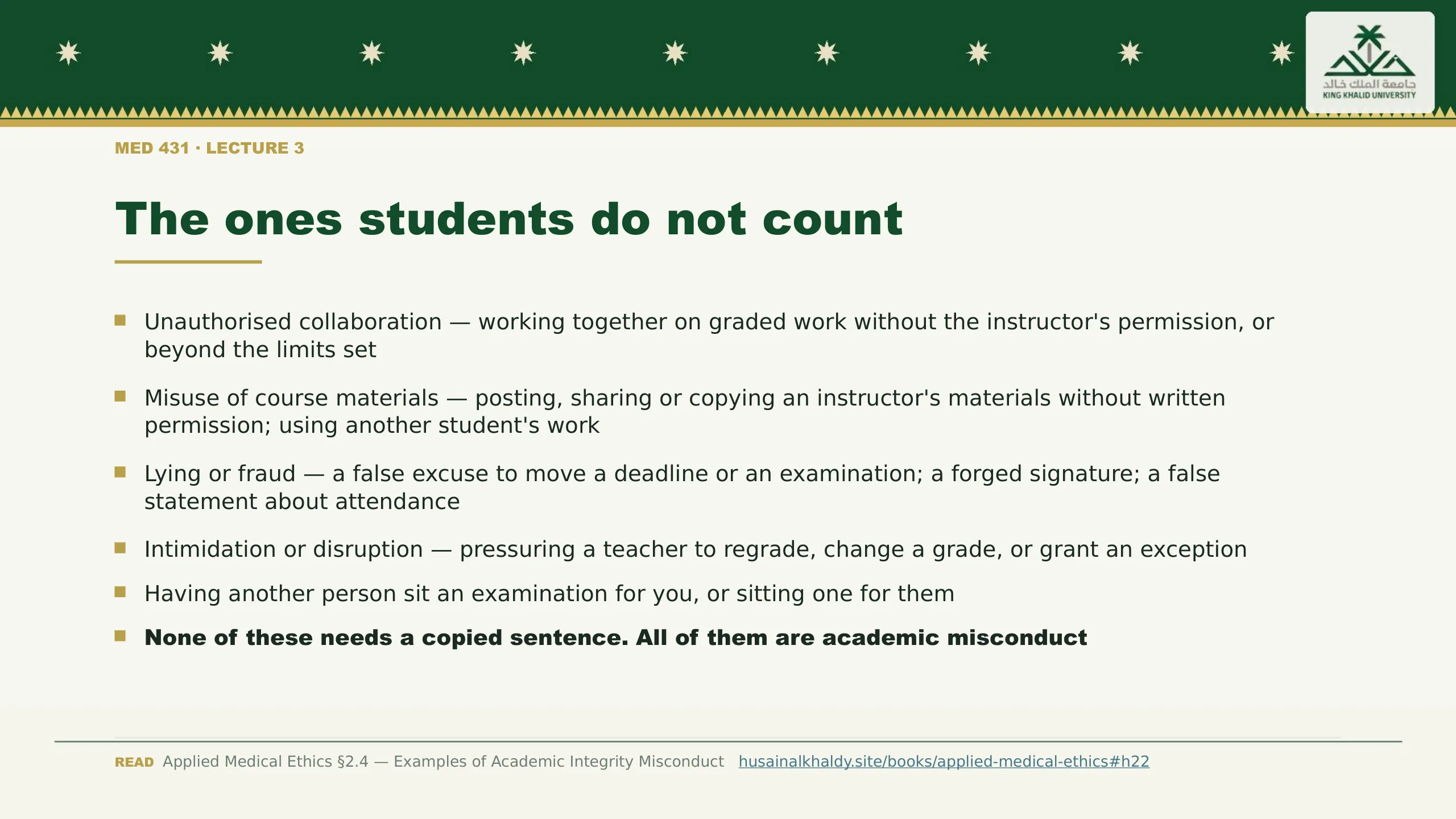
The wider list
Earlier versions of this lecture took a list of violations from a large American university's code of academic conduct, and it is kept here because it names things students genuinely do not count. Unauthorised collaboration is the group that “worked together” on individually graded work. Misuse of course materials is the lecture slide photographed and posted, and the recorded lecture shared, both of which the KKU Conduct Code treats separately, as you saw in Lecture 2 and will see again on slide 18. Lying or fraud covers the false excuse for a missed deadline, the forged signature on a form, and the false statement about attendance, which is the attendance rule from Lecture 2 seen from the other side.
Intimidation is the one that surprises students most. Pressuring a teacher to regrade work, to change a final grade, or to grant an exception, is listed as a violation in its own right, because it attacks fairness: the student who pushes hardest gets what the student who accepted the mark did not. Impersonation in an examination closes the list. None of these requires a copied sentence, and all of them are dealt with under the same Code.
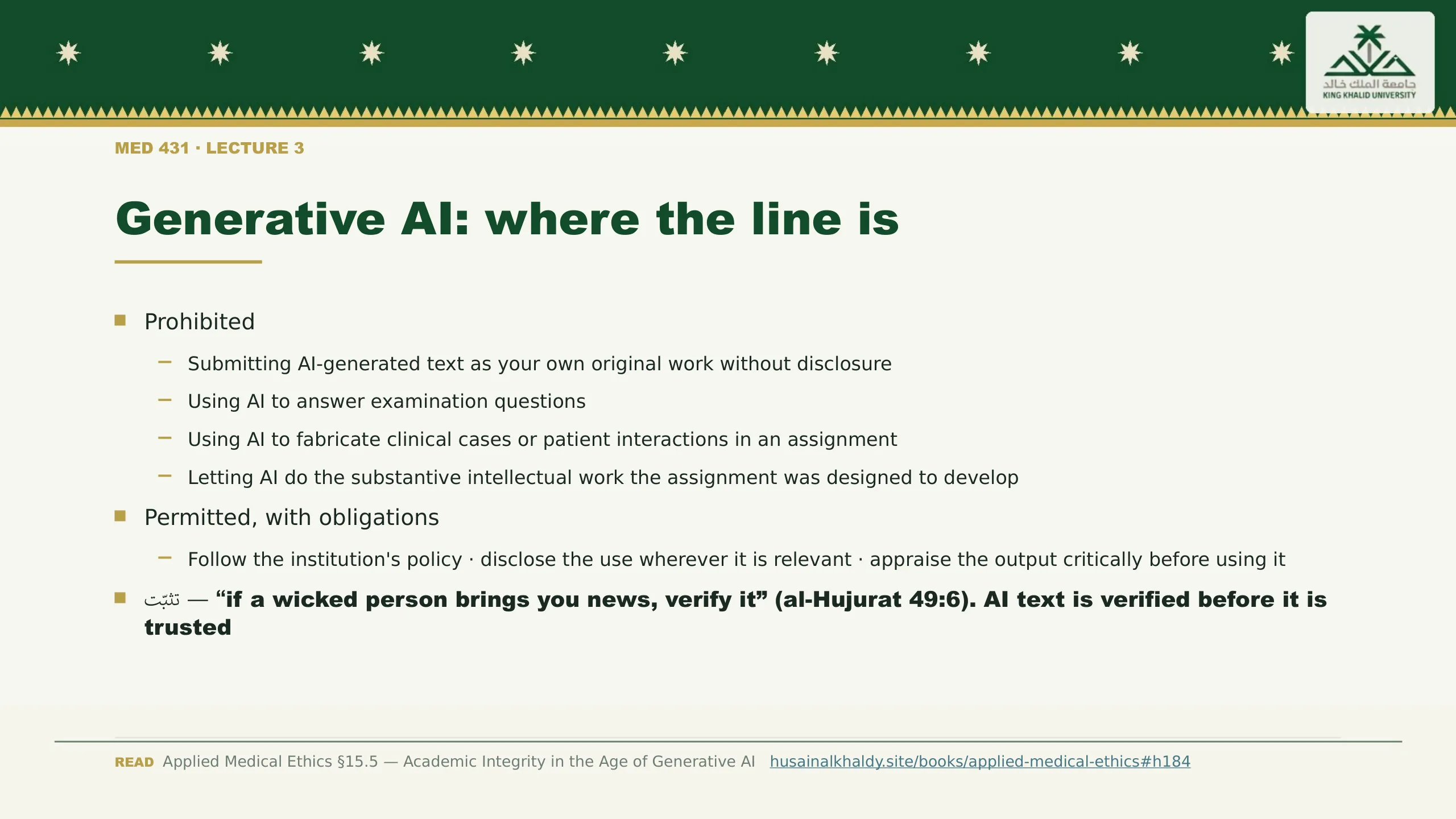
The book's line, and the obligations on the permitted side
Chapter 15 draws the line in one place, and it is not at the tool. Large language models can draft assignments, summarise literature and generate case discussions that look like a student's work. Four uses are prohibited: submitting that text as your own without disclosure; using it to answer examination questions; using it to fabricate clinical cases or patient encounters in an assignment; and letting it do the substantive intellectual work the assignment exists to develop. The fourth is the one that matters, because it covers the polished answer that was “only edited.”
On the permitted side the book puts three obligations rather than a prohibition. Follow the institution's AI policy; disclose the use wherever it is relevant to the work; and critically appraise the output before you rely on it, because these tools produce plausible text that may be factually wrong, poorly evidenced or culturally inappropriate. The book grounds the third obligation in the Quranic command to verify news before acting on it, تثبّت, and the grounding is not decorative. An AI-generated reference that does not exist, cited in a submitted assignment, is fabrication, and the student who submitted it is the author of record.
Why the marking was not changed
When assignment 1 scripts in one section were found to converge on the same phrasing, the mark was not changed, and the note left on them said why: the assignment was meant to help you learn, and the loss falls on your learning, not your marking. Students read that as leniency. It was the opposite. The book's argument in §15.5 is that the most serious problem with generative AI in medical education is not dishonesty, which the Conduct Code can handle, but bypassed learning, which nothing can handle afterwards.
The reasoning is short. Medical education is not the accumulation of credentials; it is the development of clinical competence, and the assignments, cases and examinations are the places where that competence is built. A tool that produces the assignment produces the credential and skips the competence. The physician it produces will one day meet a patient whose presentation matches no template, and, in the book's word, will be dangerous. The effort mark was given for effort; the learning that the effort was meant to buy was not delivered, and no mark can put it back.
What the university has already decided
Lecture 2 showed you Rule 36 of the KKU Student Conduct and Discipline Code, and it belongs here as well, because it is where the names in this part acquire a price. Proven cheating, or an attempt at it, in a term test, a final, a research course or a graduation project, is a fail in that course; a second offence adds the next course in the examination timetable, and a third adds the two after it. The penalty is published in a table, for a first, second and third offence, so that the committee applies it rather than negotiates it.
Two provisions of the same rule are the ones this lecture is about. Intellectual-property violations, which the Code describes as photographing what one has no right to photograph, undocumented quotation, and submitting research not of one's own preparation, are penalised exactly as cheating. Recording or photographing a lecture without the lecturer's written permission is its own violation: the material is destroyed and the student receives a graduated response from counselling to reprimand. And in the Code's list of every student's duties, item 8 is the commitment to scientific honesty and to the intellectual property rights of others. The last line of the slide is Lecture 2's again. The Code presumes you have read it.
Consequences that do not stop at graduation
The university's penalties are the immediate ones. The book's warning in §17.6 is about the later ones: the Saudi Commission for Health Specialties licenses on character as well as knowledge, and a documented history of academic misconduct may be considered when fitness to practise is assessed. A recorded reprimand is entered in the academic file, and the file is the document that follows you to the Commission.
The pattern continues through a career. The Commission's CPD Code of Ethics, which Lecture 2 quoted, forbids a practitioner from seeking credit for an activity not attended and from falsifying attendance; the student who signs a friend into a lecture is rehearsing that offence. In research, Chapter 14 describes what happens when misconduct reaches print: retraction, the journal's referral to the author's institution, and the guidelines of the Committee on Publication Ethics that govern the process. The vaccine paper from slide 5 ended in both a retraction and the loss of the author's registration. The last line is Lecture 2's and it bears repeating.

Part three, briefly
Week 7 covered research and publication ethics in full. Two topics from Chapter 14 belong in this lecture because they are integrity questions in a different costume: using your own earlier work again, and deciding whose name goes on a paper.
Why using your own work again can be misconduct
Students find self-plagiarism hard to accept because no one else's work has been taken. Chapter 14 explains what has been taken instead: the reader's correct understanding of what was done. Duplicate publication presents one study as two. Text recycling presents old methods and results as new ones. Salami publication, the slicing of a single dataset into several papers, is the clearest case: each paper implies a complete study, and the set together misrepresents how much research there was. The journals lose their trust, the literature is inflated, and the reader who counts the papers counts wrongly.
The student version is the resubmitted essay from slide 13. The assignment asked for new effort; the resubmission supplied an old one and implied it was new. The principle at the foot of the slide is the one that connects them: ownership of the work does not make the representation of it honest.
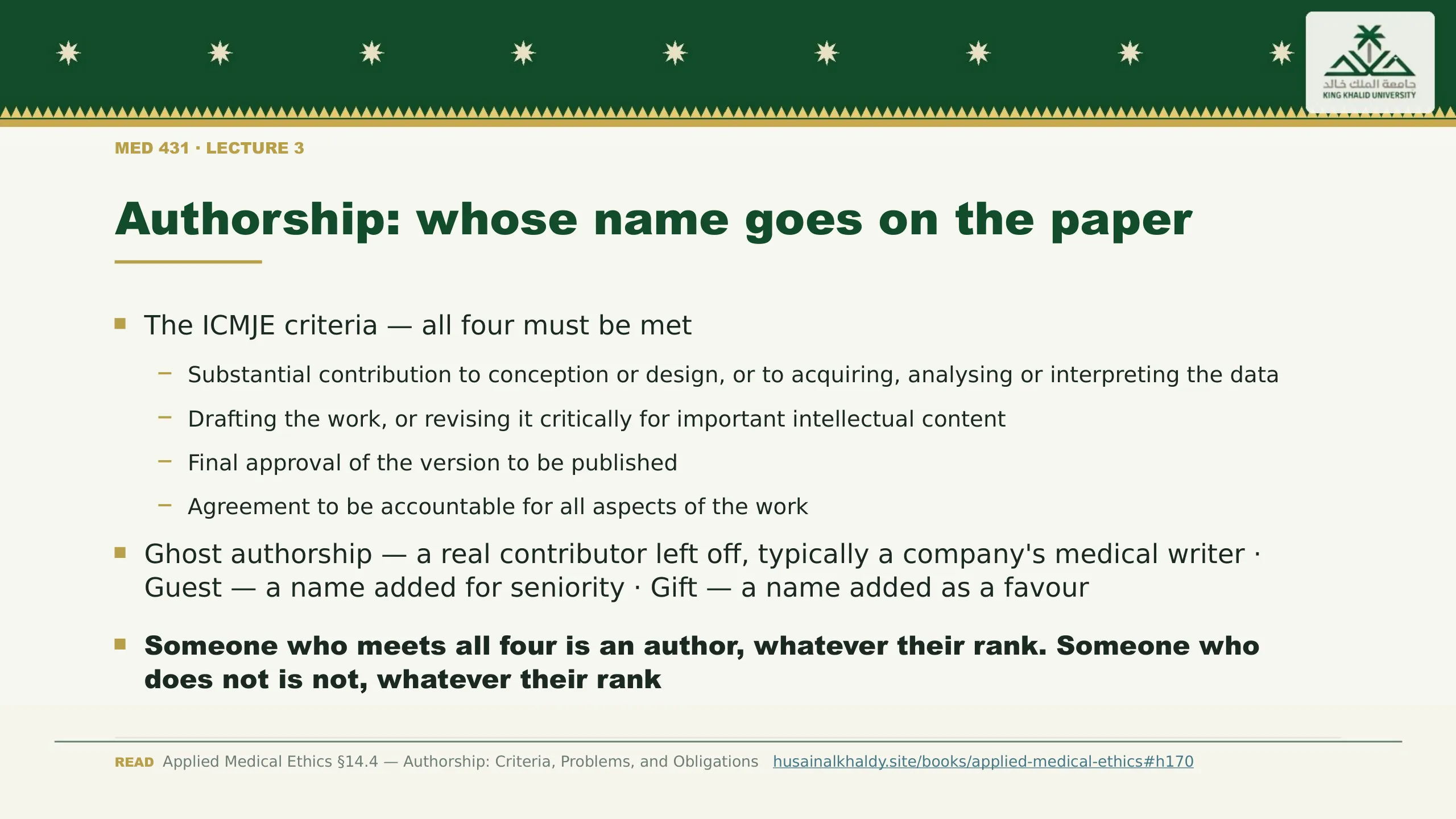
The four criteria
The International Committee of Medical Journal Editors defines authorship by four criteria, and the book insists on the word all. An author made a substantial contribution to the conception or design of the work or to the acquisition, analysis or interpretation of its data; drafted it or revised it critically for important intellectual content; approved the final version; and agreed to be accountable for every aspect of it. Meeting three is not authorship. The fourth criterion is the reason the other three matter: a name on a paper is a promise to answer for what it says.
The three named abuses break that promise in different directions. Ghost authorship leaves off someone who did the work, most often a professional writer employed by a pharmaceutical company, so that the person who drafted the paper is not accountable for it. Guest authorship adds a senior name that did none of the work, so that a person is accountable for something they did not do. Gift authorship trades names for favours. Case 2.1, the group assignment, is a gift-authorship case in miniature: two names on work that three people did. The last line of the slide is the book's principle, and it is deliberately blind to rank.
Copyright

Part four
Integrity says whose work it is. Copyright is the law that gives the owner of a work rights over it, and it binds you whether or not you attribute properly. This part reads the Kingdom's Copyright Law in the English text published by the Saudi Authority for Intellectual Property, because earlier versions of this lecture drew on other countries' law, and the rules that apply to you are these.
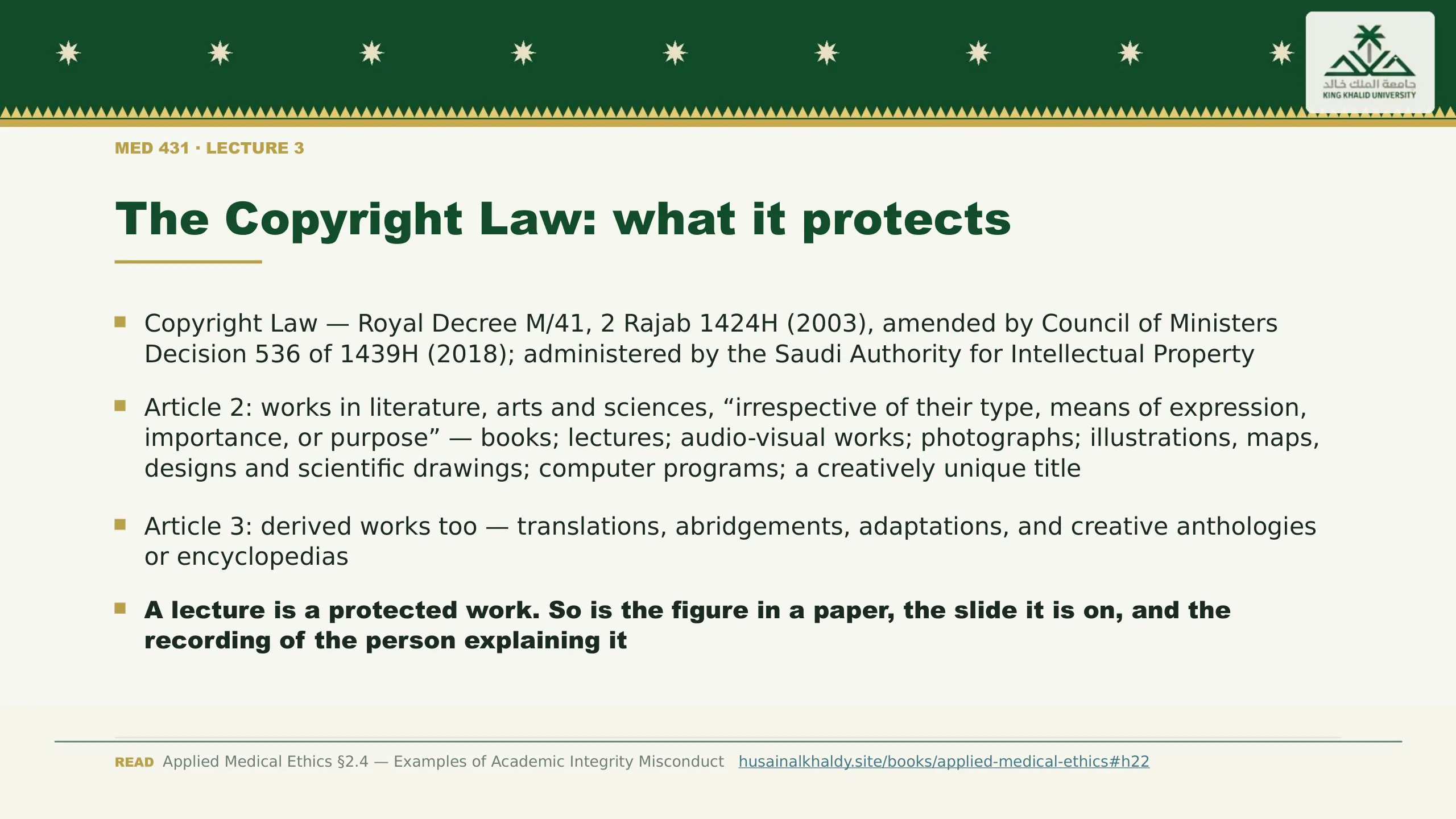
The statute
The Kingdom's copyright statute is the Copyright Law issued by Royal Decree M/41 of 2 Rajab 1424H, corresponding to August 2003, amended in 2018 when the Saudi Authority for Intellectual Property took over its administration from the Ministry of Culture and Information. Article 2 lists what it protects, and the list is broad on purpose: works in literature, arts and sciences, irrespective of their type, means of expression, importance or purpose of authorship. The items that matter to you are named explicitly: written materials like books; works delivered verbally, like lectures and speeches; audio and audio-visual works; photographic works; illustrations, maps, designs and drawings related to science; computer programs; and even the title of a work, if it is creatively unique.
Article 3 extends protection to derived works: translations, abridgements, adaptations, and encyclopedias or anthologies that are creative in their selection. Two consequences follow for a medical student. A lecture is a protected work under Article 2(2), which is why the Conduct Code's rule on recording lectures is a copyright rule as well as a conduct rule. And a translation you make of somebody's chapter is a derived work: yours to the extent of the translation, theirs in everything the translation carries.
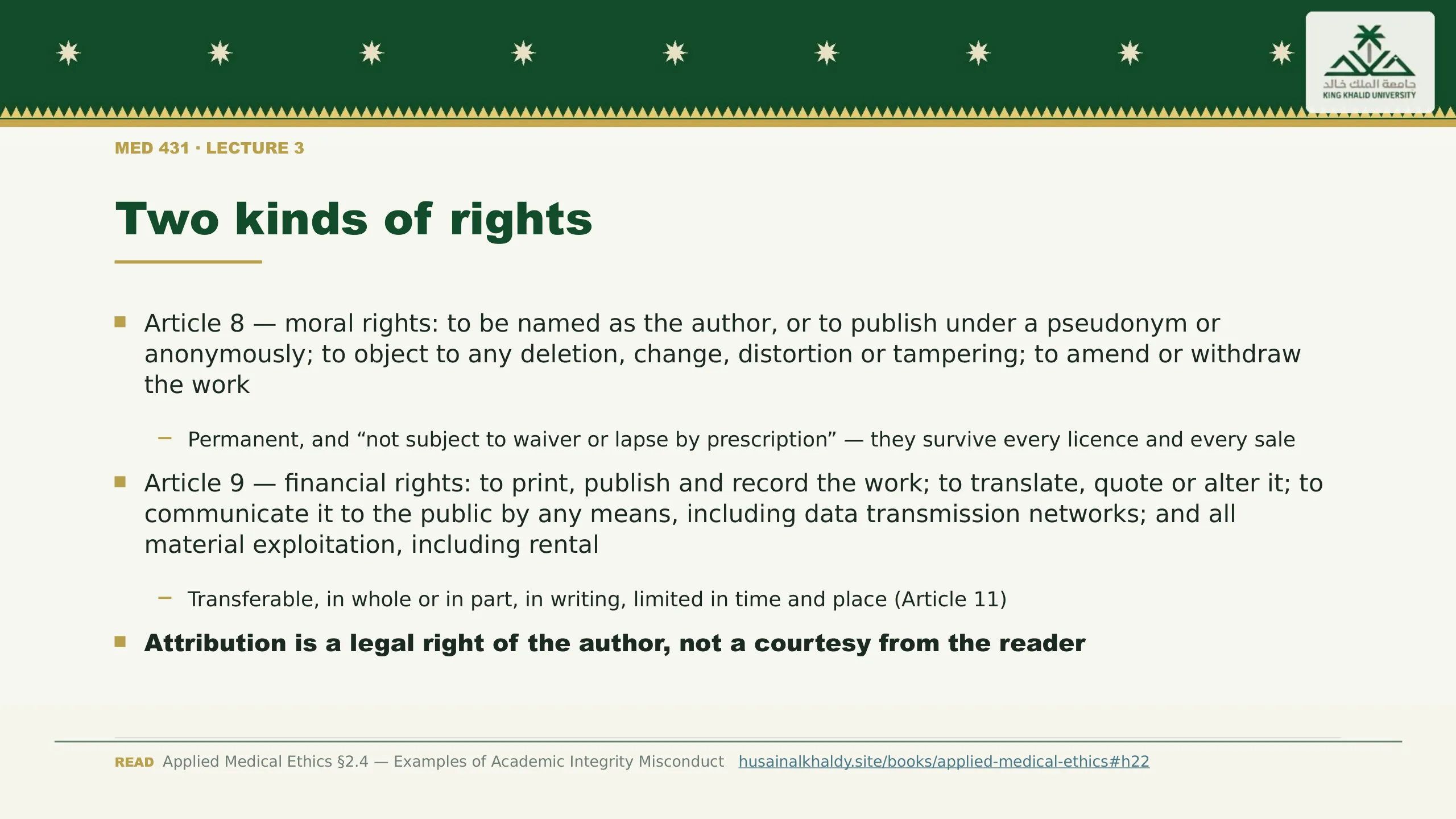
Moral rights and financial rights
The Law divides an author's rights in two. Article 8 lists the moral rights: to attribute the work to oneself or to publish it under a pseudonym or anonymously; to object to any deletion, change, addition, distortion or other tampering with it; to amend it; and to withdraw it from circulation. These rights are permanent. The article says they are not subject to waiver or to lapse by prescription, that they are retained even when the right to exploit the work has been granted to someone else, and that on the death of an author without heirs they pass to the Authority. The right to be named, in other words, cannot be signed away, and a publisher who buys a work does not buy the author's name off it.
Article 9 lists the financial rights, which are the ones that can be sold: printing, publishing and recording the work; translating, quoting or altering it; communicating it to the public by any means, and the article names data transmission networks, which is the internet; and material exploitation generally, including rental. Article 11 makes them transferable in whole or in part, in writing, with limits of time and place. The line at the foot of the slide is the point of the whole part. When Part 1 called attribution a form of respect, that was ethics. Article 8 makes it a right the author holds against you in law.
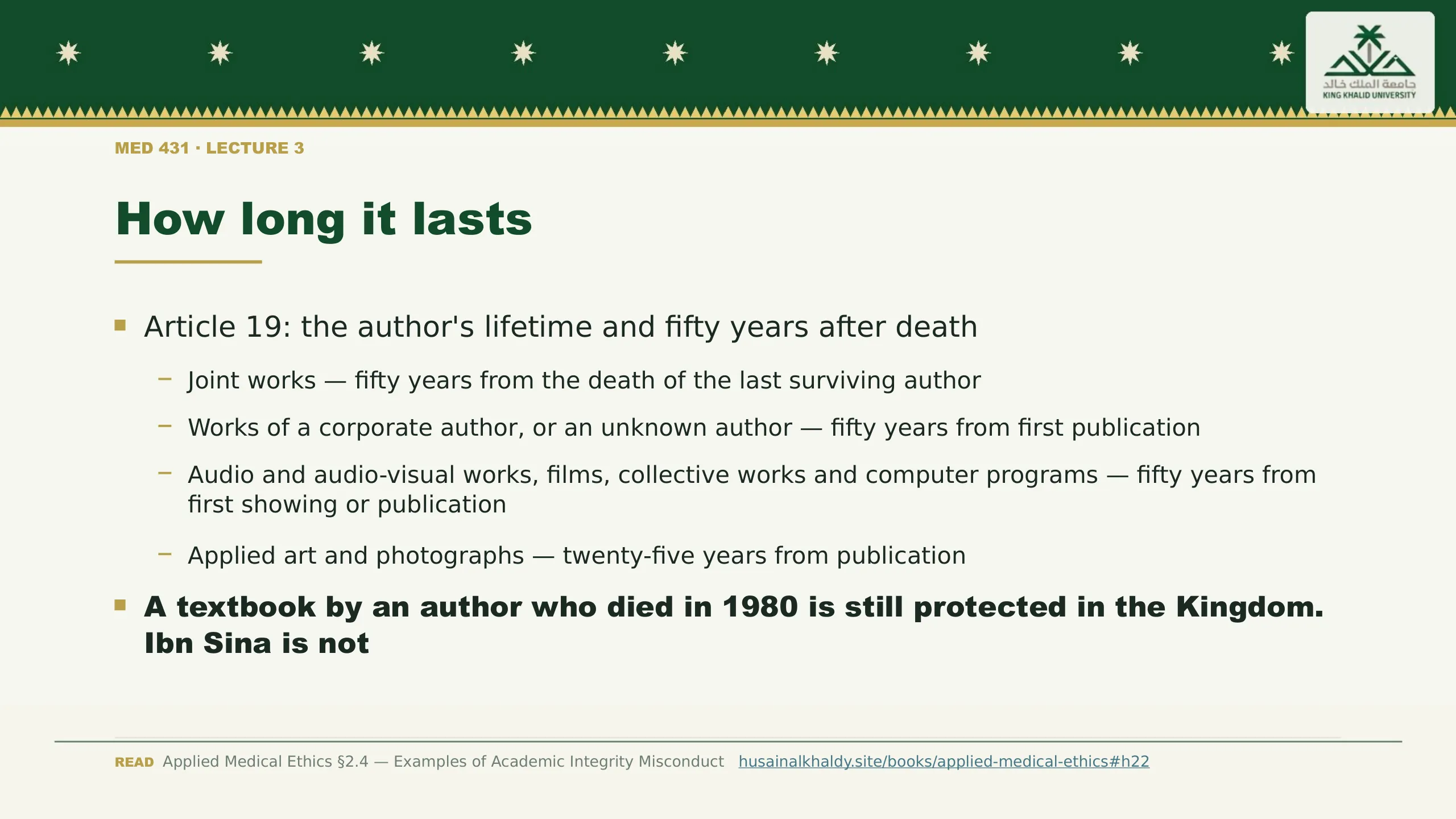
Article 19
Copyright is not permanent, and the Law fixes its length by the kind of work. The general rule is the author's lifetime and fifty years from the end of the year of death; for joint works the clock starts at the death of the last surviving author. Works whose author is a corporate body, or is unknown, are protected for fifty years from first publication, and if the author's name becomes known within that period the general rule applies instead. Audio and audio-visual works, films, collective works and computer programs get fifty years from first showing or publication; applied art and photographs get twenty-five.
The practical point for a student is the last line. The classical texts of Islamic medicine are long out of copyright, and the Arabic library on this site publishes them freely for that reason. Almost everything you read in medical school is not. A textbook whose author died forty years ago, a review article from last year, a figure in a journal, and this lecture are all protected, and the fact that they are online does not change it.
The exceptions, and their conditions
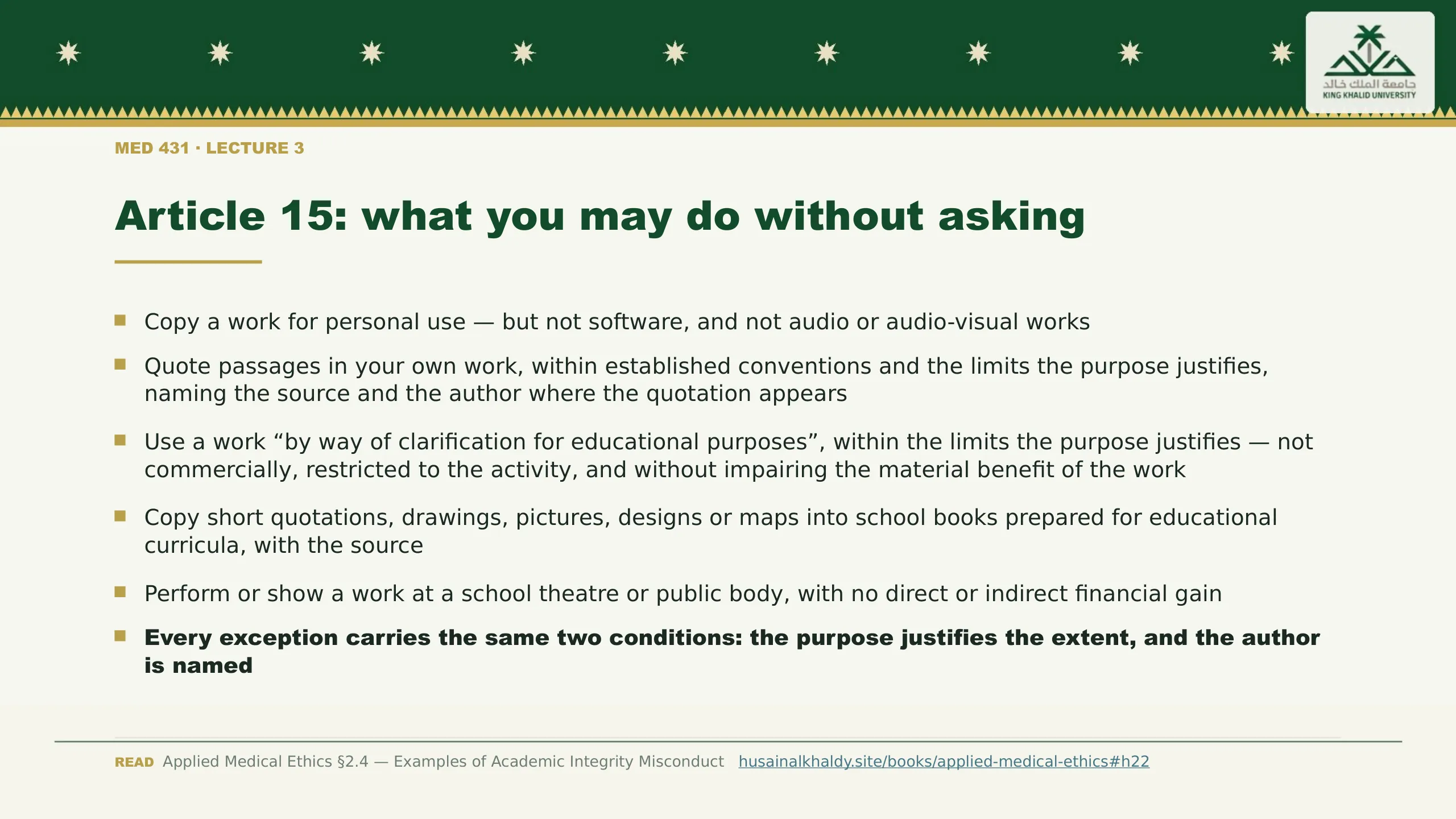
Article 15 is the article a student needs, because it lists the uses that are lawful without the copyright owner's permission. Copying a work for personal use is the first, with two exclusions that matter: computer software, and audio and audio-visual works. Quotation is the second: passages from a work may be quoted in another, provided the quotation is consistent with established conventions, stays within the limits the intended objective justifies, and gives the source and the author's name where the quotation appears. Educational use is the third: a work may be used by way of clarification for educational purposes, within the limits the purpose justifies, on four conditions, that the use is not commercial, that copying is restricted to the requirements of the activity, that it does not impair the material benefit of the work, and, for library copies, that the work is out of print or lost.
The remaining exceptions cover school textbooks prepared for curricula, non-profit performances by schools and public bodies, and the press. Notice what is common to all of them. Each is bounded by its purpose, so that the extent of the use must be justified by what you are using it for, and each requires the author to be named. That is the same rule as Part 1's, stated by a legislator. The exception the earlier version of this lecture called “fair use” is American law; in the Kingdom, Article 15 is the list, and the list is closed.
The cases the old lecture used, read against the statute
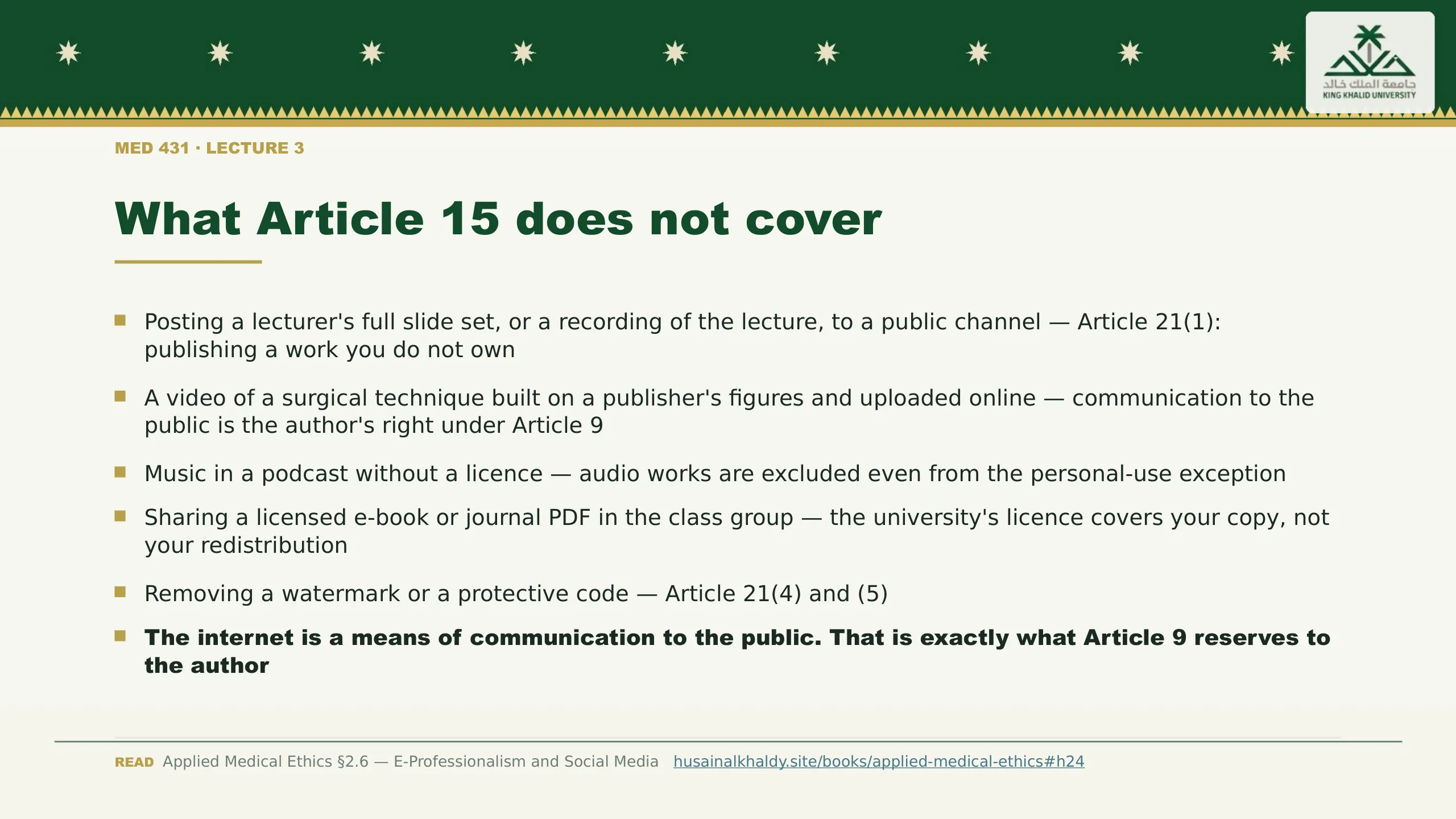
Earlier versions of this lecture gave a list of scenarios, a professor's slides with unattributed material, a student's video on a surgical technique posted online, a podcast with music, a poster with a journal's figures. Read them now against the Law. Article 21 lists the infringements, and the first is publishing a work not owned by the publisher, or without written authorisation from its author. A full slide set or a lecture recording posted to a public channel is that infringement, and it is also Rule 36 of the Conduct Code. Article 9 reserves communication to the public by any means, including data networks, to the author; a video built on a publisher's figures and uploaded is communication to the public of the publisher's work. Music is an audio work, which Article 15 excludes even from the personal-use exception, so a podcast needs a licence for its music.
The e-book and journal PDF case is the one students least expect. The university's licence lets you read and keep your copy; it does not license you to redistribute it, and redistribution to a class group is publication. Article 21(4) and (5) add the removal of ownership information and the circumvention of protective codes, which covers the cracked PDF and the stripped watermark. The general rule is at the foot of the slide: everything Article 15 allows is private or educational and bounded; everything the internet does is communication to the public, which the author owns.
What the Law can do to an infringer
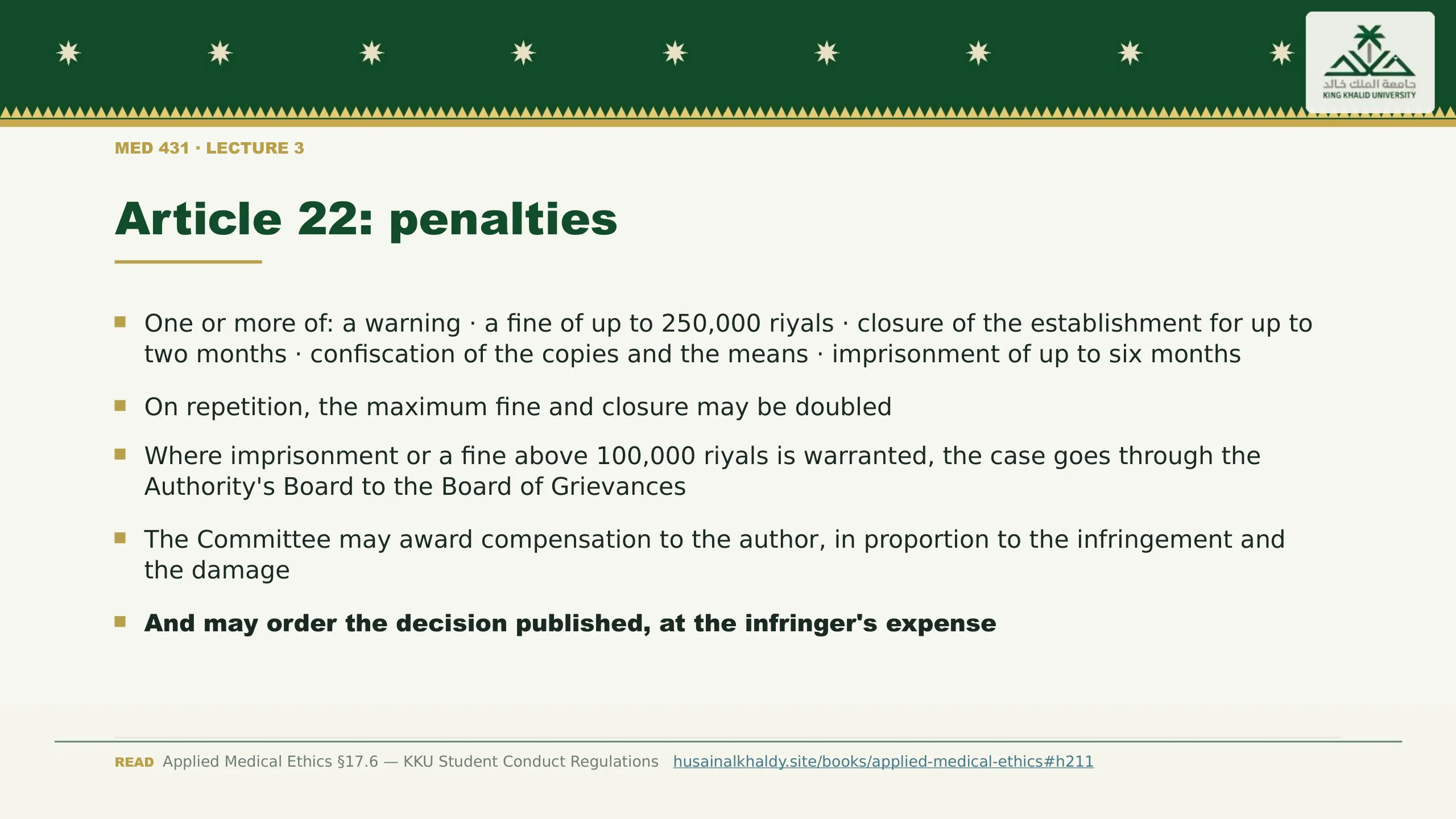
Article 22 lists the penalties, and a violator may receive more than one of them: a warning; a fine of up to two hundred and fifty thousand riyals; closure of the violating establishment, or one that took part, for up to two months; confiscation of all copies and of the materials used or intended for the infringement; and imprisonment of up to six months. On repetition, whether on the same work or another, the maximum fine and closure may be doubled. Cases that warrant imprisonment or a fine over one hundred thousand riyals are referred through the Authority's Board of Directors to the Board of Grievances, the same appellate body you met in the Law of Practicing Healthcare Professions.
Two further powers are the ones that reach a student or a young doctor. The Committee may award financial compensation to the author who filed the complaint, in proportion to the infringement and the damage, and it may order its decision published at the infringer's expense. For a medical professional whose name is their practice, the second is the heavier penalty. The scenarios on the previous slide are not merely bad manners; each is an act to which this article attaches.
The three labels you will meet
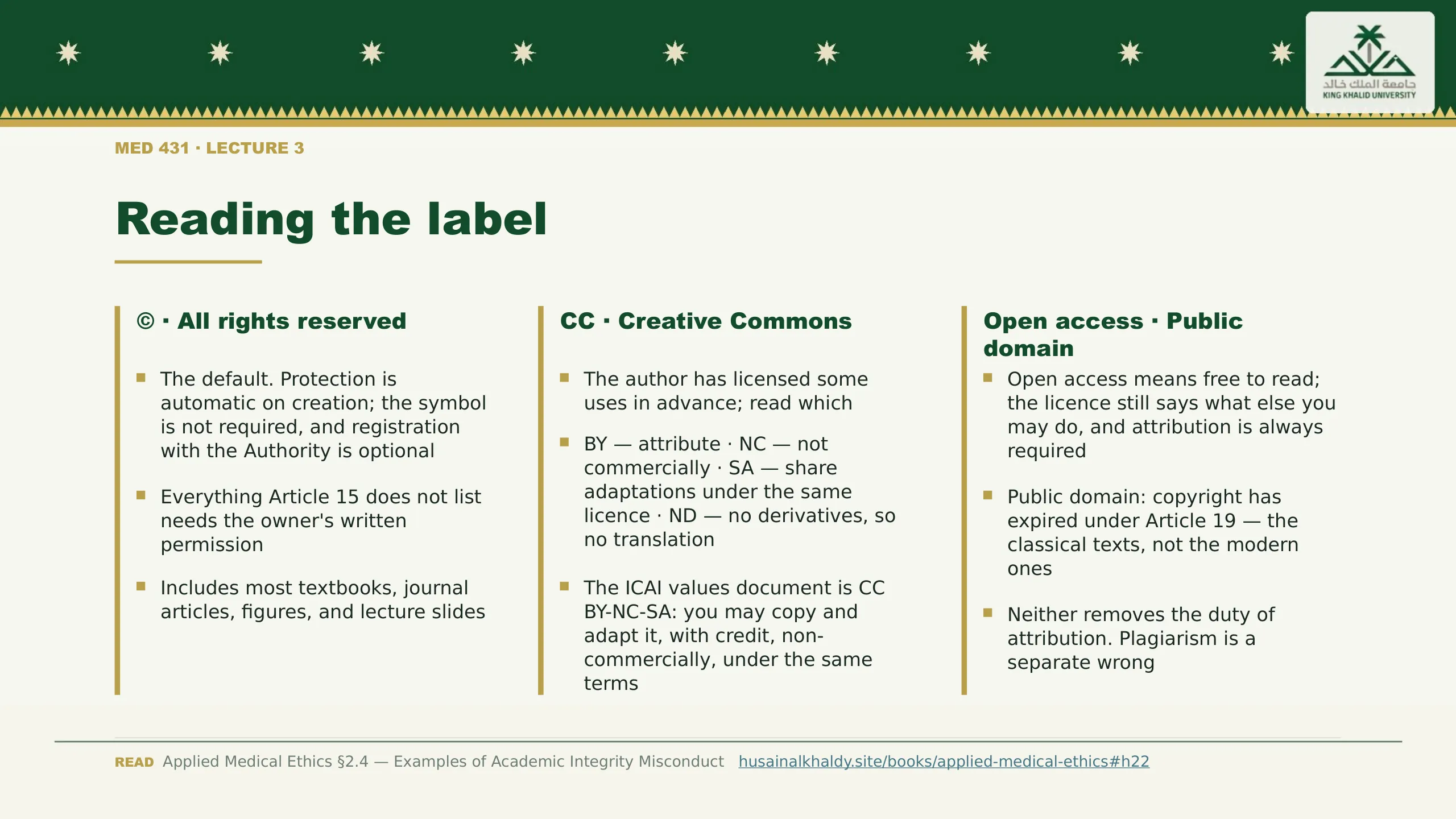
Earlier versions of this lecture taught this as a set of symbols, and the symbols are still worth knowing, read against the Law. The copyright sign means all rights reserved, and it is the default: under the Law, protection arises when the work is created, no symbol is needed, and registration with the Authority under its 1440H regulations is optional. Anything not covered by Article 15 needs the owner's written permission, and that covers most of what you read.
A Creative Commons licence is the author exercising Article 9 in advance, granting some uses to everyone on stated conditions. The four letters are the conditions: BY requires attribution; NC forbids commercial use; SA requires adaptations to carry the same licence; ND forbids derivatives altogether, which includes translation. The ICAI document that Part 1 quoted is CC BY-NC-SA, so this course may copy and adapt it, with credit, for teaching. Open access is narrower than students think: it means free to read, and the licence attached to the article still governs reuse. Public domain means copyright has expired under Article 19, which for medicine means Ibn Sina and al-Razi, not the current edition of Harrison. None of the three labels removes the duty to attribute. Plagiarism and copyright infringement are different wrongs, and a work you may lawfully copy is still a work you must not present as your own.
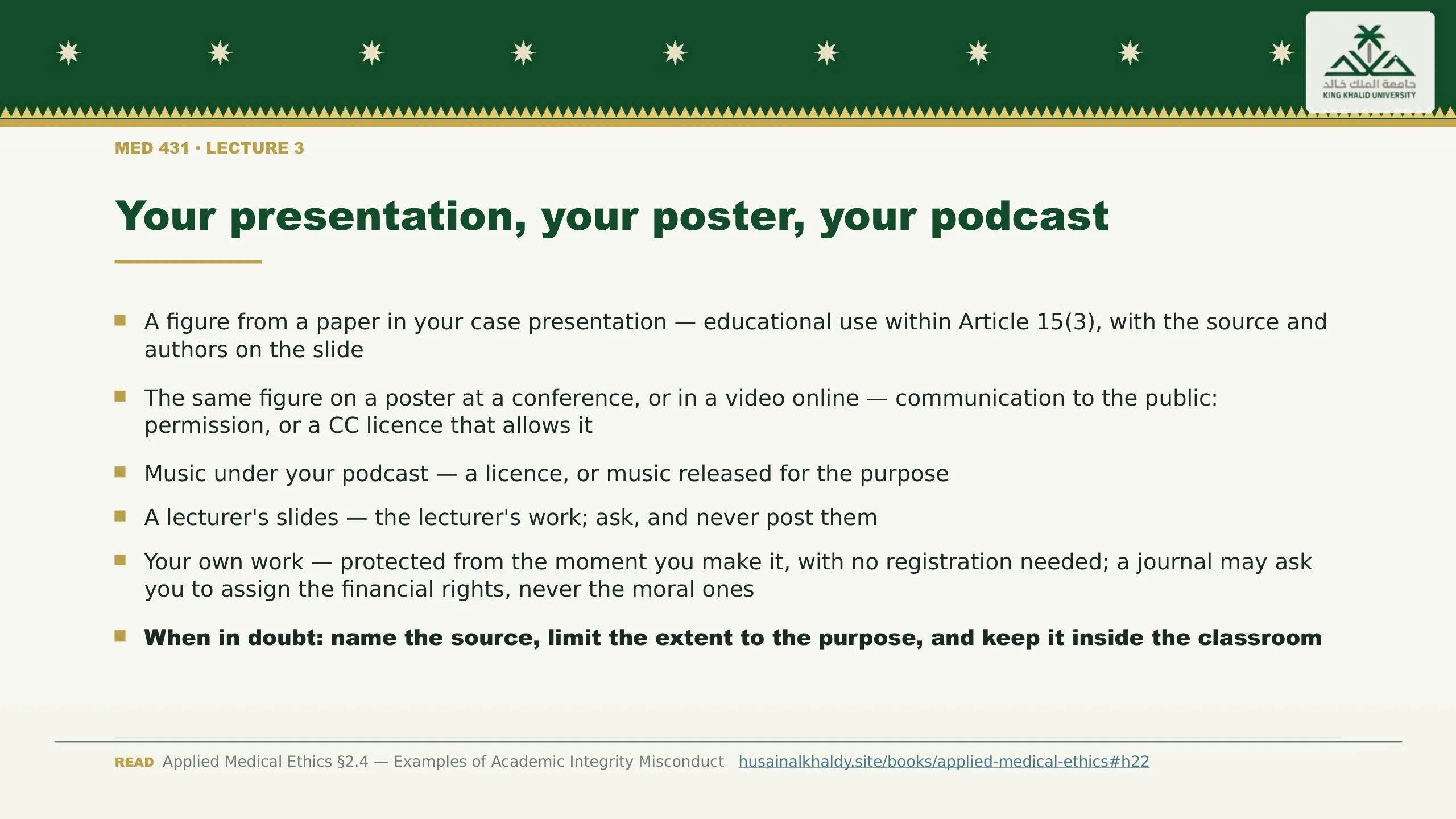
Applying Article 15 to what you will actually make
The scenarios from the earlier lecture resolve cleanly once the article is in view. A figure from a published paper on a slide in a case presentation to your group is educational use within Article 15(3), provided the source and the authors are on the slide, the use is not commercial, and the extent is what the teaching needs. The same figure on a poster at a conference, or in a video uploaded to a public platform, has left the classroom and become communication to the public, and needs either the owner's permission or a Creative Commons licence that allows it. Music under a podcast needs a licence, or music released for that purpose, because audio works have no personal-use exception at all.
A lecturer's slides are the lecturer's work under Article 2(2), and the Conduct Code adds its own penalty for recording or photographing them without written permission; the safe rule is to ask, and never to post. Your own work is protected from the moment you make it, without registration, and the rights are yours until you assign them. When a journal publishes your first paper it will ask you to assign the financial rights under Article 11; it cannot take the moral ones, and Article 8 says so. The last line is the working rule: name the source, keep the extent to the purpose, and remember that the internet is public.
Writing to your teachers

Part five
Lecture 1 ended with an instruction: write to me by email, and write it properly. This short part says what properly means, because the evidence is that most medical students do not know, and because the way you write to a teacher is the first professional communication anyone will judge you on.
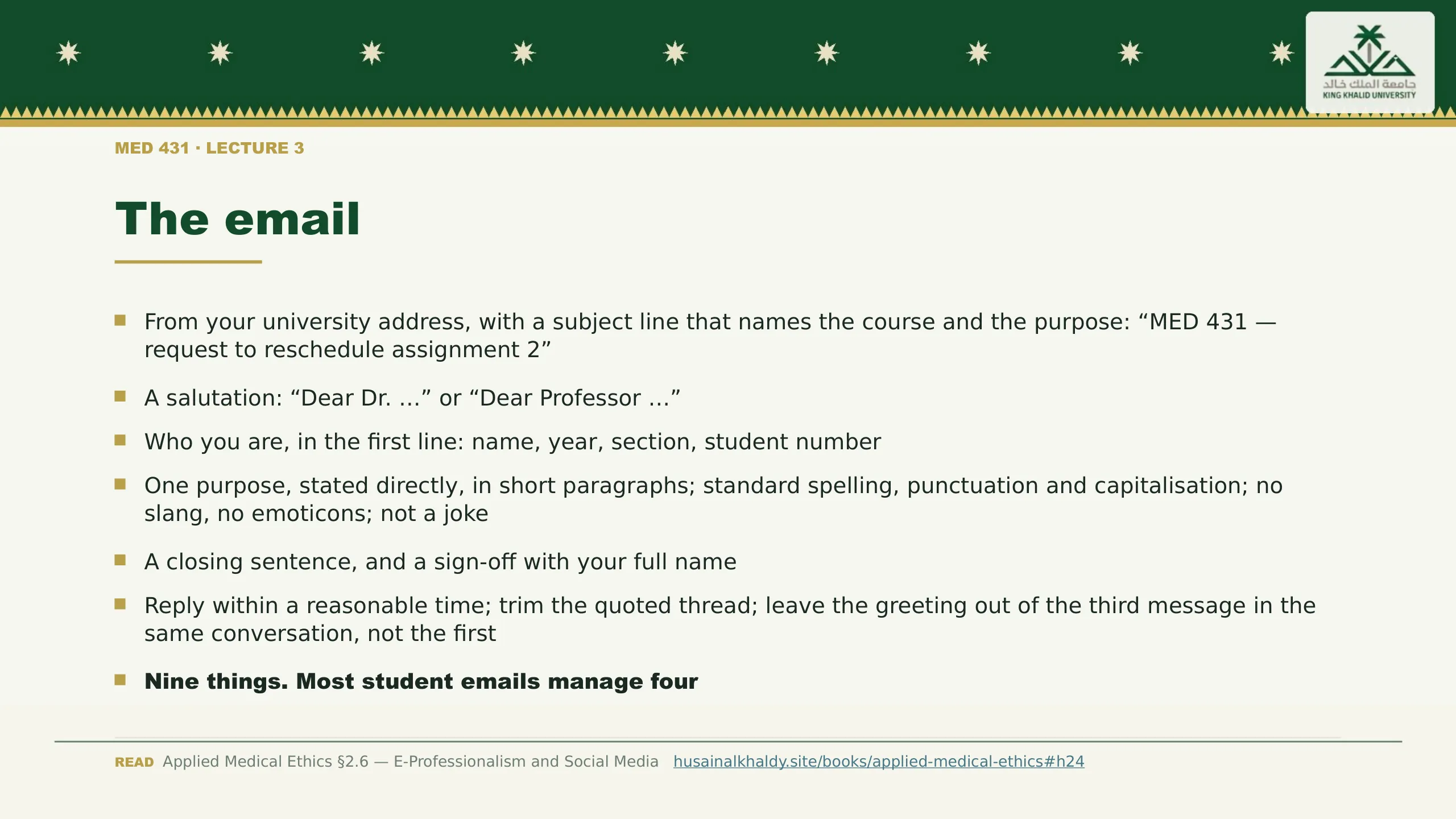
What properly means
The list on the slide is a merger of two sources: the short etiquette guide that this course has handed out for several years, and the ten-item rubric that a group at Seoul National University built from the published guidelines in order to score their own students' emails. The items are not arbitrary; each one does a job. The subject line lets the reader prioritise and file. The salutation and the sign-off are the two items that most strongly predicted whether the reader judged the email polite. The self-identification, name, year, section and student number, is what lets a teacher with a hundred and fifty students act on the message at all. One purpose per email, stated directly, respects the reader's time; professionals treat their inbox as work.
The rest is register. Standard spelling and capitalisation, because an email in capitals reads as shouting and one in lower case reads as a text message. No slang, no emoticons, and no jokes, which do not travel well in writing to someone senior. A reply within a reasonable time, with the old thread trimmed. And a distinction students get backwards: the greeting can be dropped from the third message in a running exchange, not from the first. The last line is the finding of the next slide.
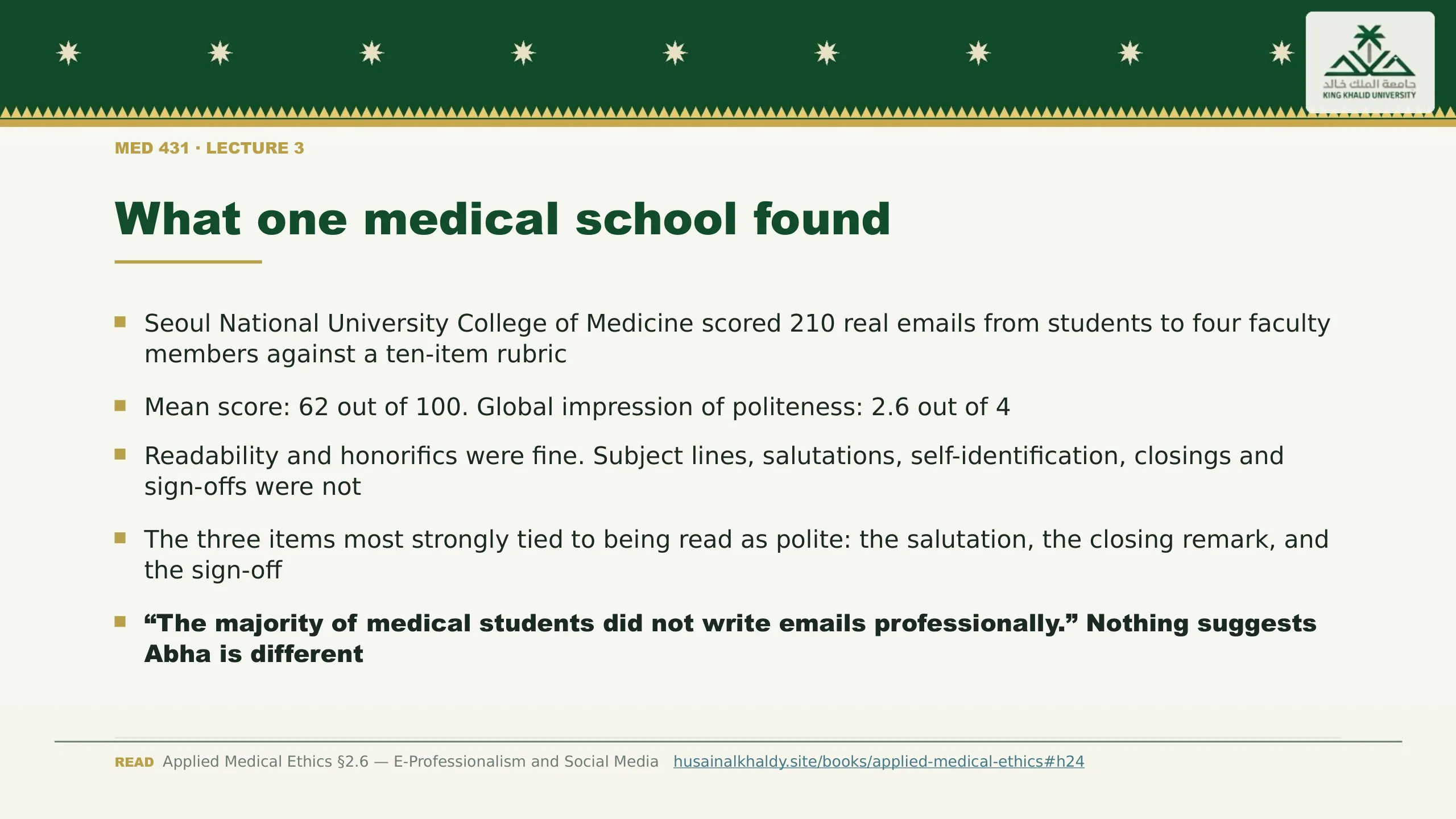
The evidence behind the list
Kim and colleagues at Seoul National University collected two hundred and ten emails sent by medical students to four faculty members and had three evaluators score each against a ten-item rubric: subject line, salutation, self-identification, readability, honorifics, internet slang, closing, sign-off, and an overall impression of politeness. The mean component score was sixty-two out of a hundred, and the mean politeness impression was two point six out of four. Students did well on the things their language made automatic, readability and honorifics, and badly on structure: subject lines, salutations, saying who they were, closing, and signing off.
The finding that matters for you is which items predicted the reader's impression. The salutation, the closing remark and the sign-off correlated most strongly with being judged polite, which means the three cheapest items on the list carry most of the weight. The authors' conclusion, that the majority of medical students did not write emails professionally, was drawn from a strong school in a formal culture. There is no reason to expect the finding to be better here, and every email this course has received suggests it is not.
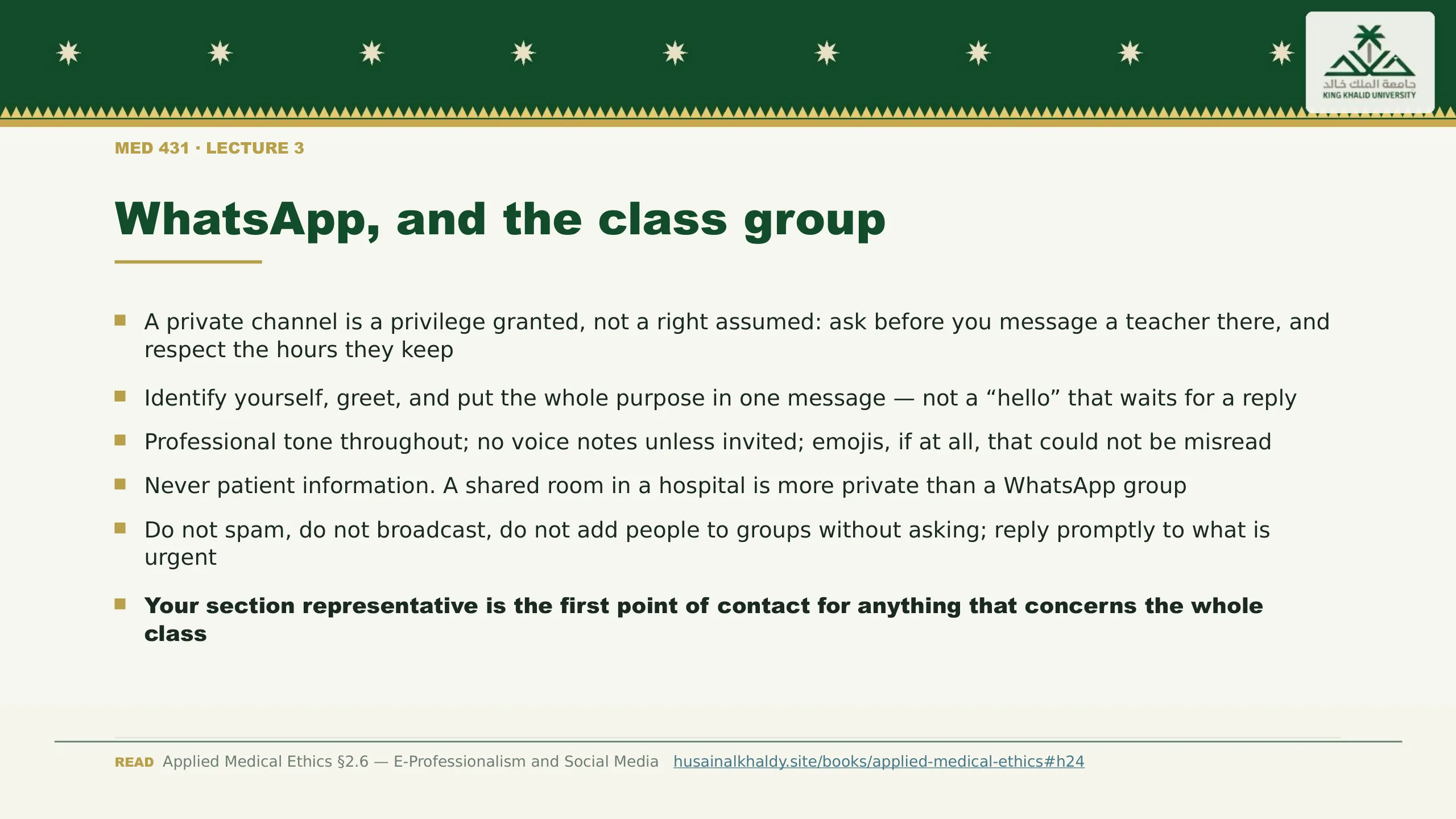
The rules the course has taught for private channels
These are the rules this course has given for WhatsApp since 2024, and they are here rather than in a footnote because the class group is where most of the professionalism failures of a term actually happen. A private channel to a teacher is a privilege, so the first rule is permission and timing: ask before you use it, and do not message outside working hours unless it is an emergency. The second is efficiency: identify yourself, greet, and put the whole purpose in one message. A “hello” that waits for a reply before stating its business wastes two people's attention.
Tone is kept professional throughout; voice notes are sent only when invited; emojis are used, if at all, only where they cannot be misread. The rule that has legal weight is the fourth: never patient information. A hospital's shared room, where Lecture 2 warned you that conversations carry, is more private than a group whose members you cannot see and whose screenshots you cannot recall. The remainder are courtesy with consequences: no spamming, no broadcasts, no adding people to groups without asking, and prompt replies to what is urgent. The last line is Lecture 1's, and it is the reason the class group exists: for anything that concerns the whole section, the representative writes, not thirty people.
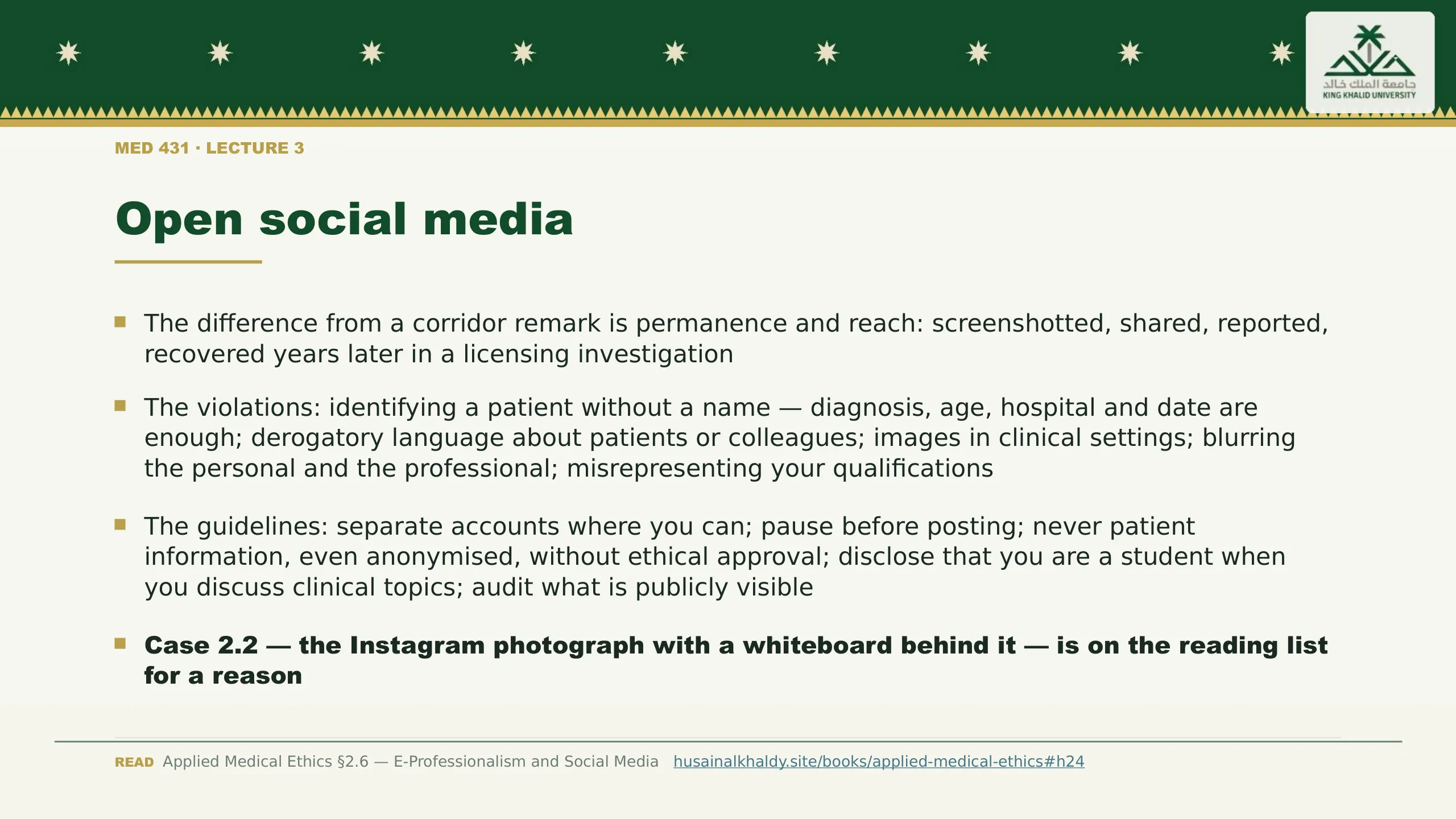
E-professionalism in one slide
Week 4 covered professionalism, and §2.6 of the book belongs to it, but the online part is inseparable from this lecture because the same platforms carry the plagiarised paragraph, the posted slide and the leaked patient detail. The book's frame is permanence and reach. A thoughtless remark in a corridor is forgotten; the same remark online is screenshotted, shared, reported to the school, and recoverable years later during a licensing investigation. Its instruction follows: assume anything you post could be read by your patient, your dean, a journalist or a licensing board, and post accordingly.
The listed violations are the ones that have actually ended student placements. Identifying a patient without using a name, because diagnosis, age, hospital and date together identify a person; derogatory or discriminatory language about patients or colleagues; photographs in clinical settings; a blurred line between personal and professional identity; and misrepresented qualifications. The guidelines are practical and short: separate accounts where possible, a pause before posting, no patient information even anonymised without ethical approval, disclosure of student status when discussing clinical topics, and a periodic audit of your own public presence. Case 2.2, the white-coat photograph at the nurses' station with a patient's name on the whiteboard behind it, is the whole section in one image.
The sentence to keep from Part 5
The book's rule for social media is also a rule for email and for the class group, and it is the same test as integrity's. Integrity is what you do when no one is looking. Online, someone always is.
Cases, and next

Part six
Two of the four cases at the end of Chapter 2 follow, with the order in which to work them. The other two, the ward photograph and the observed catheterisation, are yours for next time.
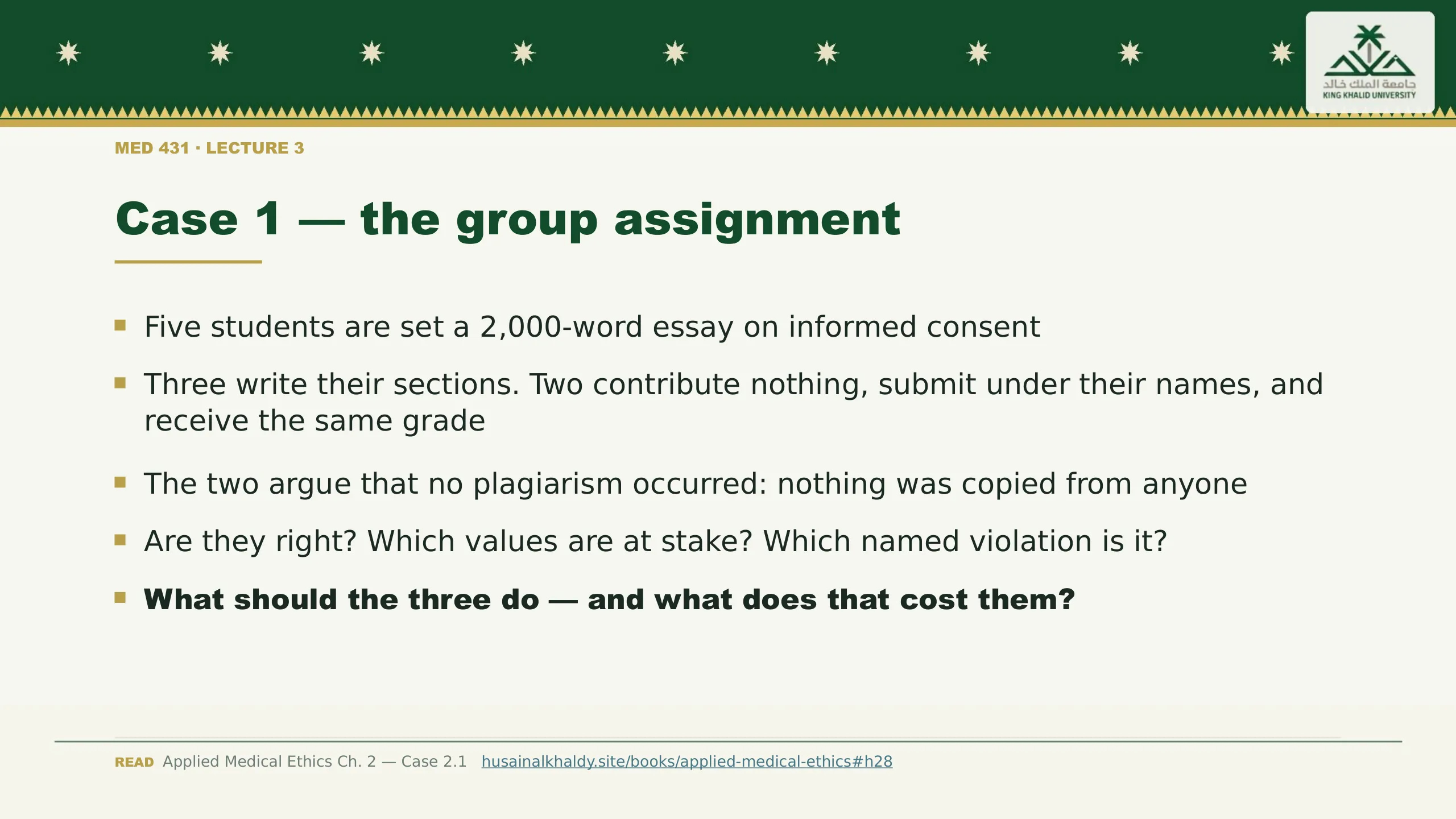
Case 2.1
Start with the two students' defence, because it is the interesting part. They are right that nothing was copied: no text was taken from a source without attribution. They are wrong that nothing happened. The book's definition of ghostwriting is submitting work written entirely by someone else as your own, and the source it lists includes a fellow student. The two have submitted work that three other people wrote, under their own names, for a grade. In publication terms it is gift authorship; in the university's terms it is submitting research not of one's own preparation, which Rule 36 penalises as cheating.
Then run the six values. Honesty fails, because the submission represents effort that was not made. Trust fails, because the teacher assumed five contributors. Fairness fails twice: against the three, who did the work, and against every other group. Respect fails, because the three's intellectual work has been claimed. Responsibility is the two students' alone. Courage is the question the case is really asking, and it is asked of the three, not the two: reporting is uncomfortable, and the alternative, silence, makes them complicit in a misrepresentation to which their own names are attached. Note that the marks are the same for all five. That is the fairness argument's proof.
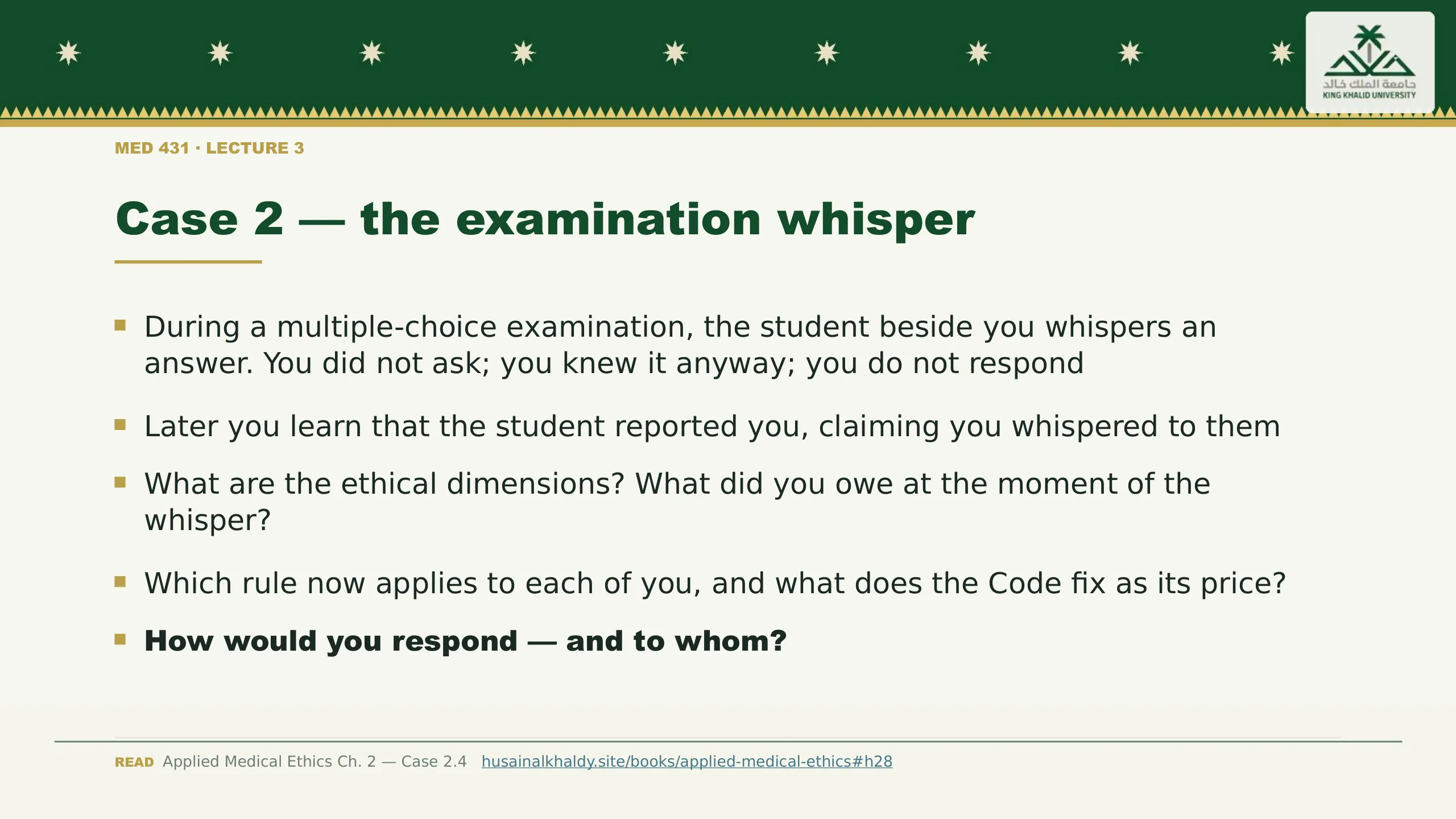
Case 2.4
This case has two moments and students usually argue only about the second. Take the first. A whisper in an examination is an attempt to cheat under Rule 36, whether or not it is answered, and the student who receives it has a choice that the six values settle: courage and responsibility point to reporting it, or at least to telling the invigilator at once, and silence, however natural, leaves the attempt unrecorded. The book's Case 2.3 makes the same point on a ward: silence in the face of misconduct is not neutrality.
The second moment is the false accusation, which is lying or fraud under the wider list on slide 15 and, if it was made to divert an investigation, a further violation in itself. Your response has a channel: the Code gives every student the right to complain and to appeal without harm following from it, and the duty not to complain maliciously. Use the channel, state the facts, and do not answer an accusation with one. An examination hall has invigilators, seating plans and answer scripts; the truth of a whisper is usually recoverable, and the student who told the truth first is the one the process protects.
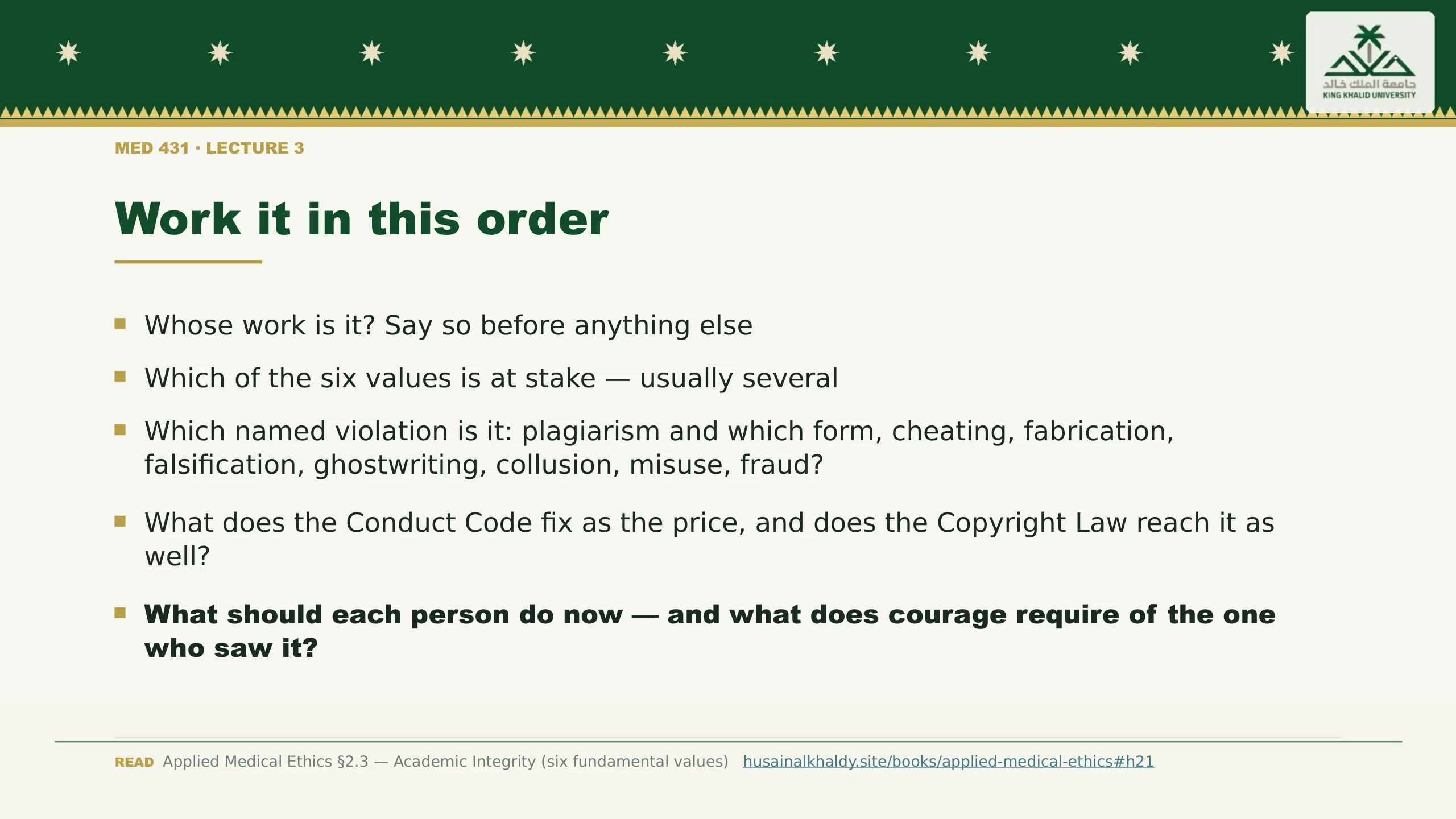
A method for integrity questions
As in the earlier lectures, the order is also the examiner's order. Whose work it is comes first, because every integrity question is a question of ownership and attribution, and a student who answers it honestly has usually answered the rest. Then the values, in the plural, because a breach rarely offends only one. Then the name, precisely: not “cheating” for everything, but plagiarism and which form, fabrication or falsification, ghostwriting, collusion, misuse of materials, fraud. Then the price, from the Conduct Code's tables, and the question whether the Copyright Law is engaged as well, which it is whenever a work has left the classroom.
The last question is the one this lecture was built to ask. In every case in Chapter 2 someone saw what happened, and the case turns on what they did next. Courage is the sixth value because the other five depend on it.
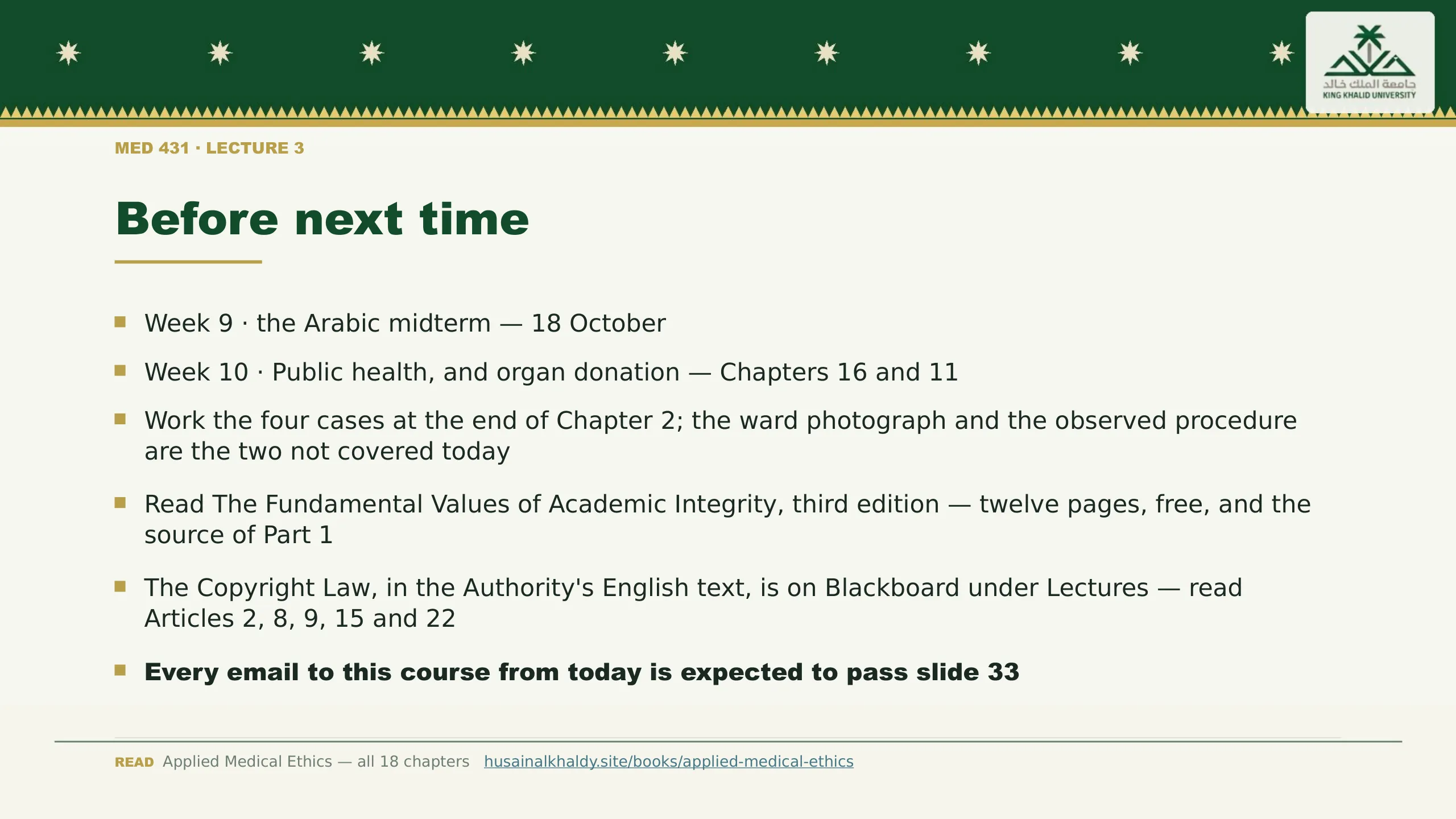
Reading, and one expectation
The Arabic midterm is next week, on 18 October. The next English lecture is week 10, public health and organ donation, and its chapters are 16 and 11; read them before the lecture, as the course requires of every week. For this lecture, the four cases at the end of Chapter 2 are the test of whether it landed. Two were worked today. The ward photograph and the observed catheterisation are yours.
Two documents are worth reading in full. The International Center for Academic Integrity's statement of the six values is twelve pages, free under a Creative Commons licence, and the source of Part 1. The Copyright Law in the Saudi Authority for Intellectual Property's English text is on Blackboard under Lectures; Articles 2, 8, 9, 15 and 22 are the ones this lecture used, and they take a quarter of an hour. The last line is the only assessment attached to Part 5, and it is continuous.

The question, answered
Yours, when you did it, and say so. Theirs, when they did it, and say so. The law protects the second answer; integrity is giving both when no one would know the difference. Week 10: public health.
Before next time
This lecture was Chapter 2 — The Professional Student, with §14.3–14.4 of Chapter 14 for publication and §15.5 of Chapter 15 for generative AI. Work the four cases at the end of Chapter 2 and bring your answers. Week 9 is the Arabic midterm; week 10 is public health and organ donation, Chapters 16 and 11.
Two documents quoted here are worth keeping: The Fundamental Values of Academic Integrity (ICAI, 3rd edition, free under a Creative Commons licence) and the Saudi Copyright Law in the English text published by the Saudi Authority for Intellectual Property. Both will be on Blackboard under Lectures.
The question bank has 113 scenarios with the answers explained, and the Trainee Edition is the shorter version written for the wards.