Rules and Regulation
By what authority? — during undergraduate study and postgraduate training
The student
What this lecture is about
Lecture 1 asked who decides when medical knowledge runs out. This one asks a narrower and more practical question: by what authority do you sit in a lecture hall, walk onto a ward, examine a patient, sign a note, and one day write a prescription? At every one of those steps somebody has written a rule, and the rule has a name, a number and a penalty.
The lecture follows a career in order. First the student, governed by the university's regulations and the College's ward rules. Then the intern, who holds a degree but no licence. Then the practitioner, governed by the Law of Practicing Healthcare Professions and the Commission's Code of Ethics. Chapter 17 of the course book is the text behind it, with §2.5 of Chapter 2 for the student's part.
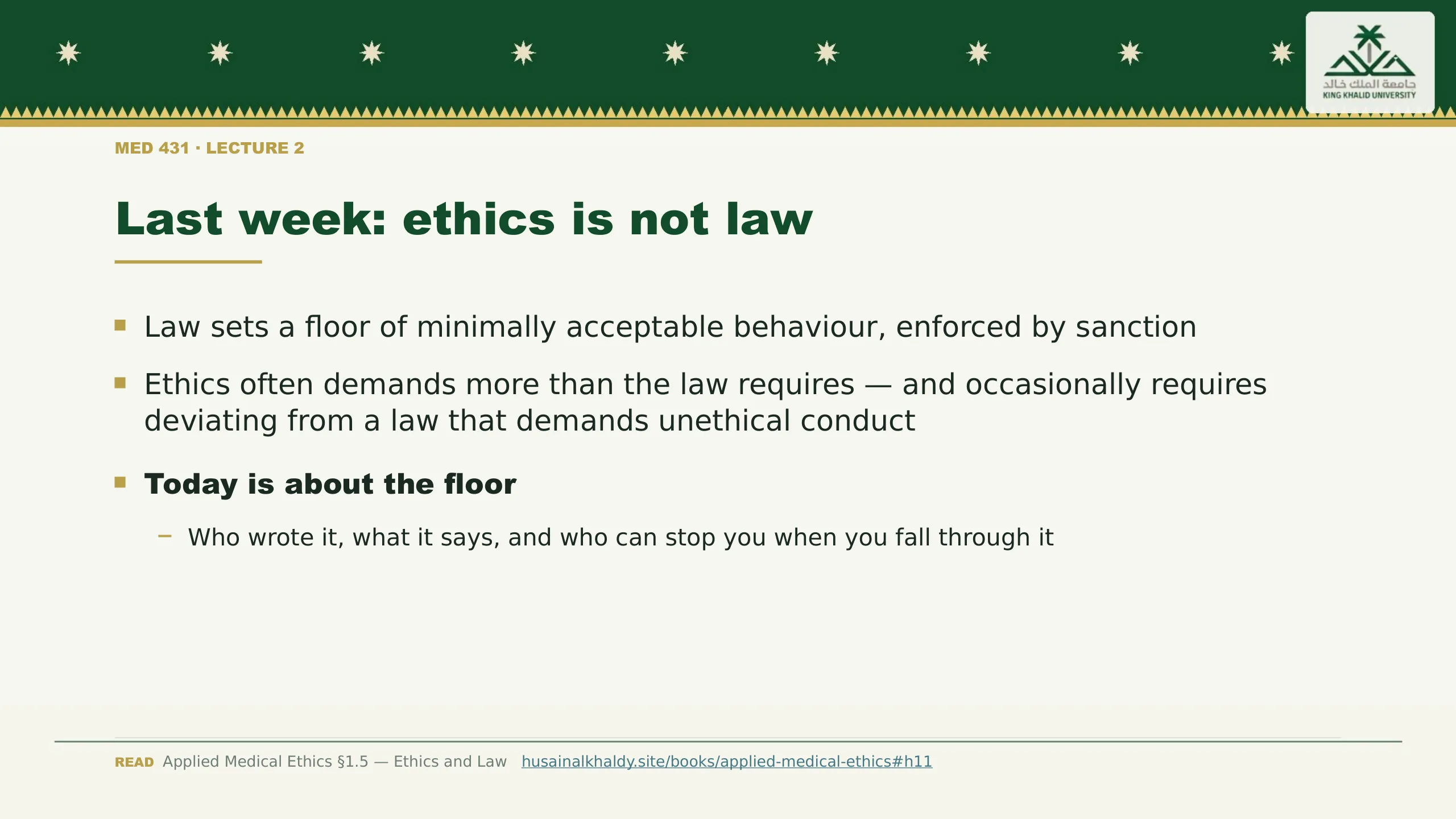
Keep last week's distinction in mind throughout. Ethics is what ought to be done; law is the floor of what must not be done. Today is about the floor.
Three situations, none of them exotic
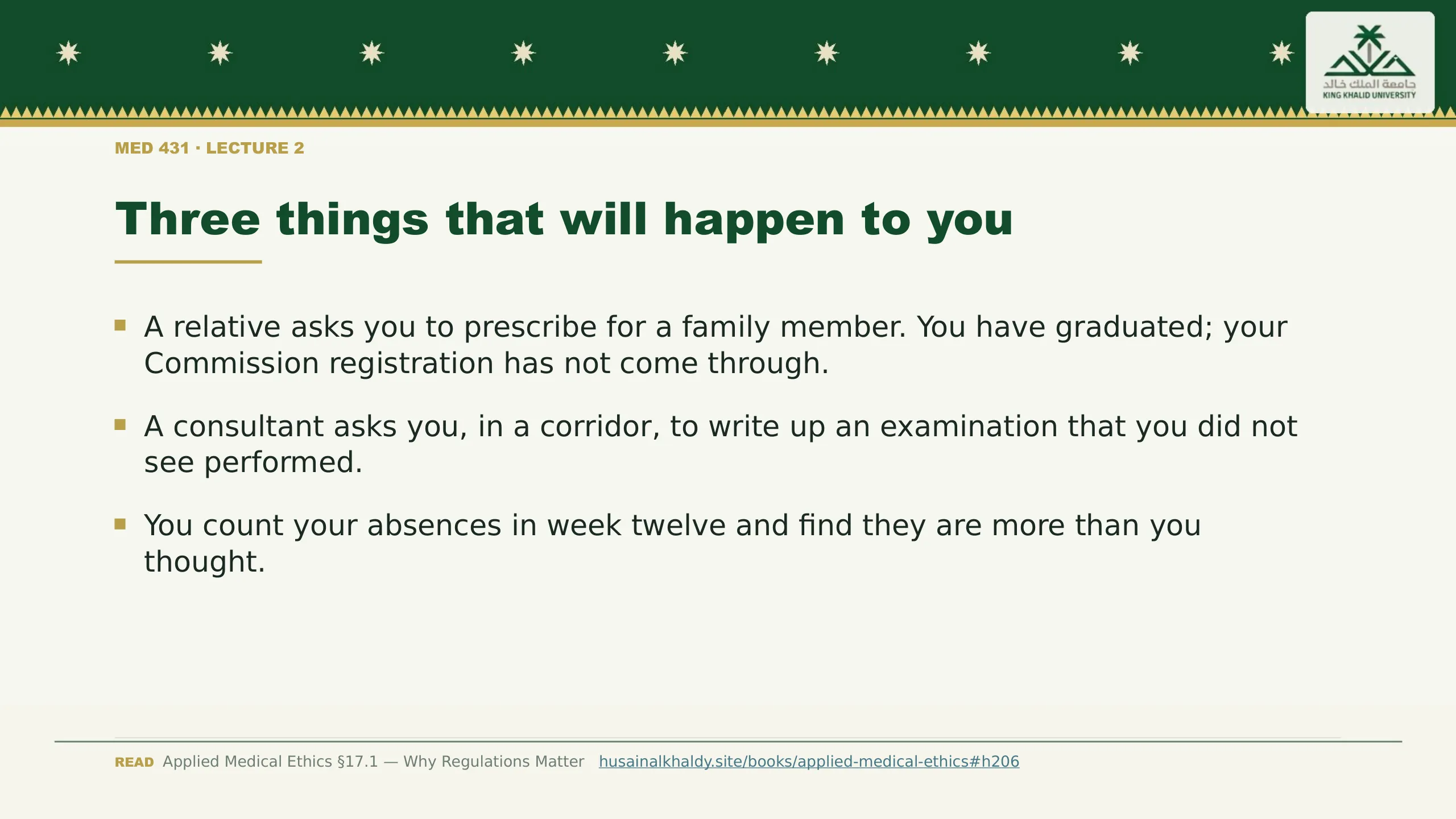
Each of these will happen to you or to someone standing next to you, and each feels at first like a judgement call. The relative is family, and you do know how to manage the condition. The consultant is senior, and the examination was “going to be done anyway.” The absences were for good reasons.
The first two are Cases 17.1 and 17.2 in the book. The third is not a case at all; it is Article 14 of the Study and Examinations Regulations, and it ends more medical careers at this university than any ethical dilemma does. Hold all three in mind. By the end of the lecture you should be able to name the rule that settles each one, the body that enforces it, and what it costs.
Why this is not Lecture 1 again
Last week's test for an ethical dilemma had four conditions: a decision must be made, there are at least two defensible options, each option violates something, and no option is clearly better on every dimension. Apply it to the three situations and it fails at the second condition. Prescribing without a licence is not a defensible option; it is an offence under Article 28 of the Law. Documenting an examination that was not performed is not a defensible option; it is a false record under Chapter 9 of the Code. Missing more than a quarter of a course is not a defensible option; it is an automatic bar from the final.
That is the point of a regulation. It takes a class of situations out of the space of judgement and settles them in advance, so that neither you nor the person pressing you can reopen them at the bedside. The professional's job is to know where those settled lines are. Ignorance of them is not a defence, and, as you will see, the Conduct Code and the Law both say so in their own way.
The floor, and why it is worth a whole lecture
It is tempting for an ethics course to treat regulations as beneath it. The book resists that. Laws governing healthcare are, at their best, the codification of ethical principles: autonomy becomes the consent article, non-maleficence becomes the malpractice article, accountability becomes the disciplinary chapter. When you read Article 19 of the Law you are reading the four principles translated into something a judge can apply.
The reverse is also true. A doctor who knows only the law will tell a patient the bare minimum needed for a valid consent, and will be acting lawfully and not ethically. So the two run together, and the sequence of this course reflects that. This week is the floor. Every week after it is about what a good doctor does above the floor.
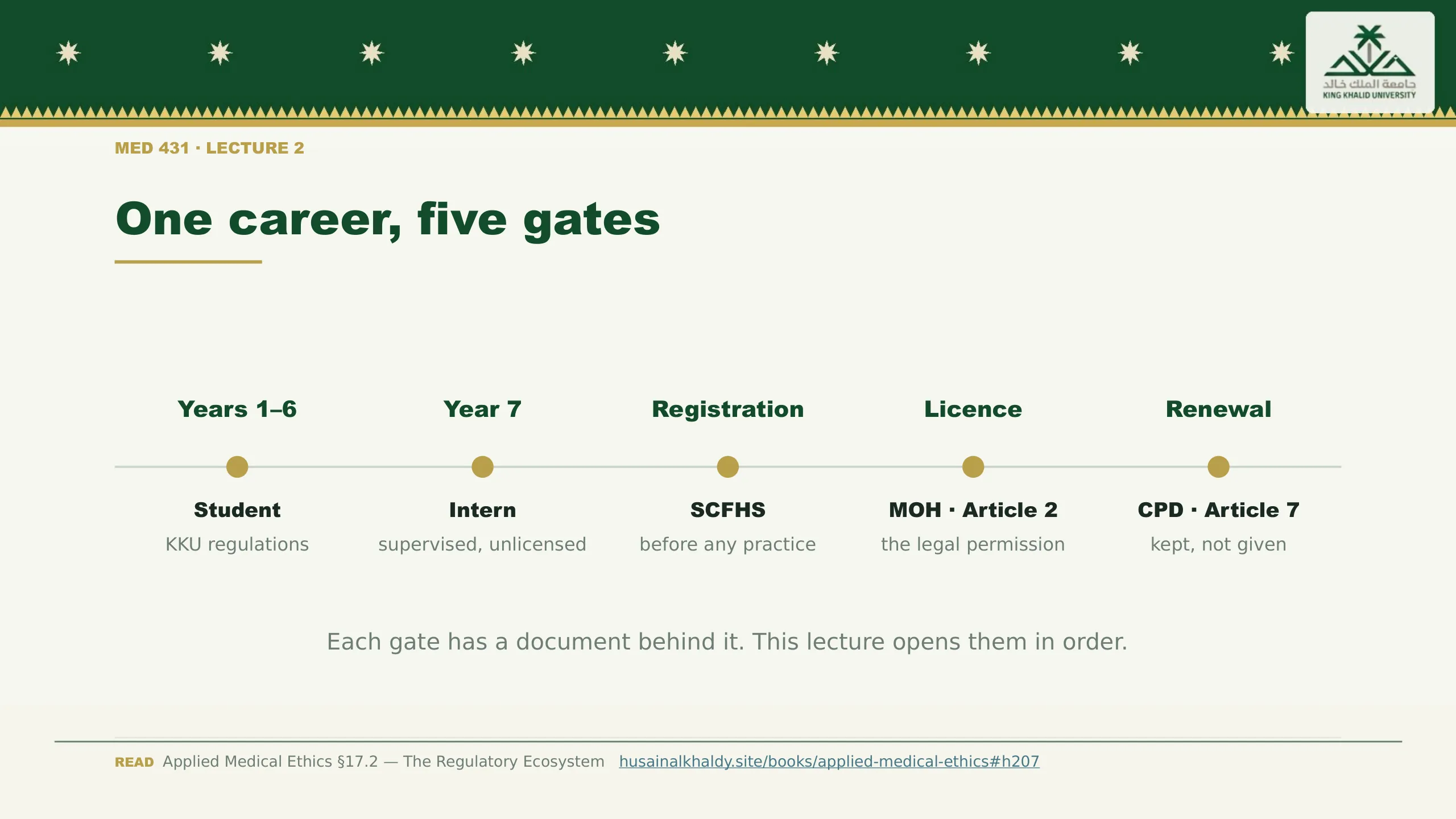
The map for the next forty slides
Regulation looks like a thicket until you lay it along the career it governs. For six years you are a student, and the documents that bind you are the university's: the Study and Examinations Regulations, the Conduct and Discipline Code, and the College's ward guidelines. In the seventh year you are an intern, a graduate the Law recognises as being in mandatory training, supervised and unlicensed. Then come two gates that students often merge and should not: registration with the Saudi Commission for Health Specialties, which classifies you, and the licence from the Ministry of Health, which Article 2 of the Law makes the condition of practising at all.
The fifth gate is the one nobody warns you about. A licence is kept, not given. Article 7 makes continuing education a duty, and the Commission's regulations weigh it at every re-registration and renewal. The floor does not stop at graduation; it follows you for the length of your practice.

Part one
Everything in this part is in force now, for you, in this course. That is why it comes first, and why it is more detailed than the book's single section on student conduct. The attendance rule, the cheating rule and the dress rule are the three that students in this course most often discover after they have broken them.
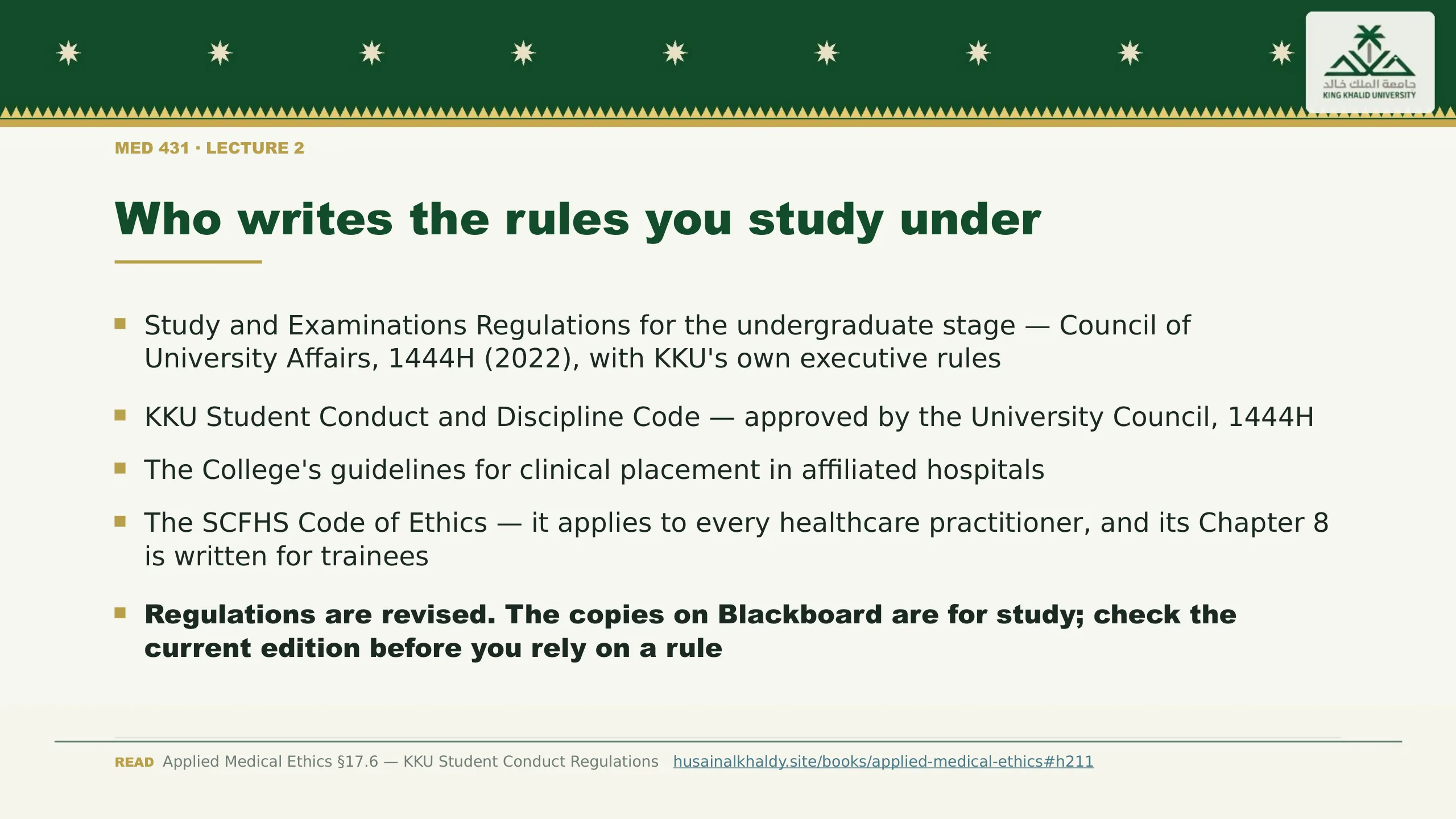
Four documents, and a warning about editions
The first two are the university's. The Study and Examinations Regulations are national, issued by the Council of University Affairs in 1444H, and each university attaches its own executive rules; the attendance percentages you will see on the next slide are KKU's executive rules under the national article. The Conduct and Discipline Code is KKU's own, approved by the University Council the same year, and it is the document that fixes penalties.
The third is the College's, written for the clinical years, and the fourth is the Commission's. Students are surprised that the SCFHS Code reaches them before they are registered, but Chapter 8 of the Code is titled “Ethics of Teaching and Learning on Patients” and is addressed to trainees and their teachers by name.
The warning on the last line is not a formality. The regulations currently on Blackboard were the ones in force when they were uploaded. The university revises them, and a student who relies on a superseded rule about registration or examinations has no appeal. Read from the university's website when it matters.
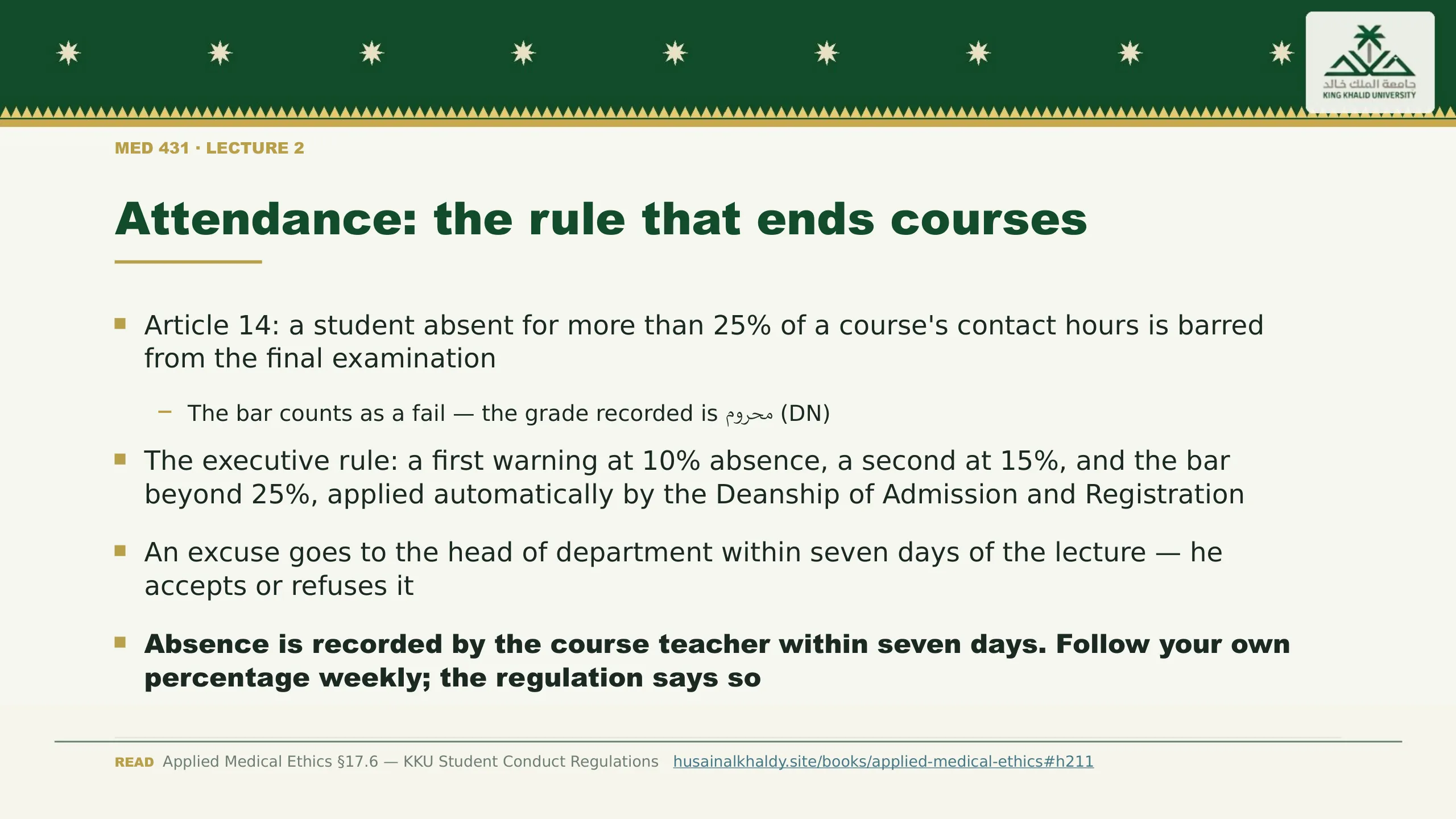
Article 14 and its executive rules
The national article says that a student who attends less than the proportion set by the University Council is barred from the final examination, and that the bar is a fail. KKU's executive rule sets the proportion: more than 25% absence from the course's contact hours. Two warnings come before it, at 10% and 15%, and the bar itself is applied automatically by the Deanship, not by the course coordinator, once the threshold is passed.
Two procedural points matter more than the percentage. First, the course teacher must record absence within seven days of each lecture, and a student who wants an absence converted to an excused absence must put the excuse to the head of department within seven days as well. An excuse produced in week fourteen for a lecture in week three has missed its window. Second, executive rule 6 places a duty on you: to follow your own absence percentage weekly. The regulation does not accept surprise as a defence, because it has told you to check.
Lifting the bar is possible but not routine. The College Council may lift it for an acceptable excuse and set an alternative examination, provided total absence did not exceed 50%; above that, only a graduating student can be excepted, and only if they sat every assessment and scored at least half the coursework marks.
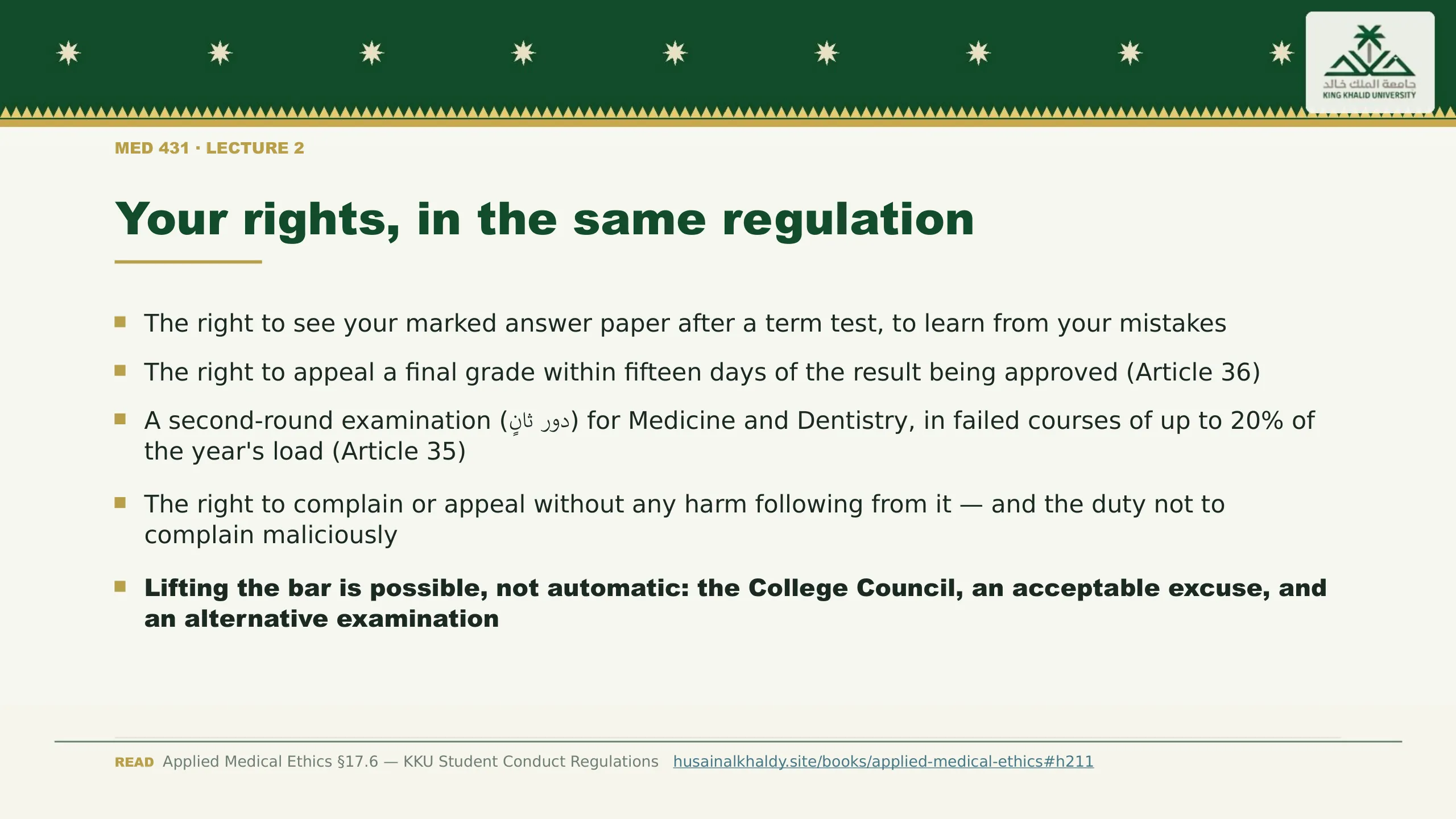
Regulations cut both ways
Students read regulations as lists of things done to them. Read them again as lists of things you are entitled to. Article 36 gives you fifteen days from the approval of a result to appeal a final grade, and its first executive rule gives you the right to see your marked answer paper after any term test. Article 35 is specific to Medicine and Dentistry: a second-round examination after the finals for failed courses, up to a fifth of the year's load, with a pass recorded as a pass in the second round rather than the earlier fail.
The Conduct Code's chapter on rights adds the right to complain or appeal without any harm following from it, in your relations with faculty, departments and the administration. The same chapter, in its list of duties, adds the corresponding obligation: to use that right properly and never maliciously. A regulation that gives you a protected channel for complaint is a regulation you should use before you use any other.
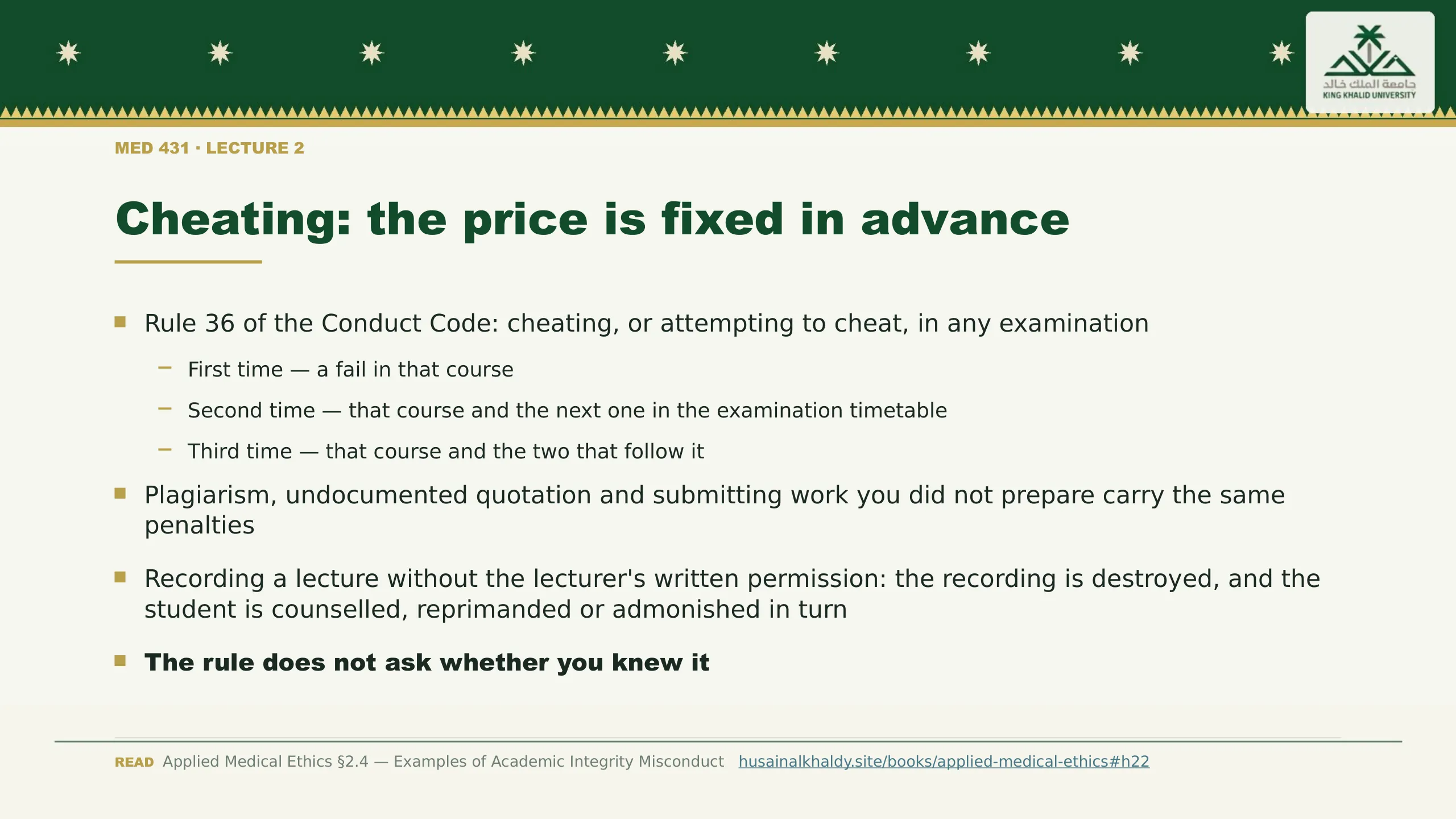
Rule 36 of the Conduct Code
The Code's table of academic violations is unusual in one respect: it publishes the penalty for a first, second and third offence side by side, so that nothing is left to the discretion of the committee that hears the case. Proven cheating in a term test, a final, a research course or a graduation project means a fail in that course. A second proven offence adds the next course in the examination timetable; a third adds the two that follow. Where the course was the last in the timetable, the penalty runs backwards instead.
Two extensions matter for you. Intellectual-property violations, listed as photographing what you have no right to photograph, undocumented quotation, and submitting research you did not prepare, are treated exactly as cheating. And recording a lecture without the lecturer's written permission is its own violation, with the recording destroyed and a graduated response from counselling to reprimand.
Chapter 2 of the book names the forms plagiarism takes, including text generated by an AI tool and submitted as your own. The Code was written before those tools were common, but its wording, “research not of his own preparation,” already covers them. Week 8 returns to academic integrity in full.
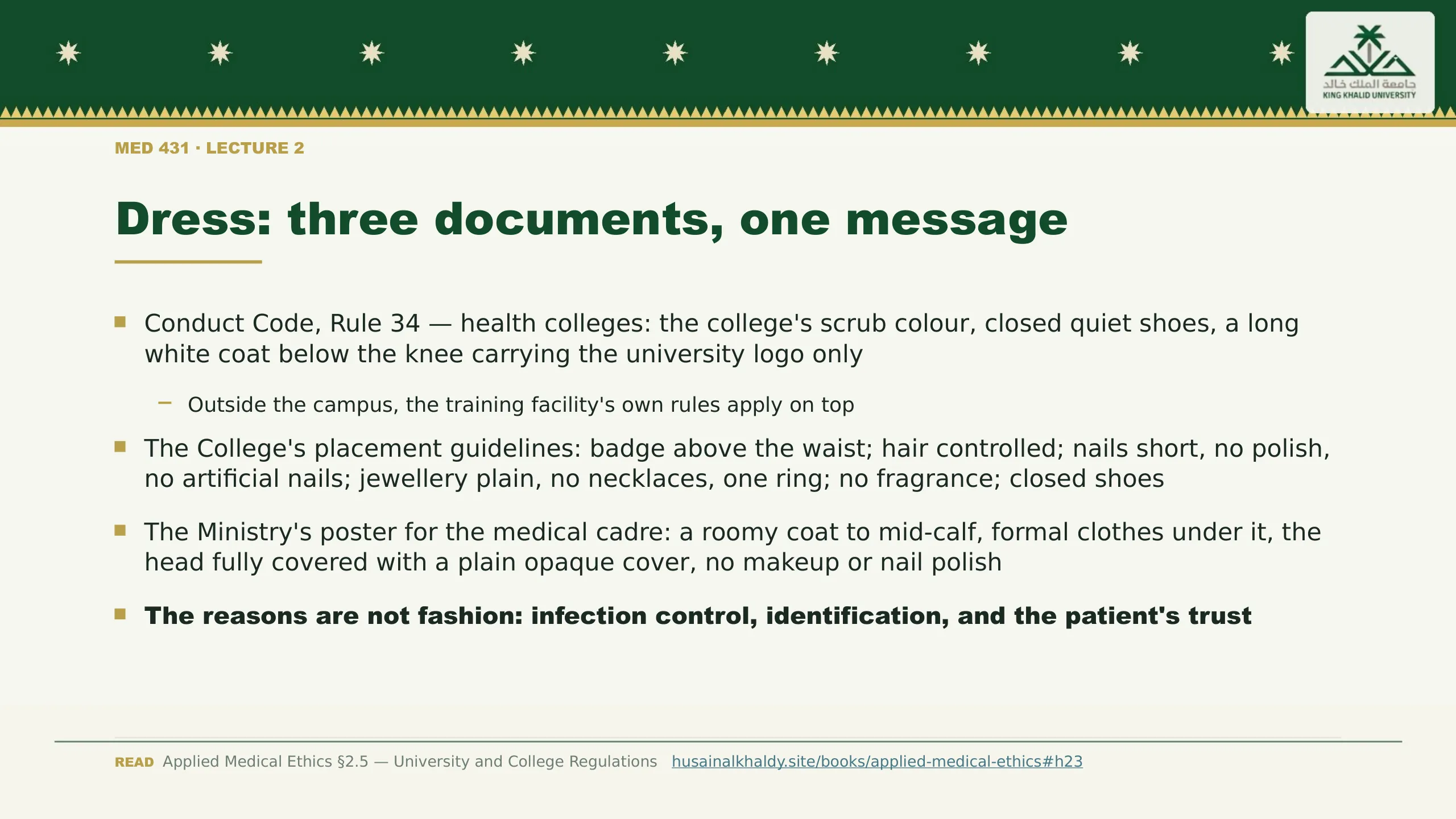
Why three documents say almost the same thing
Rule 34 of the Conduct Code sets the campus standard and, for the health colleges, names the items: scrubs in the college's colour, closed shoes that do not sound on the floor, and a long white coat below the knee with the university logo and nothing else. Off campus, it defers to the training facility, and adds for women a full opaque head covering, no long nails and no makeup. The College's clinical-placement guidelines fill in the ward detail, and the Ministry's poster for the medical cadre says the same again for the hospitals you will train in.
The convergence is not accidental. Every item traces to one of three reasons. Short unpolished nails, no artificial nails, no necklaces, no fragrance and closed shoes are infection control and safety. The badge above the waist and the plain coat are identification: a patient must be able to tell at a glance who is examining them. The rest is the patient's trust, which the Code of Ethics places on you the moment you enter a clinical area in the university's coat.
Under Rule 32, dress that breaches the university's standard is a listed violation, with a warning and written undertaking for a first offence and suspension for repeat offences. Under Rule 34 of the same code the health-college standard is the stricter one, and it is yours.
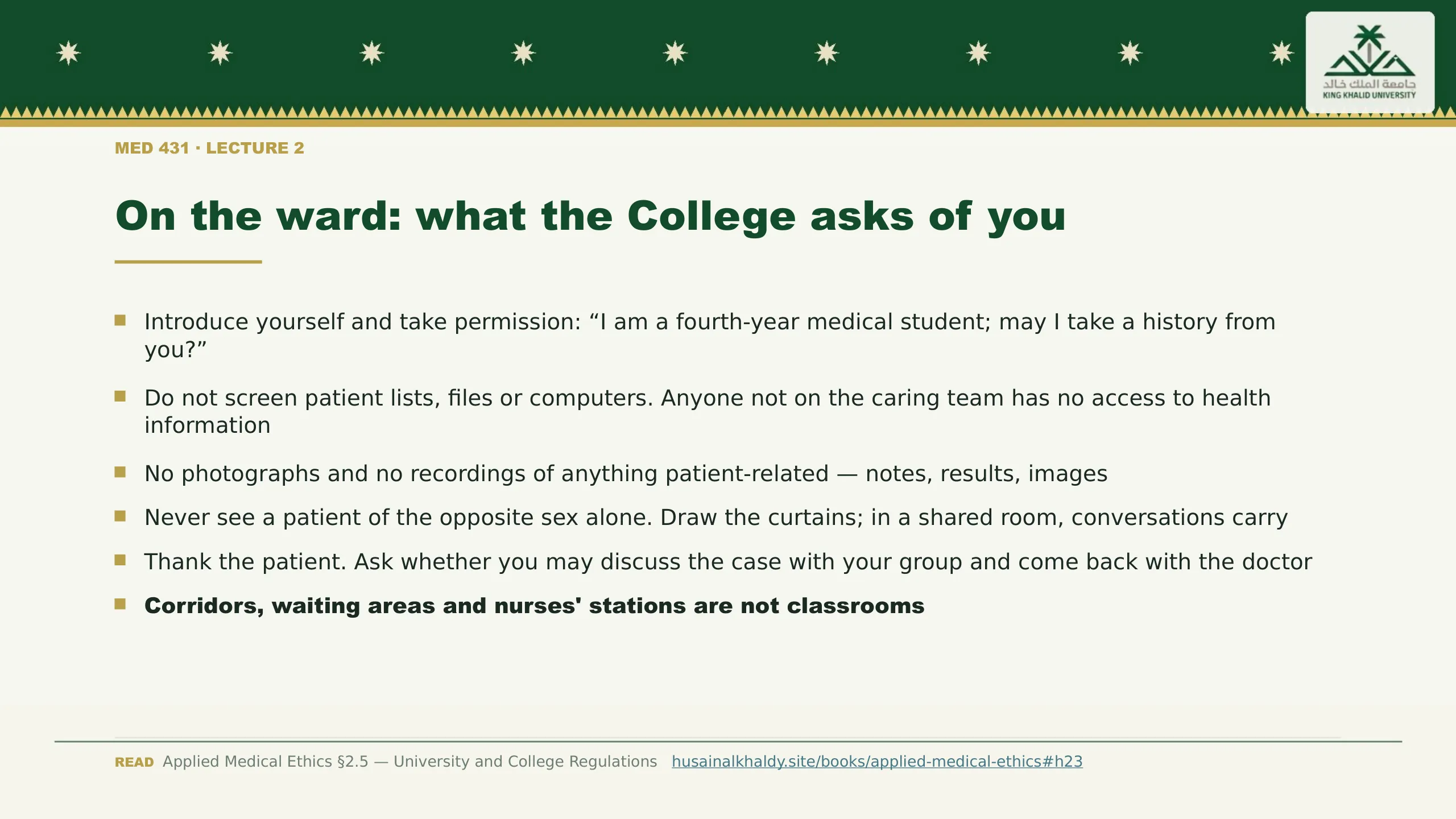
The College's placement guidelines
These are the rules written for the clinical years by the College, for its affiliated hospitals. Read them as the ward version of Chapter 2 of the Code. The introduction is not courtesy alone; the Code requires that a patient knows they are being seen by a trainee, and the permission you ask for is the consent the Law requires before any clinical contact. The prohibition on screening lists and records is confidentiality: you are not on the caring team, and the Law's Article 21 and the Code's Chapter 9 both restrict the record to those who are.
The photograph rule is absolute and often broken. Notes, laboratory results and images are patient information, and a photograph of a whiteboard in the background of a selfie has ended more than one placement. Case 2.2 in the book is exactly that. The rule about not seeing a patient of the opposite sex alone is both the Code's Chapter 7 and the hospital's protection of you; a watcher present at the bedside is usually enough if the patient agrees.
The last line is the one the guidelines spend most words on. Corridors obstruct patient transfer, waiting areas belong to patients, and the nurses' station and oncology unit are restricted. There are classrooms for discussion; use them.
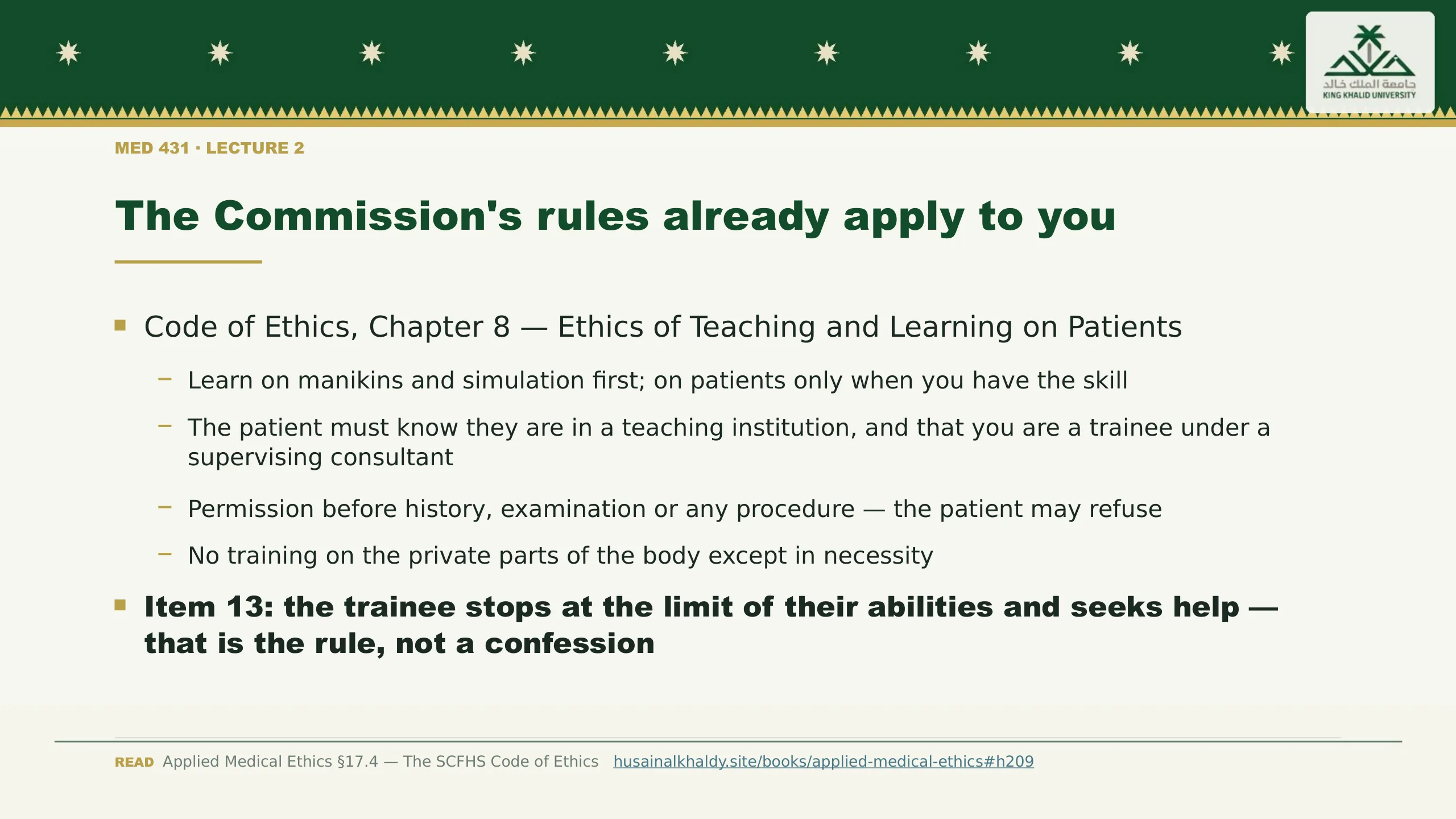
Chapter 8 of the Code, written for you
The Code's chapter on teaching and learning on patients has thirteen items, and they divide between the trainee and the teacher. Yours are the first five and the last: learn on models and simulation before patients wherever that is possible; make sure the patient knows they are in a teaching institution and that you are a trainee under a consultant who remains responsible; take permission before history, examination or any procedure, and accept a refusal; respect privacy, dignity and secrets; and never train on the private parts of the body except in necessity, and then with the alternatives exhausted.
The teacher's items protect you as much as the patient. A teacher must not harm the patient in the course of teaching, must not over-examine one patient in a short time, must be a role model, and, in item 11, must not blame, scold or rebuke a trainee in front of a patient. If that happens to you, the Code is on your side.
Item 13 is the one to memorise. The trainee is responsible for stopping at the limit of their abilities and seeking help from those more knowledgeable. The book's chapter on the intern says the same: “I need supervision for this” is a mark of professional maturity. It is also, under the Code, a duty.
What a disciplinary record does
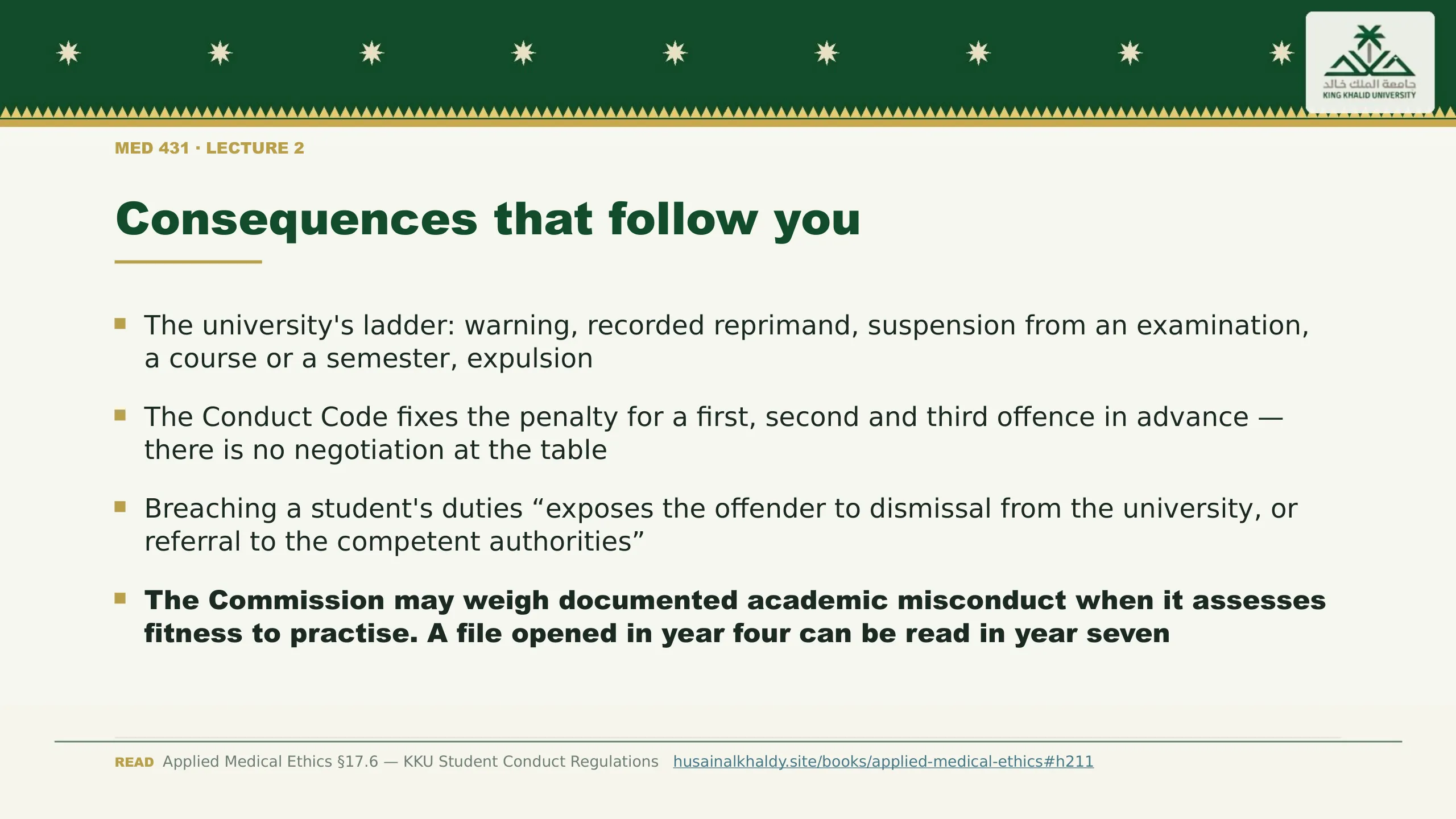
The book describes the university's graduated system: a warning, informal or formal; a recorded reprimand entered in the academic file; suspension from an examination, a course or a full semester; and expulsion for serious or repeated violations. The Conduct Code turns that ladder into tables, one per class of violation, with the penalty for each repetition written down. The committee that hears your case applies the table; it does not bargain.
The sentence quoted on the slide is from the Code's chapter on student duties, and it is the university's own statement of what a breach can cost: dismissal, or referral outside the university. The last line is the book's, and it is the one to carry into the next part of the lecture. The Commission licenses on character as well as on knowledge. Article 2 of the Law refuses a licence to anyone convicted of a crime against honour or honesty, and the book records that a documented history of academic misconduct may be weighed when fitness to practise is assessed. The medical student who copies in an examination is practising a version of the doctor who falsifies a record, and the regulatory system is built to notice the resemblance.
The intern

Part two
The internship year is the hinge of the whole regulatory structure. It is the point at which the university's rules stop and the Commission's and the Ministry's begin, and the intern lives in both worlds at once: a graduate to the university, a trainee to the Commission, an unlicensed person to the Law.
The intern's legal position
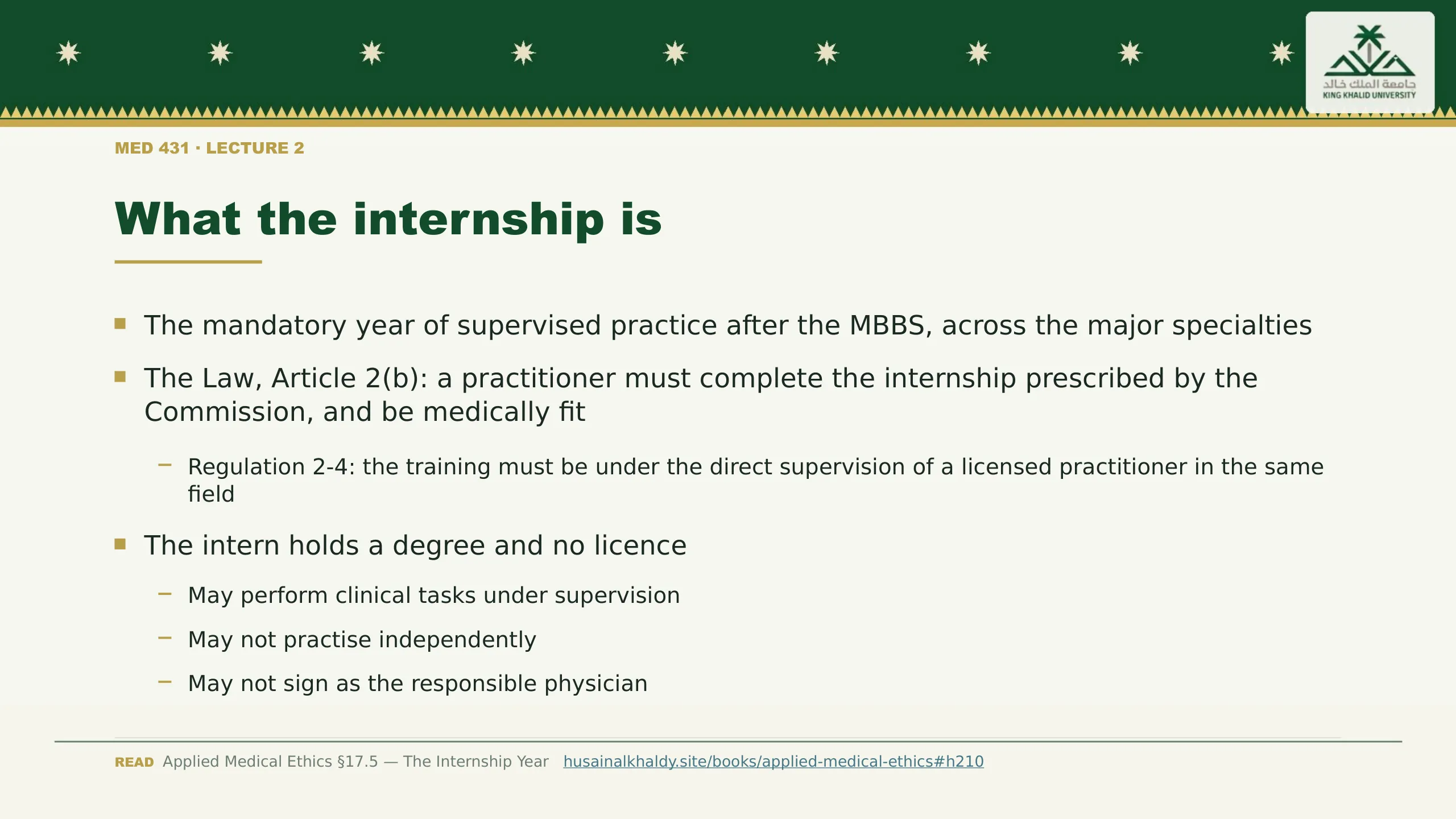
The internship is not a university course and not employment. It is the “mandatory internship prescribed by the Commission” in Article 2(b) of the Law, one of the four conditions of a licence, and Regulation 2-4 adds the condition that makes it what it is: the training must be under the direct supervision of a licensed practitioner in the same professional field. Supervision is not a courtesy extended to interns; it is the legal basis on which they touch patients at all.
From that follow the three limits on the slide. An intern may perform clinical tasks under supervision, may not practise independently, and may not sign a clinical document as the responsible physician. The signature matters because, as the next slides show, responsibility in the Law runs through the licensed practitioner and the institution, and an unlicensed signature has no place to rest.
Medical fitness is the condition students forget. Article 2(b) pairs it with the internship, and the Commission's registration requires it. It is also the reason the internship offices of every medical school require medical clearance and vaccination before the first rotation.
What the intern owes, and who answers for the intern
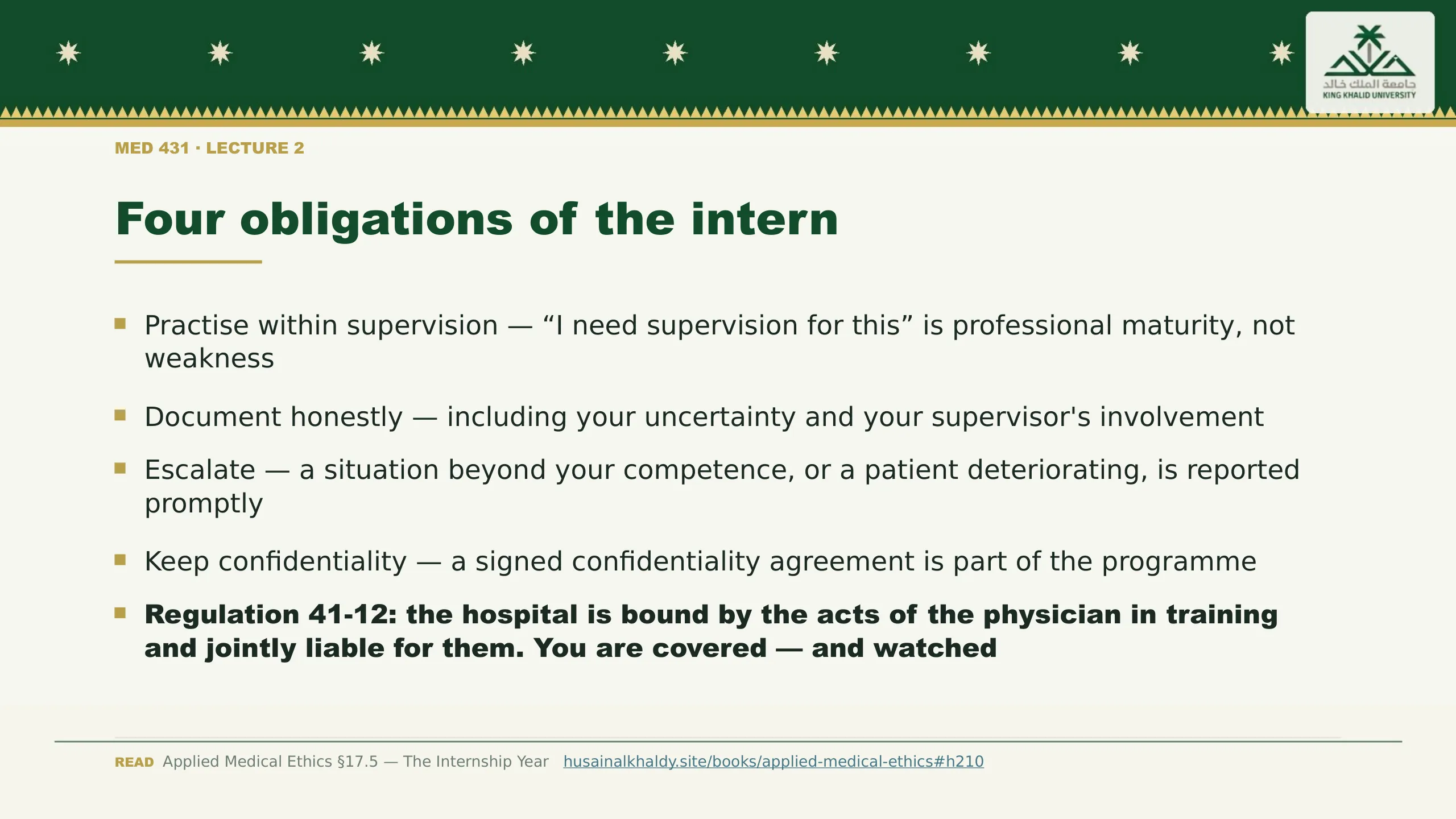
The book's four obligations are the practical form of Chapter 8, item 13 of the Code. Supervision is asked for, not avoided. Documentation records what you did not know and who was involved, because a record that reads as if a consultant saw a patient he did not see is a false record. Escalation is prompt because the intern is, by definition, the person least able to manage a deteriorating patient alone. Confidentiality is signed for, because the intern has for the first time full access to the record.
The last line is the Law's answer to a question interns rarely ask: if I make an error, who pays? Regulation 41-12 says the health institution is bound by the acts of the physician in training and jointly liable to third parties for the trainee's malpractice. That is the protection the internship gives you, and it is conditional on the supervision that defines it. An intern who practises outside supervision has stepped outside the arrangement that covers them.
Chapter 2 of the book opens with Libby Zion, who died in 1984 under exhausted, lightly supervised junior trainees. The reforms that followed were about supervision. So is Regulation 2-4.
The Commission's three verbs
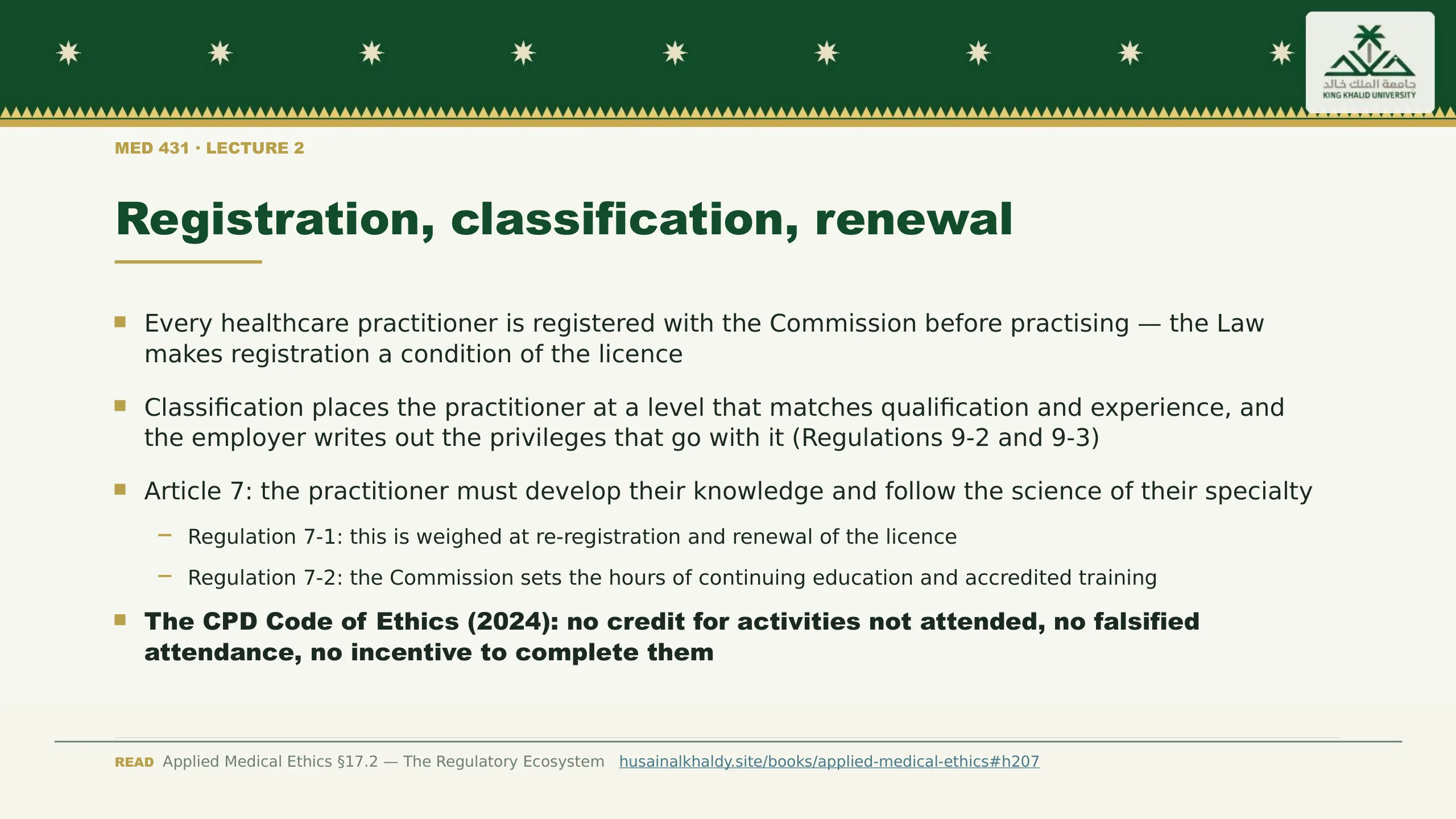
The Commission registers, classifies and renews. Registration is the gate: Article 2(b)(3) of the Law makes it a condition of the licence, and Regulation 2-7 refuses even the appointment of a contracted practitioner to a government facility until classification and registration are complete. Classification sets the level, and the Law gives it teeth in Regulation 9-2: the practitioner works within the privileges and job description that follow from the Commission's classification, and Regulation 9-3 requires the employer to write those privileges down. Case 17.4, the joint injection, turns on exactly that written list.
Renewal is where continuing education stops being a slogan. Article 7 makes developing one's knowledge a duty of the practitioner and a duty of the facility to facilitate. Regulation 7-1 says it is taken into account at promotion, re-registration and renewal of the licence; Regulation 7-2 leaves the hours and the kinds of course to the Commission. The Commission's 2024 CPD Code of Ethics then closes the obvious loophole: a participant may not seek credit for an activity not attended, may not falsify attendance, and may not accept an incentive to complete one. Attendance fraud in year four and CPD fraud in year twenty are the same offence at different ages.
The practitioner
Part three
This is the longest part, and it is the part you will need for the rest of your working life. The Law of Practicing Healthcare Professions is short, forty-four articles, and it is on Blackboard in English and in Arabic with its implementing regulation. Read it once, in full, before you graduate. Very few of your colleagues have.
Three bodies, three jobs
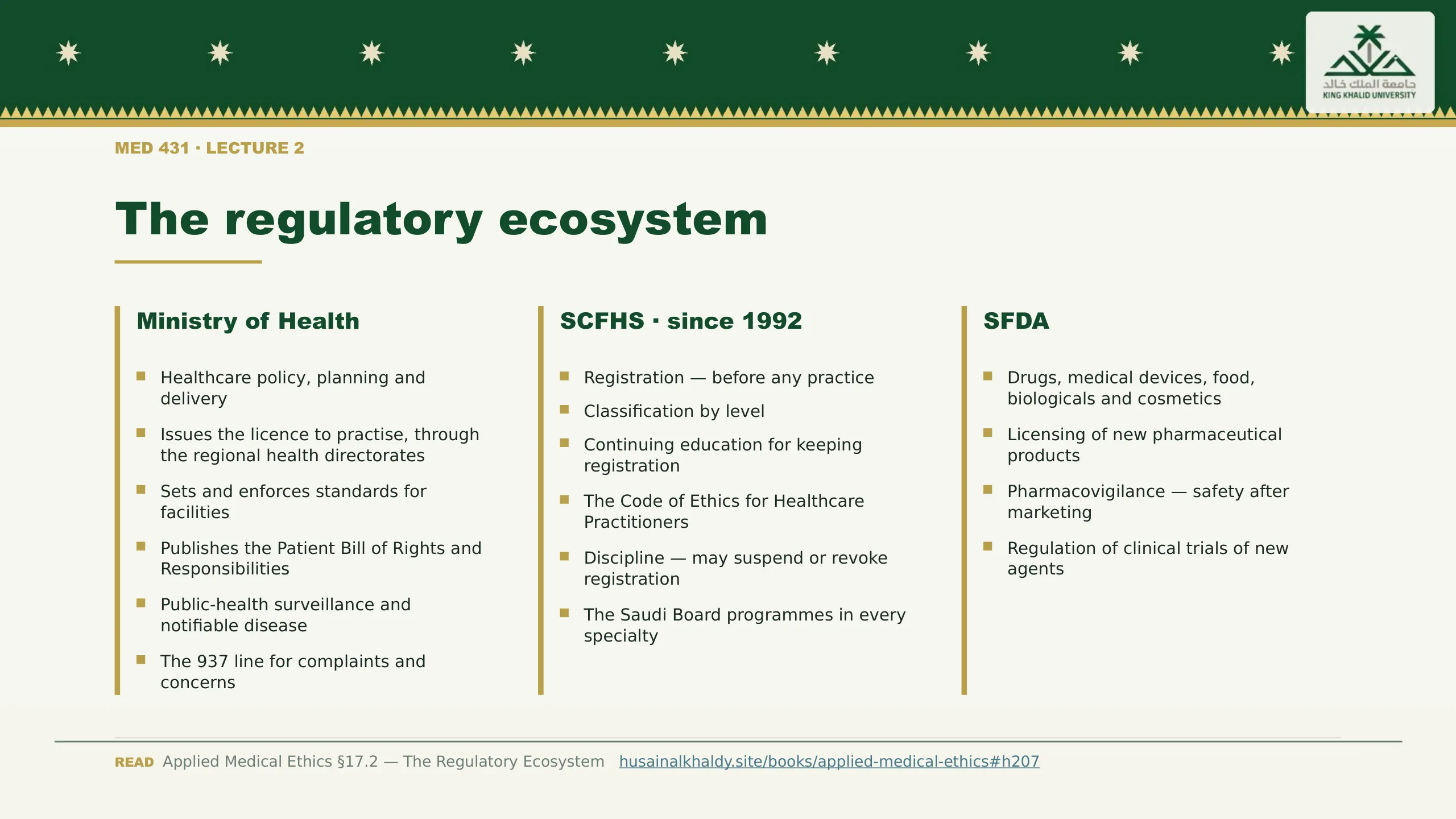
Students conflate the Ministry and the Commission, and the Law itself keeps them distinct. The Ministry licenses; Article 2 says the licence comes from the Ministry, and Regulation 2-1 places it in the regional health affairs directorates. The Commission registers and classifies, and the licence depends on that registration. The Ministry also runs most public hospitals, sets facility standards, and publishes the Patient Bill of Rights, which is why the complaint in Case 17.3 goes to a health directorate and not to the Commission.
The Commission, established in 1992, is the profession's regulator. It owns the Code of Ethics, the Saudi Boards, the continuing-education requirement, and the disciplinary power to suspend or revoke registration. The Food and Drug Authority is the third body, and the one you will meet least as a clinician: it licenses medicines and devices, watches their safety after marketing, and regulates the clinical trials that Chapter 13 of the book returns to.
The statute, and how to read it
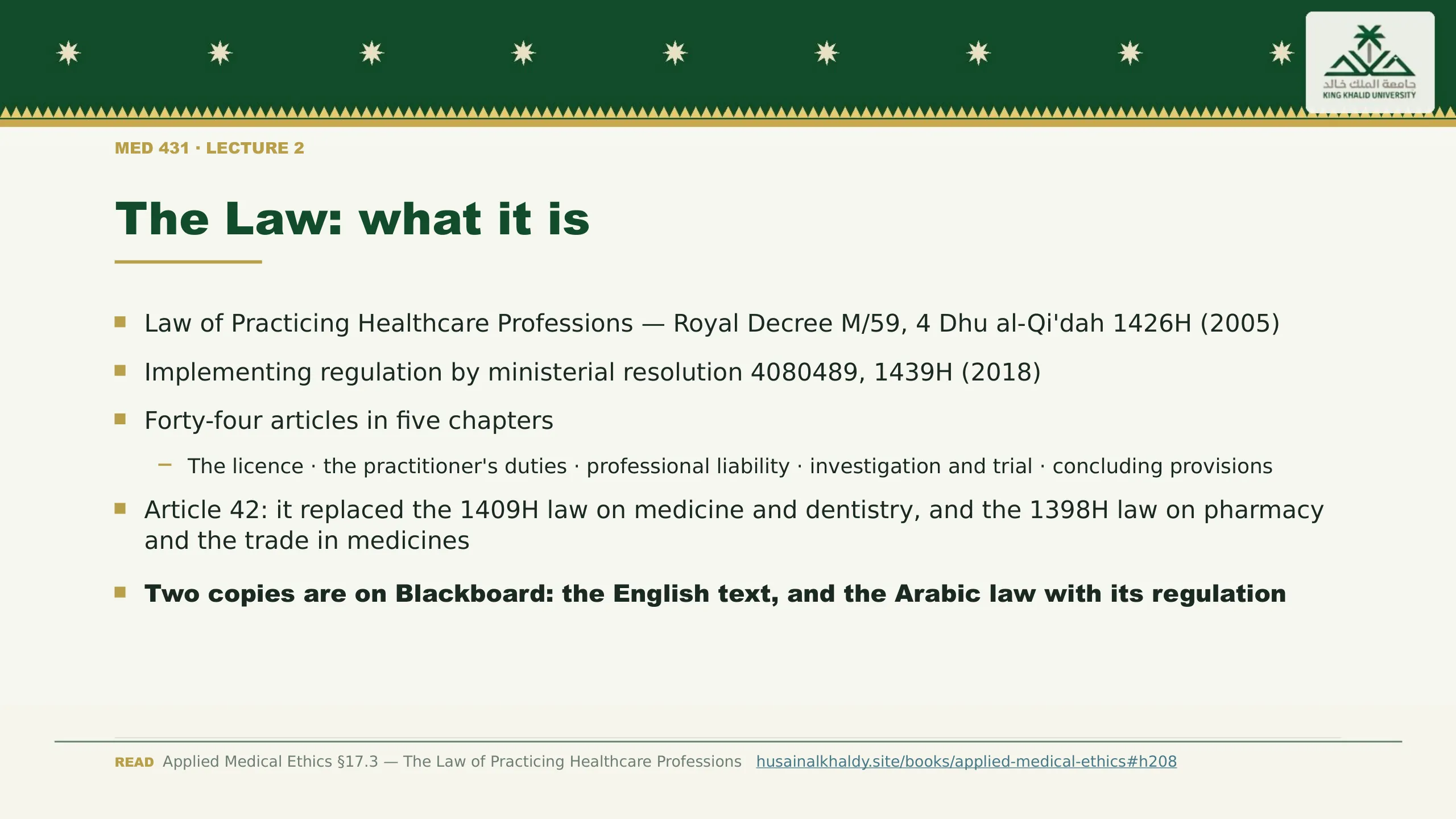
The book's opening to Chapter 17 puts it in one sentence: for most of medical history a physician's conduct in the Muslim world was governed by conscience and the Sharia, and in 2005 the Kingdom found, as every modern state has, that conscience alone was not enough. Royal Decree M/59 is the result. It replaced two older laws, one for medicine and dentistry from 1409H and one for pharmacy from 1398H, and it is the single statute every health practitioner in the Kingdom practises under.
The English edition on Blackboard prints each article followed by the regulation that implements it, numbered 2-1, 2-2 and so on. That is the format to learn: the article states the rule, and the regulation says how the Ministry applies it. When this lecture cites “Regulation 9-2,” it means the second implementing provision under Article 9. The Arabic edition, the third edition of 1440H, is the authoritative text; the English is a translation, and where they differ the Arabic governs.
The article the whole Law hangs on
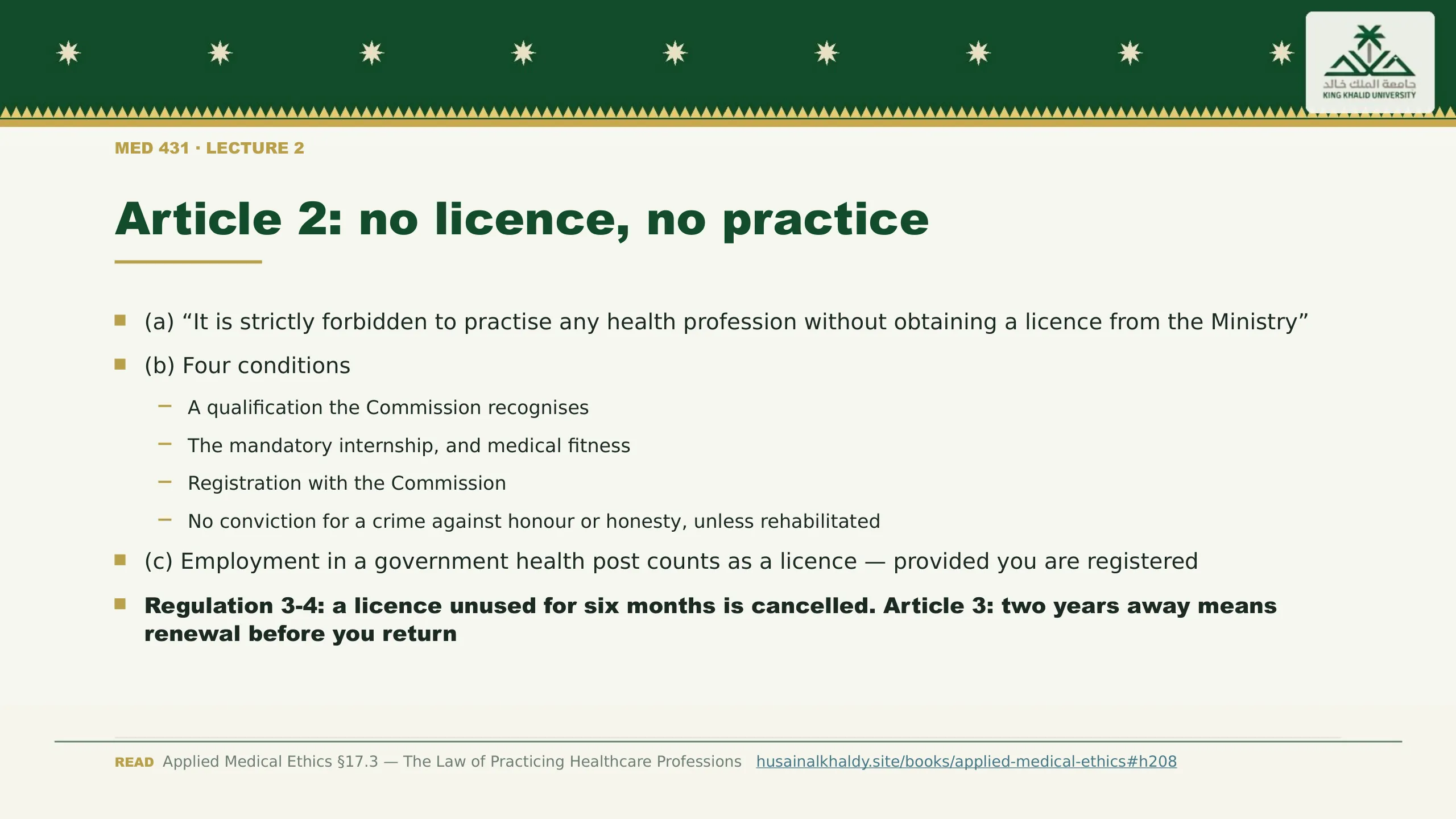
Article 2 does three things. Paragraph (a) is the prohibition, and it is absolute: no health profession may be practised without a licence from the Ministry. Paragraph (b) lists the four conditions, and every one of them is a gate you have already seen on the timeline: the recognised qualification, the internship with medical fitness, registration with the Commission, and a clean record in respect of crimes against honour or honesty, which Regulation 2-10 extends to renewal as well as first grant. Paragraph (c) is the practical route most of you will take: appointment to a government health post is itself the licence, provided registration with the Commission came first.
The licence is not permanent. Regulation 3-4 lists the ways it lapses: six months after issue without actual practice, cancellation of the facility's licence, a change of specialty without the Ministry's approval, a suspension or cancellation by the competent authority, and death. Article 3 adds that a practitioner away from practice for two consecutive years, for reasons other than study or training, may only resume after renewal. Regulation 3-5 requires the renewal application a month before expiry, and Regulation 3-6 makes practising on an expired licence a disciplinary matter. Keep a calendar.
The criminal article
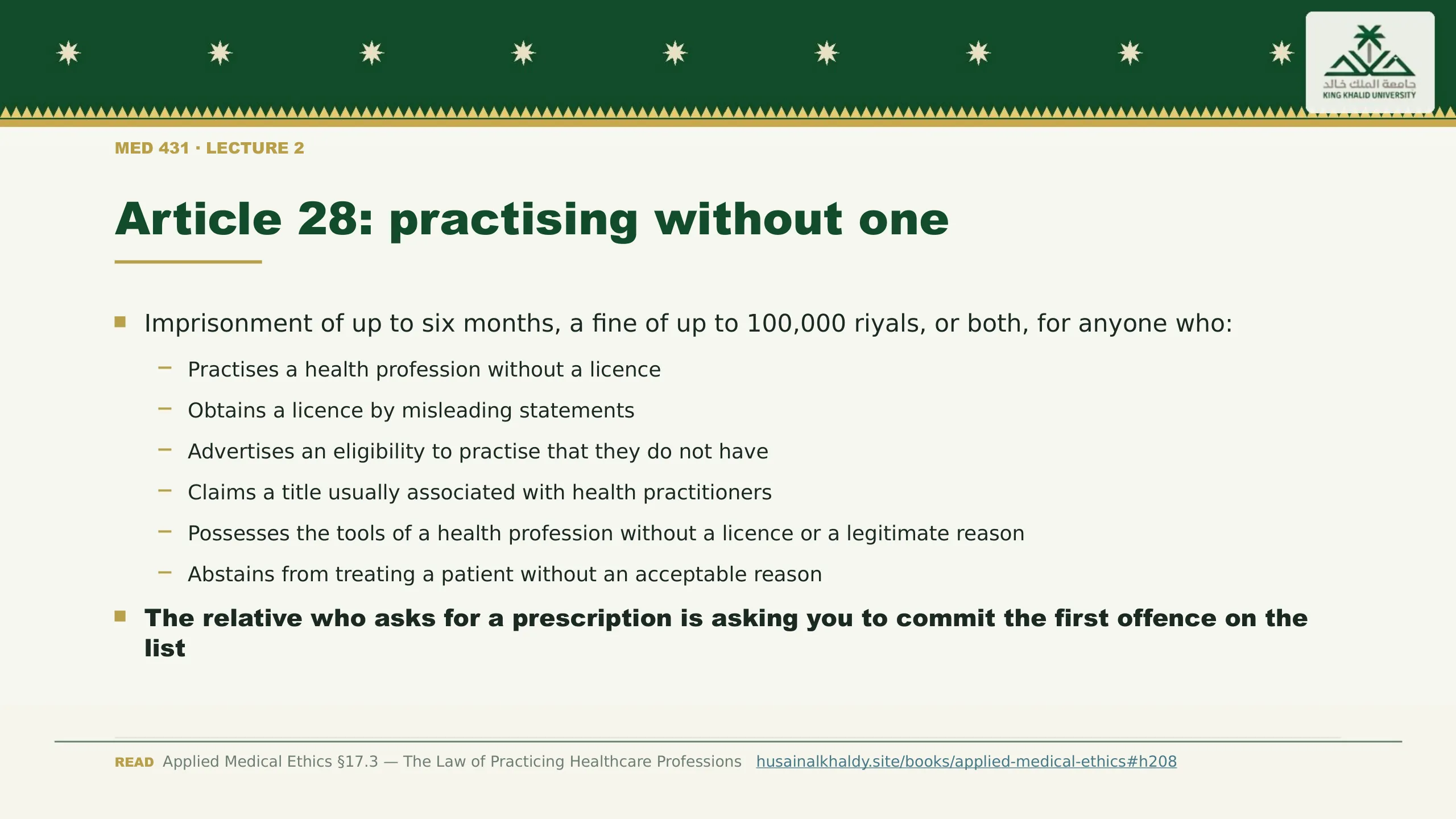
Article 28 is the Law's criminal provision, and it opens with the offence that answers the first of the three situations at the start of the lecture. Practising without a licence carries up to six months' imprisonment, a fine of up to one hundred thousand riyals, or both, without prejudice to any heavier penalty in another law. The graduate awaiting registration who writes a prescription for a relative has practised a health profession without a licence, and the prescription is the evidence.
The rest of the list is worth reading slowly, because two items reach students. Claiming a title usually associated with health practitioners is an offence; a student who lets a patient believe they are a doctor has committed it. Abstaining from treating a patient without an acceptable reason is an offence; Article 8, which requires all possible assistance to a patient in a critical condition, is the duty it enforces. The paragraph also lists breaches of Articles 9, 11, 14, 19, 20, 22 and 24, so that acting beyond one's specialty, failing to report a notifiable disease, and intervening without consent are criminal as well as disciplinary matters.
Chapter 2 of the Law, section 1
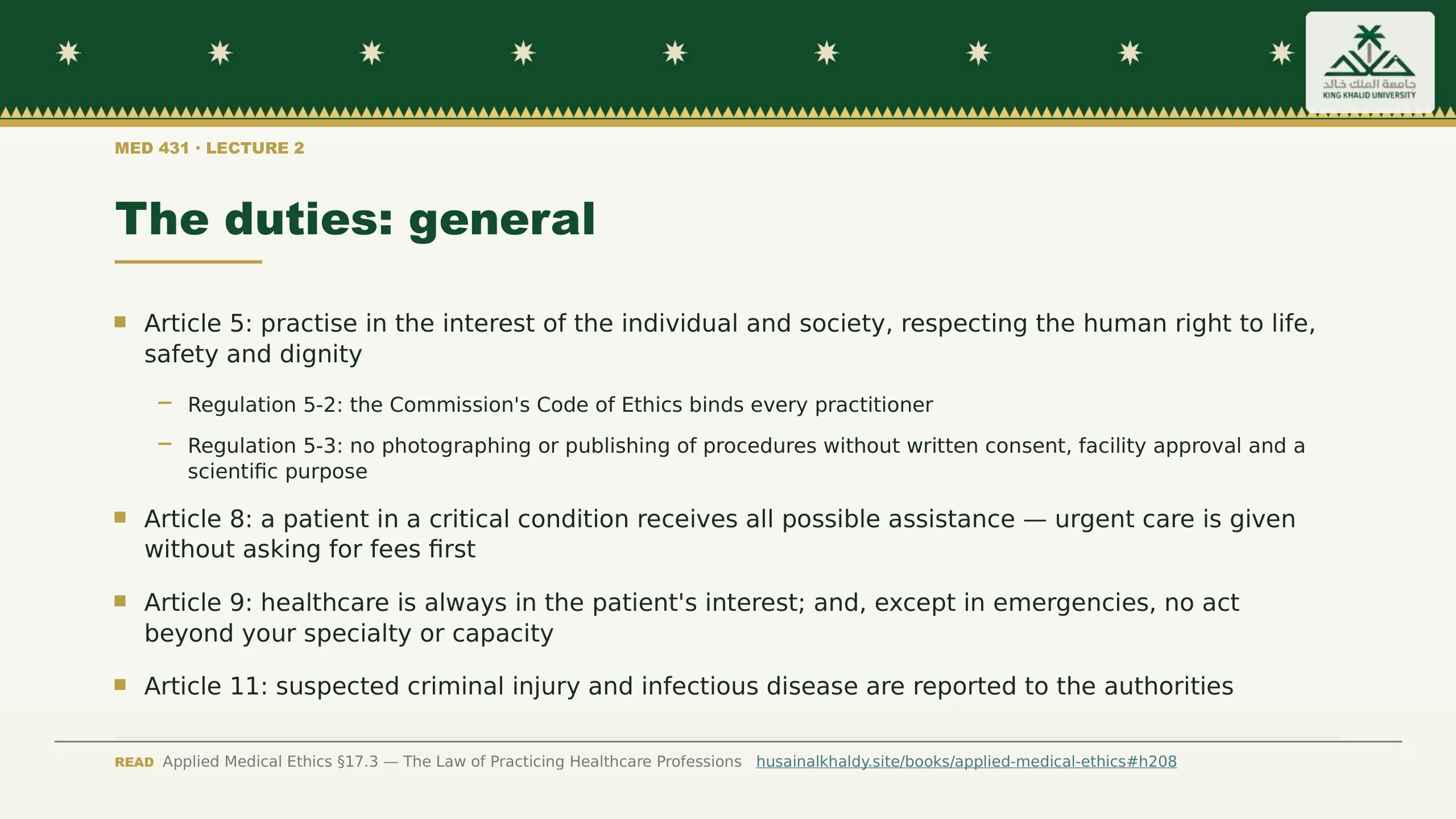
Article 5 is the Law's statement of purpose, and it reads like the four principles written for a court: the interest of the individual and society, the human right to life, safety and dignity, the customs of the Kingdom, and no exploitation. Its second regulation is the hinge between this lecture's two halves. Regulation 5-2 makes the Commission's Code of Ethics binding on every practitioner, which is why the Code is law and not advice. Regulation 5-3 is the rule behind the photograph prohibition you met on the ward: no photographing or publishing of surgery or treatment without the patient's written consent, the facility's approval, a recognised scientific purpose, and no offence to public morals.
Article 8 is the duty of rescue. A practitioner who learns of a patient in a critical condition provides all possible assistance or ensures they receive it, and Regulation 8-1 forbids asking for fees before urgent care. Article 9 pairs the patient's interest with the scope rule: except in emergencies, no act beyond one's specialty or capacity, with the privileges written down under Regulations 9-2 and 9-3. Article 11 is the reporting duty for suspected criminal injury and for the diseases the Minister designates as notifiable, which Chapter 16 of the book returns to in week 10.
The things a practitioner may not do
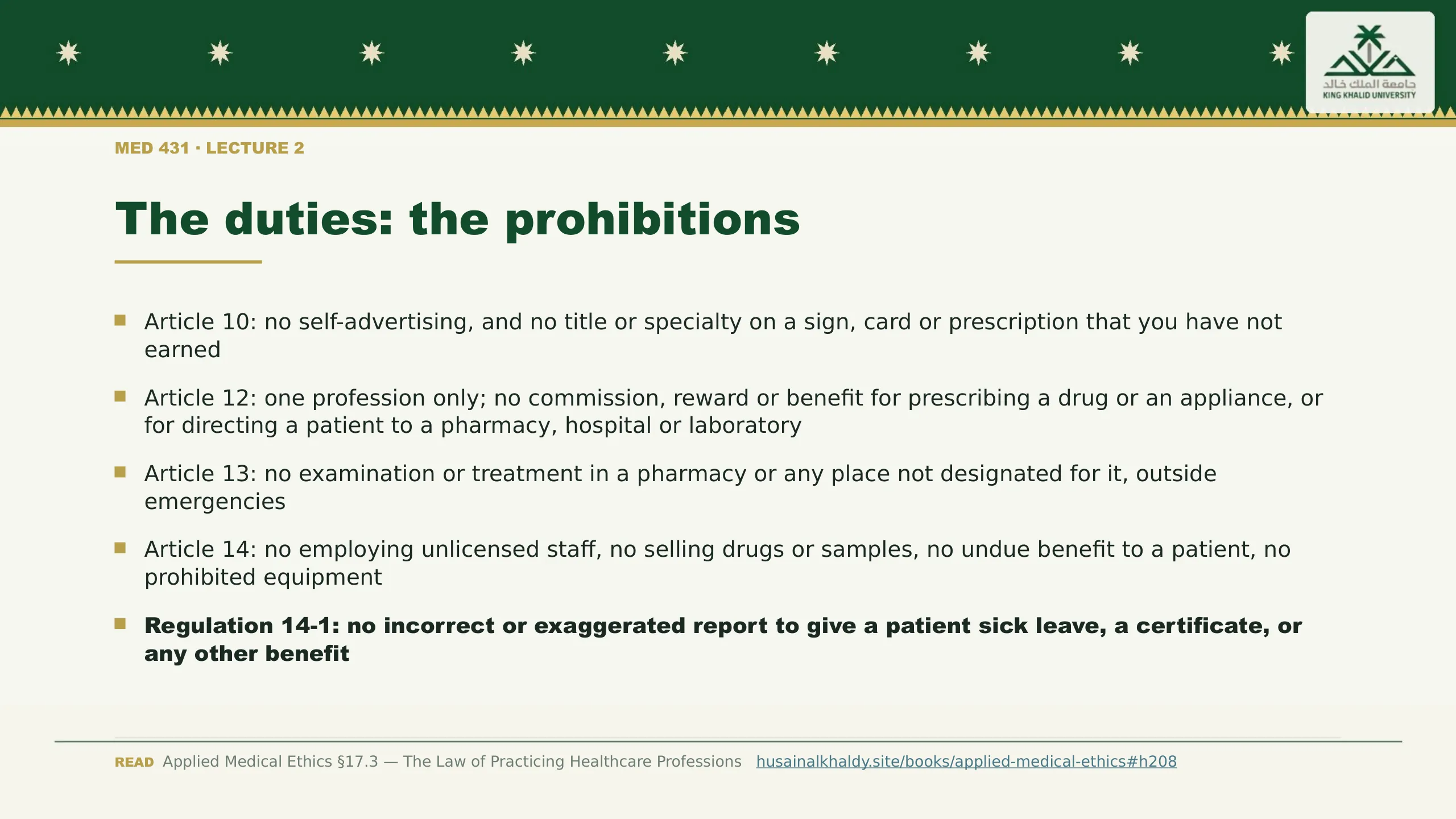
Articles 10 to 14 are the Law's list of prohibitions, and they anticipate Chapter 18 of the book on the pharmaceutical industry and the private sector. Article 10 forbids self-promotion and the display of any title or specialty not obtained under the rules; the Regulation allows what the private-institutions law allows and nothing of a commercial nature. Article 12 is the anti-kickback article: one profession only, and no commission, reward or benefit of any kind for prescribing a drug or appliance or for steering a patient to a particular pharmacy, hospital or laboratory. Regulation 12-2 names the pharmaceutical and equipment companies explicitly.
Article 14 collects the rest: no employing or assisting the unlicensed, no keeping drugs contrary to instructions, no selling drugs or samples, no facilitating an undue benefit for a patient, and no prohibited equipment. Regulation 14-1 is the one to underline, because it is the article that reaches sick notes. An incorrect or exaggerated report written to give a patient sick leave, a health certificate or any other benefit is a violation of the Law, and the Code's Chapter 9 says the same about signing any document thought to be false or misleading. Article 29 attaches a fine of up to fifty thousand riyals to breaches of Articles 10, 12, 13 and most of 14.
Section 2 of the duties chapter, in one slide
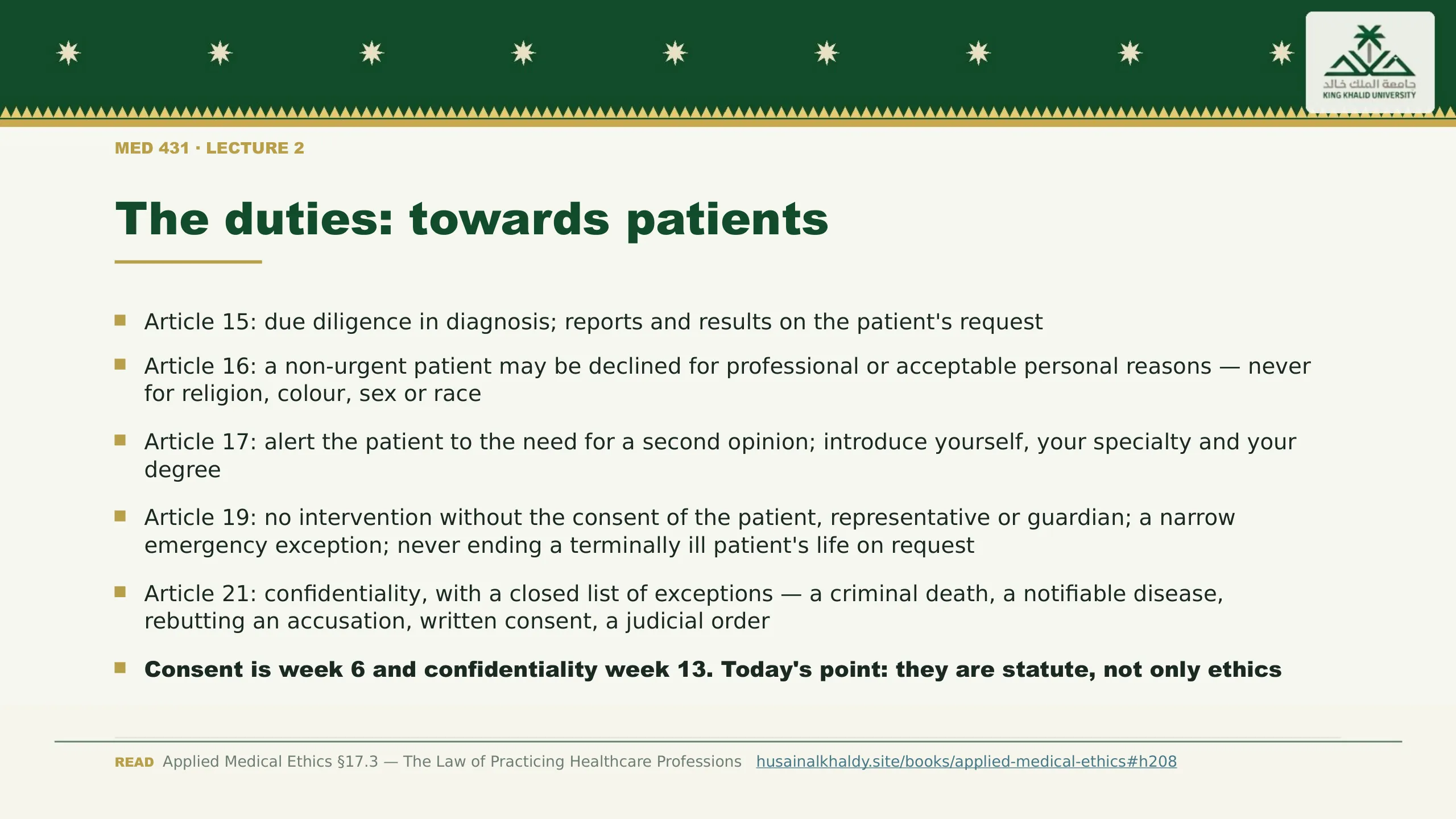
Each line here is a lecture later in the course, and each is anchored in an article you can cite. Article 15 requires due diligence in diagnosis, the use of appropriate technical methods and specialists, and the provision of reports and results at the patient's request. Article 16 allows a practitioner to decline a patient, outside serious or emergency cases, for professional or acceptable personal reasons, and its Regulation refuses any reason based on religion, colour, sex or race, and requires the patient not to be harmed and the treatment plan continued. Regulation 17-1 is the origin of the introduction you practised on the ward: name, specialty and degree at the start of treatment.
Article 19 is the consent article. No medical intervention without the consent of the patient, or of a representative or guardian where the patient is legally incompetent; intervention without consent only in accidents, emergencies and critical cases where delay would cost life, an organ or severe damage and consent cannot be obtained in time; and, in the same article, an absolute prohibition on ending the life of a terminally ill patient, whoever asks. Article 21 is the confidentiality article, and its exceptions are a closed list. Week 6 and week 13 will take each apart. For today, notice that they are in the statute, with Article 28 behind them.
Section 3: professional courtesy
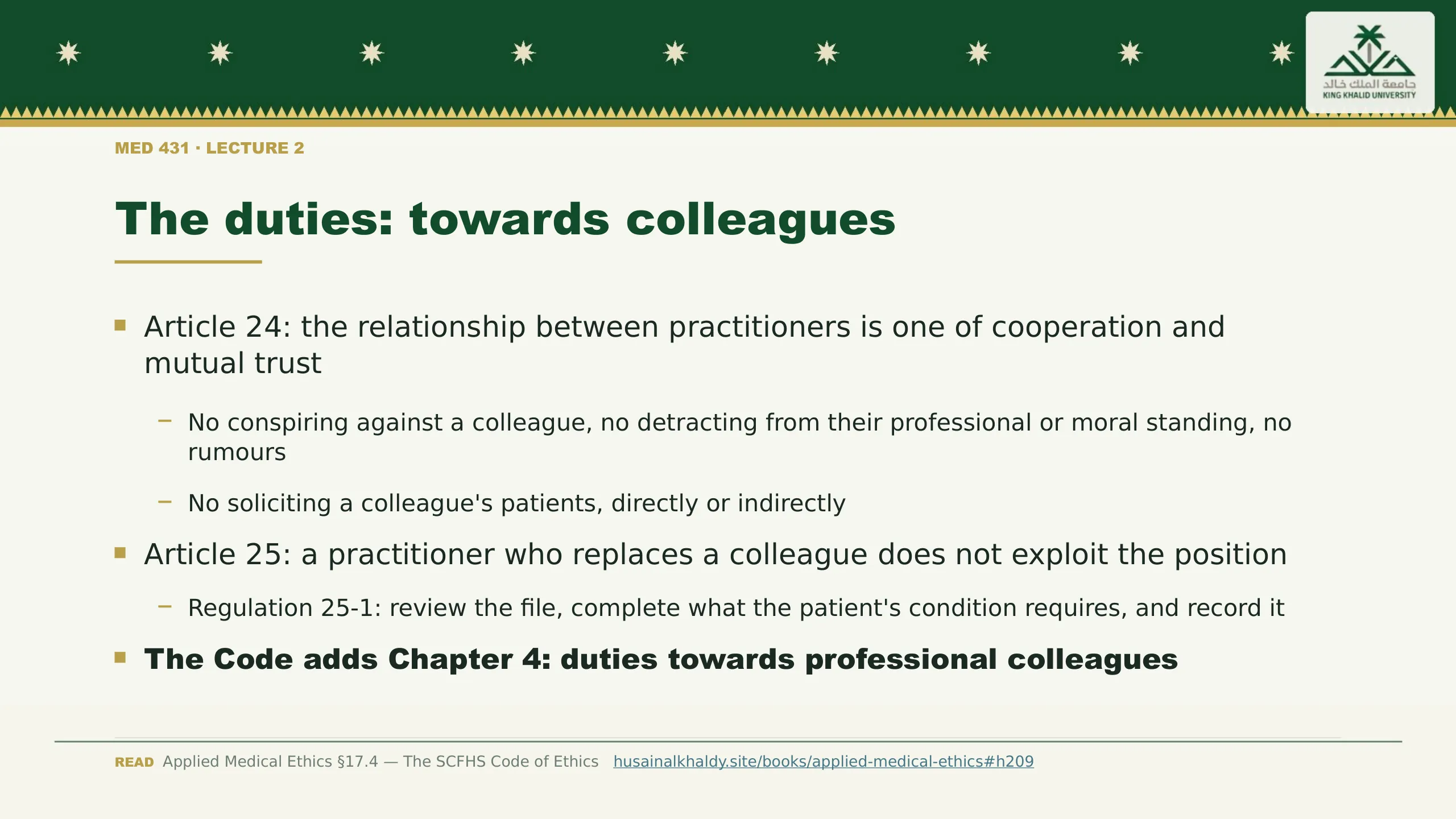
The Law's shortest section is the one students expect to be ethics alone. Article 24 makes cooperation and mutual trust the legal basis of the relationship between practitioners, and then lists what breaks it: conspiring against a colleague, detracting from their professional or moral standing, spreading rumours, and soliciting or dissuading a colleague's patients. Article 25 governs the practitioner who takes over a colleague's patient, and Regulation 25-1 turns it into a procedure: review the file and the procedures already begun, complete what the patient's condition requires, and record it.
The Code's Chapter 4 fills in what the Law leaves out, including the duty the book stresses in Chapter 2 and Chapter 3: to report unsafe or unethical conduct through the proper channels. Article 24 is not a rule of silence. Detracting from a colleague's standing by rumour is forbidden; reporting a colleague's unsafe practice to the people responsible for patient safety is required. The difference between the two is the channel, and the Code names it.
Chapter 3 of the Law
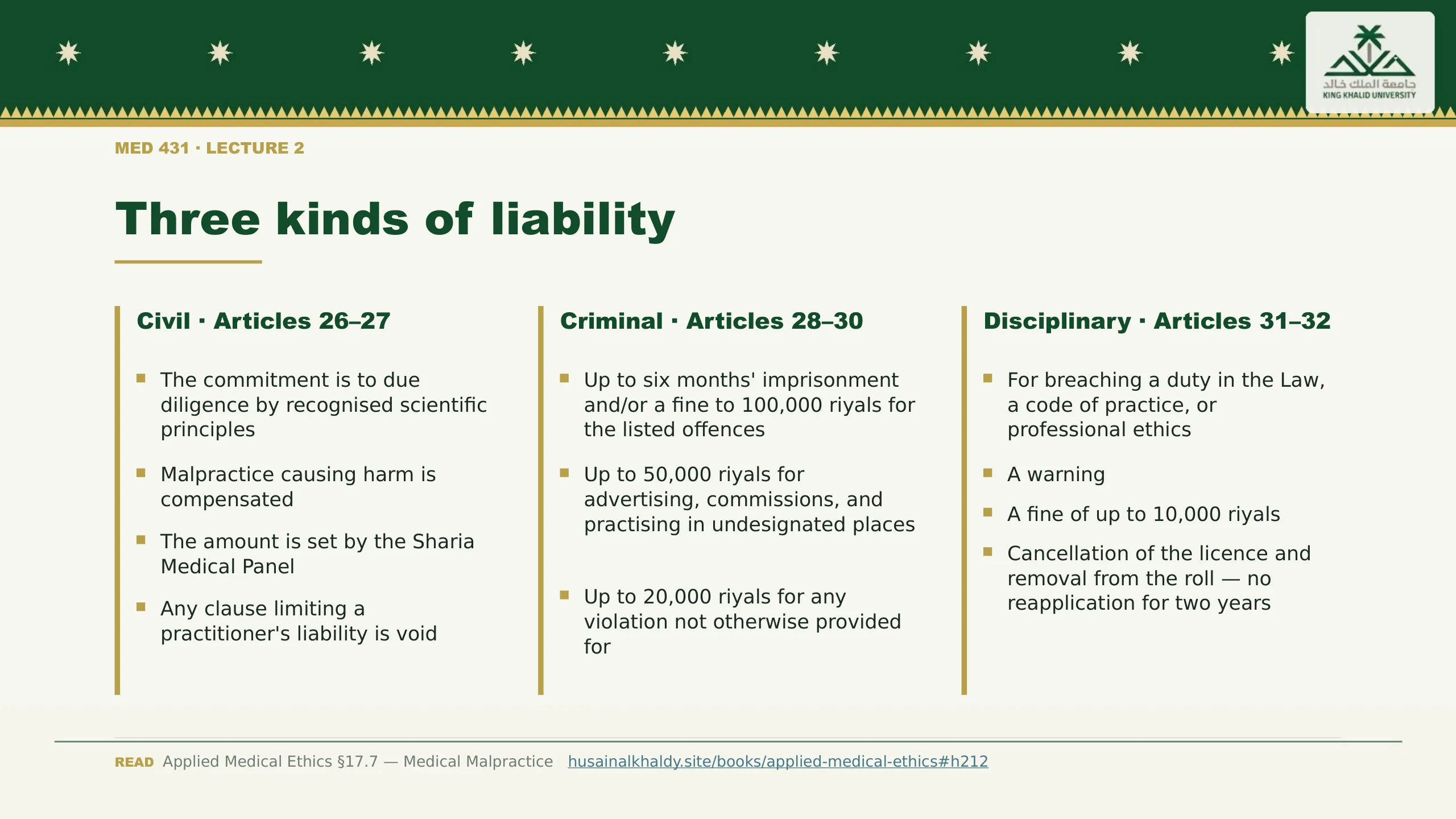
One act can engage three liabilities at once, and the Law says so in Article 31: disciplinary liability is “without prejudice to the provisions of criminal or civil liability.” Civil liability is compensation. Article 26 defines the practitioner's obligation as a commitment to due diligence consistent with recognised scientific principles, not a guarantee of cure; Article 27 makes the practitioner who commits malpractice causing harm liable to indemnify the patient, with the amount fixed by the Sharia Medical Panel, and it voids any clause that limits that liability, so a consent form cannot waive it.
Criminal liability is punishment by the state, and Articles 28 to 30 grade it: prison and the larger fine for the listed offences, fifty thousand riyals for the commercial articles, twenty thousand for everything else. Disciplinary liability is the profession's own sanction under Articles 31 and 32, from a warning through a fine to cancellation of the licence, with two years before a new application may be made. The footnotes in the English edition draw the distinction students most often miss: criminal liability requires intent or a defined offence, while civil liability requires only error, damage and a causal link. That link is the subject of the four Ds.
Article 27's list
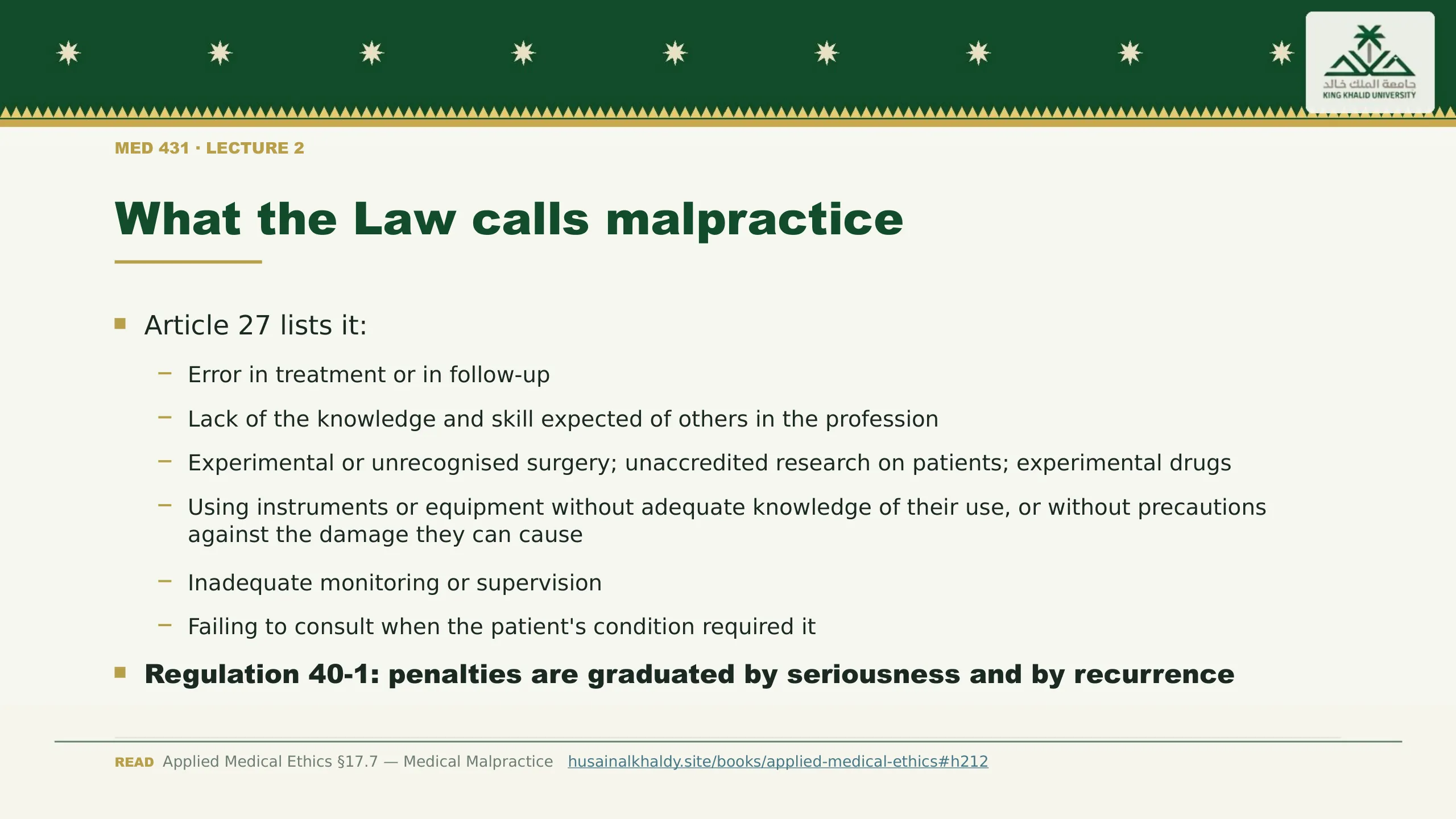
The Law does not leave malpractice to be argued from first principles. Article 27 lists eight forms, and the list is the checklist a Sharia Medical Panel works through. The first two are the ordinary negligence cases: an error in treatment or follow-up, and a lack of the knowledge or skill that others in the profession could be expected to have. The next three are the research and experimentation cases, and they connect this lecture to week 7: experimental or unrecognised surgery, unaccredited research on patients, and drugs administered on an experimental basis, all in breach of the rules that govern them.
The last three are the ones that reach interns and residents most directly. Using an instrument or device without adequate knowledge of it, or without the precautions its use requires, is malpractice; so is inadequate monitoring or supervision; so is the failure to consult when the patient's condition called for it. Notice that the supervision clause cuts both ways: the supervisor who does not supervise, and the trainee who does not call for supervision, are both described here. Regulation 40-1 then instructs the competent authorities to graduate the penalty by the seriousness of the offence and its recurrence, which is why a first minor breach and a repeated serious one sit at opposite ends of Article 32.
The analytical tool
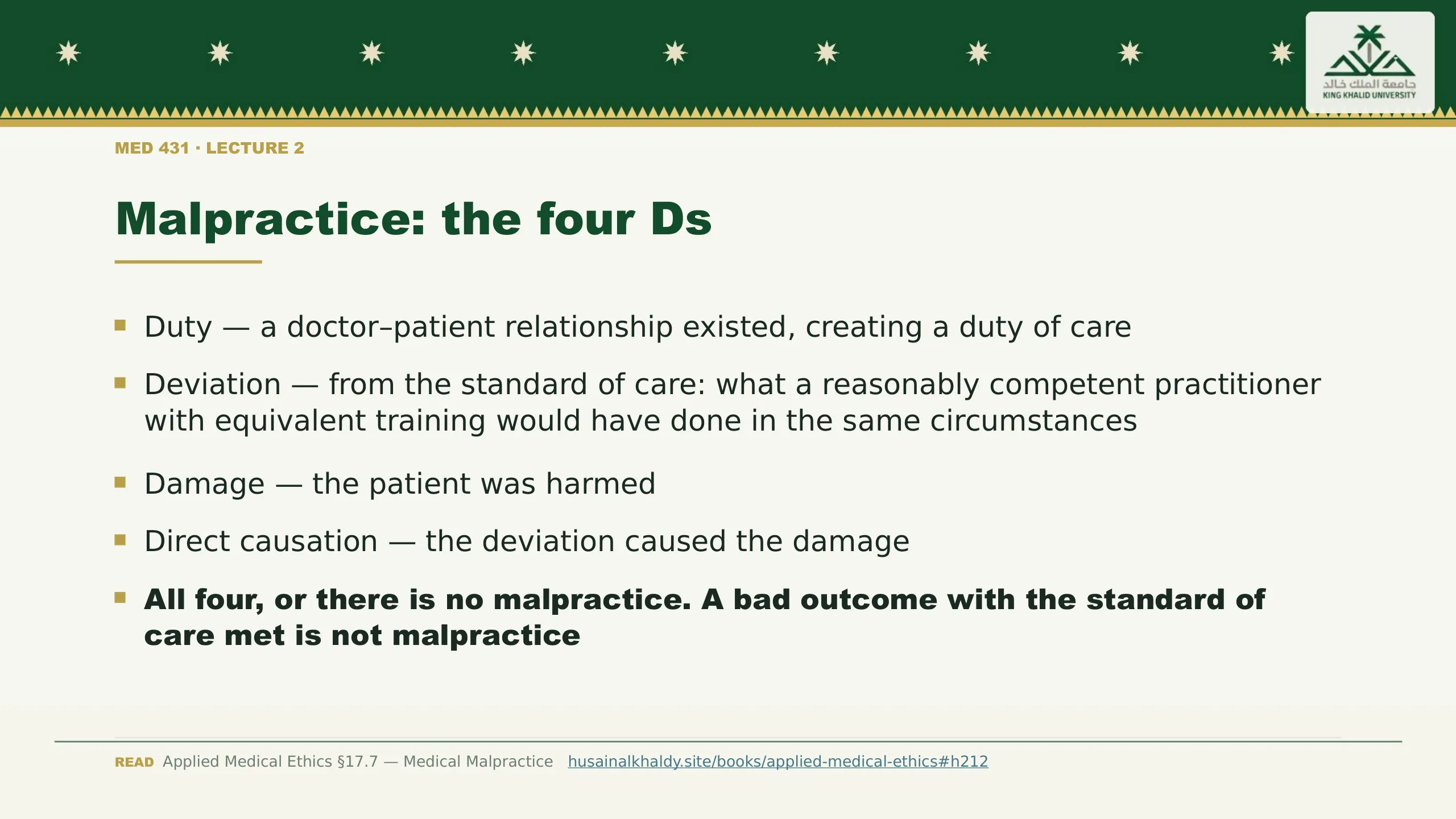
The four Ds are the book's tool for analysing any alleged malpractice, and they map onto the Law. Duty is the existence of a doctor–patient relationship; the Law creates it the moment a practitioner undertakes care, and Article 8 creates it even for the passer-by in a critical case. Deviation is the departure from the standard of care, and the book's definition is the one to learn: what a reasonably competent practitioner with equivalent training would have done in the same circumstances. Article 26 says the same thing in statutory language, due diligence consistent with recognised scientific principles.
Damage is harm to the patient, and direct causation is the link between the deviation and the harm. The footnote to Article 27 in the English edition uses the same three-part test, error, damage and a causal relationship, and adds that the damage must be a direct result of the error. All four elements must be present. A patient who suffers a recognised complication of a properly indicated, properly performed procedure has damage but no deviation, and there is no malpractice. A practitioner who deviates but causes no harm has a disciplinary problem, not a civil one. Case 17.4 asks you to run this test on a joint injection; do it element by element.
Chapter 4 of the Law: the tribunal
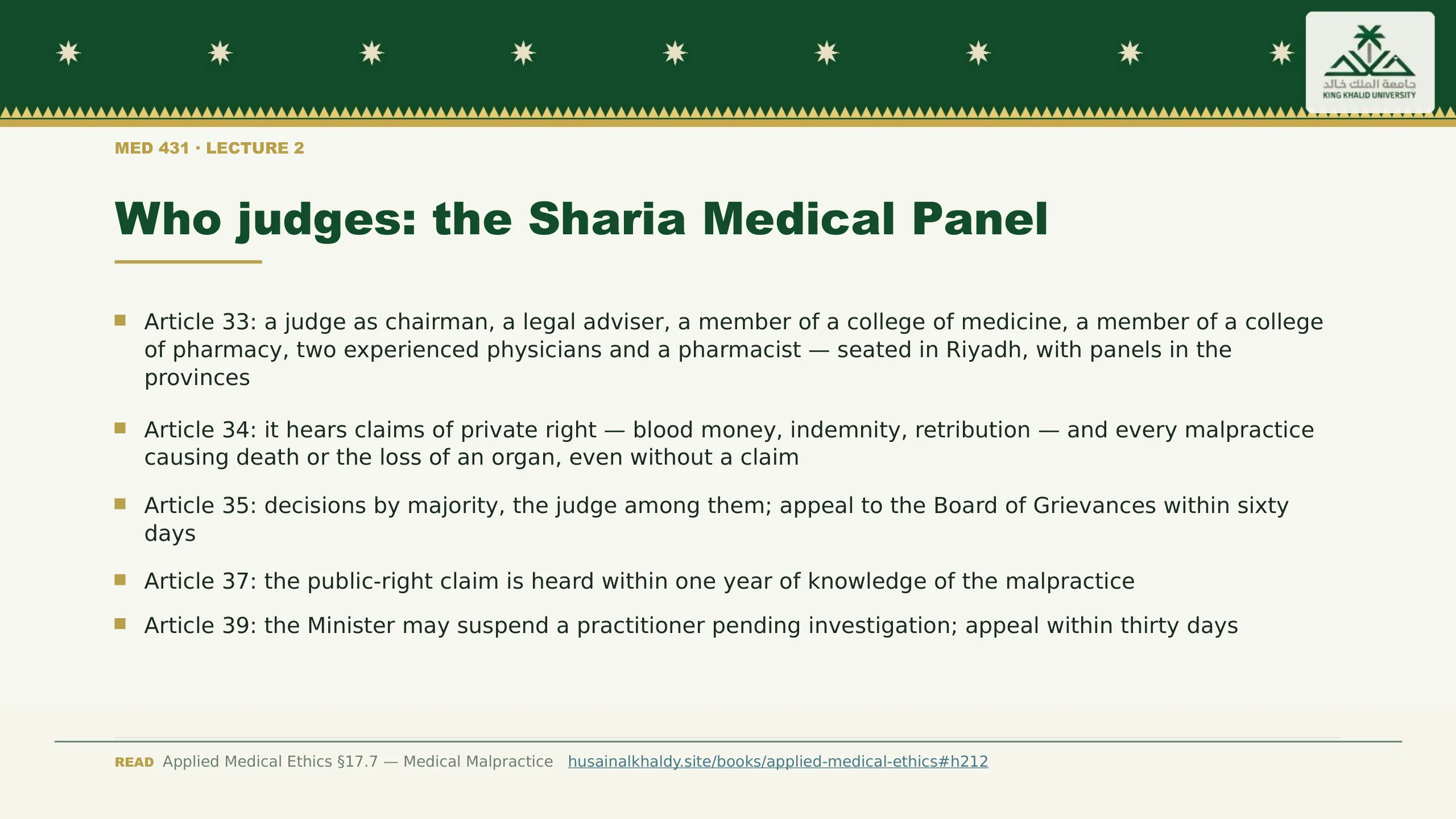
Malpractice in the Kingdom is not tried in an ordinary court. Article 33 creates the Sharia Medical Panel, chaired by a judge designated by the Minister of Justice, with a legal adviser, a faculty member from a college of medicine, one from a college of pharmacy, two experienced physicians and a pharmacist, the pharmacy members sitting only on pharmacy cases. Its seat is the Ministry of Health in Riyadh, with panels in the provinces, and it may call experts. Article 34 gives it two jurisdictions: claims of private right, meaning blood money, indemnity and retribution, and any malpractice causing death or the loss of an organ or its function, which it hears even if no one has claimed.
The procedural articles set the clocks. Decisions are by majority, but the majority must include the judge; appeal lies to the Board of Grievances within sixty days. The public-right claim expires one year after knowledge of the malpractice, which Regulation 37-1 fixes at the date of the investigator's report. Article 38 sends everything outside the Panel's jurisdiction to committees of a legal specialist and a Saudi practitioner, with the same sixty-day appeal, and Article 39 allows the Minister to suspend a practitioner where the evidence points to a violation that would justify revocation, with thirty days to appeal and a duty to keep the practitioner's patients cared for.
Regulation 40, from the practitioner's chair
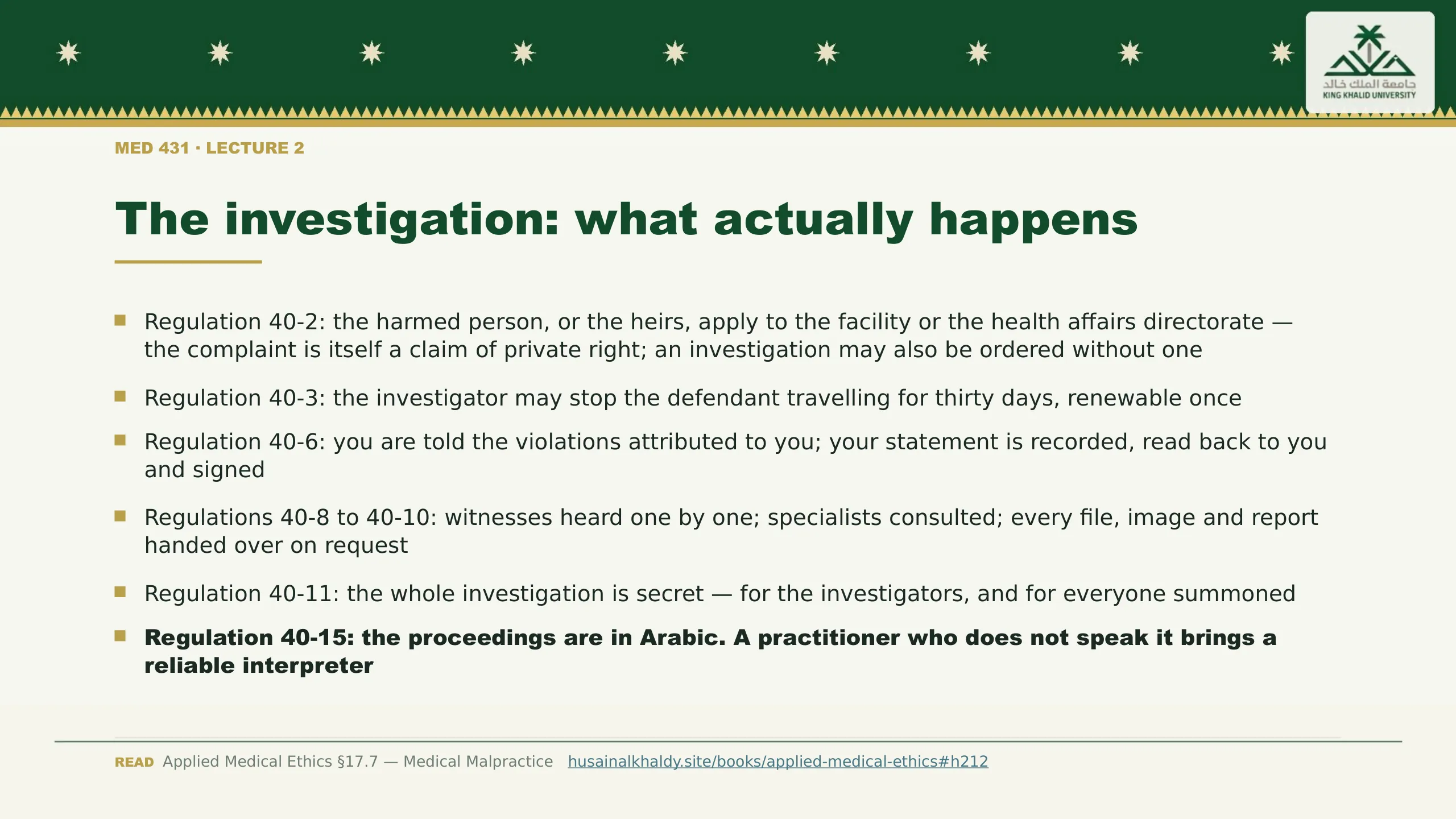
Article 40 delegates the procedure to the implementing regulation, and Regulation 40 is the longest in the Law. Read it once as the person under investigation. The complaint arrives at the facility or the health affairs directorate; it is in itself a claim of private right, and an investigation can be ordered even without one. The investigator, a competent specialist chosen by the directorate, may bar the defendant and the witnesses from travel for thirty days, renewable once by the director. You are notified of the time and place in good time. At your first appearance your personal data are recorded, the violations attributed to you are put to you, your statement is recorded, read back and signed, and you may be confronted with the other parties.
Witnesses are heard individually and sign their statements; specialists report in writing; every party must produce data, files, images and reports on request. The whole of it is secret, on pain of accountability, for investigators and witnesses alike. The investigator's report attributes each violation to its provision and recommends referral to the Panel or a committee, and the file goes with it. Regulation 40-15 is the practical line for a bilingual profession: the Panel works in Arabic, and a practitioner who does not speak it must arrange a reliable interpreter. Regulation 40-7 requires an environment in which the defendant's will to speak is not influenced. That is the protection; the rest is the process.
Article 41
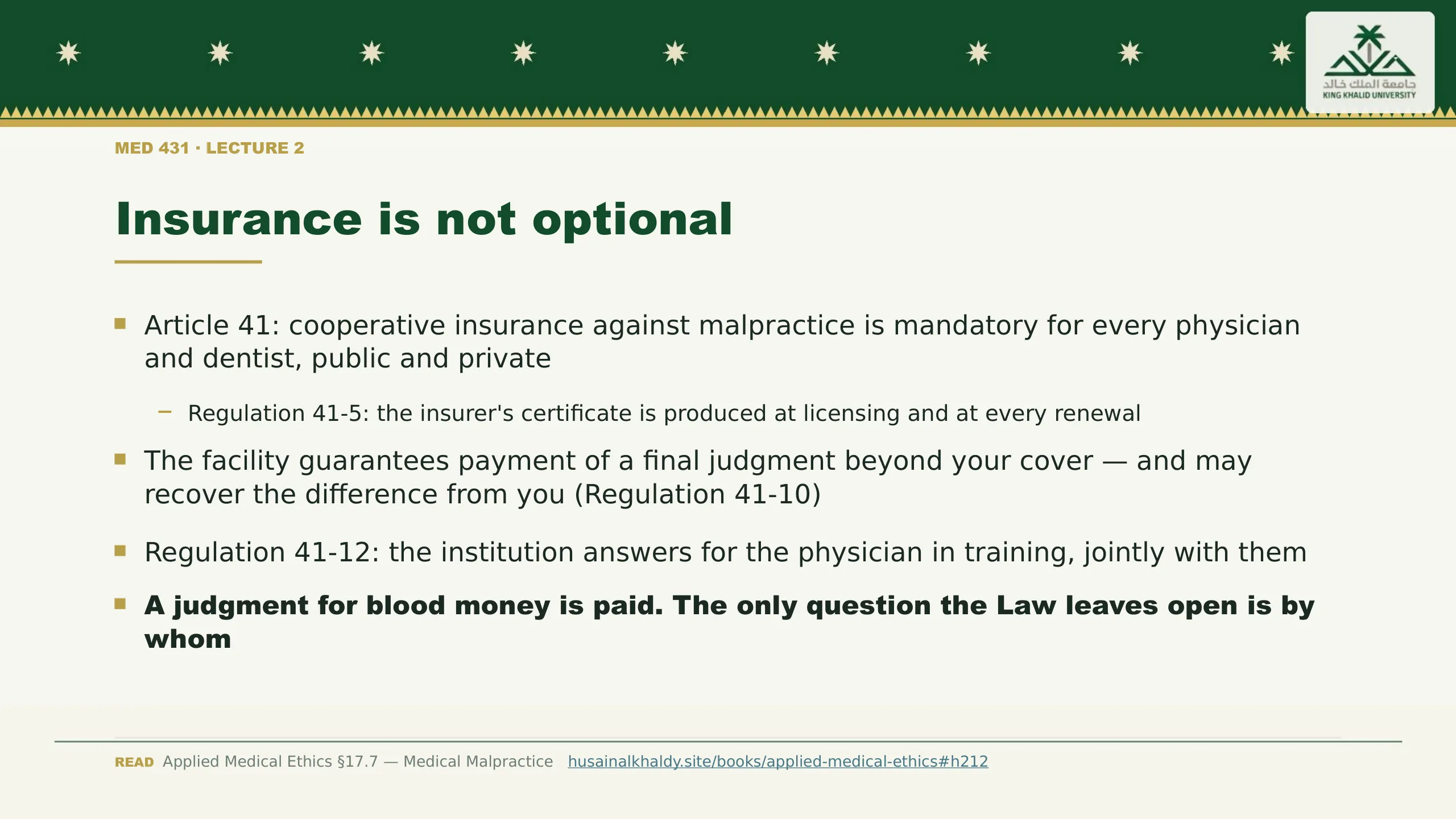
Article 41 makes cooperative insurance against medical malpractice mandatory for all physicians and dentists in public and private institutions, regardless of income or length of service, and Regulation 41-2 requires each to hold a policy with an insurer licensed in the Kingdom. The certificate is produced at licensing and at every renewal under Regulation 41-5, so an uninsured physician is, in practice, an unlicensed one. Cover runs to the value of the private-right claim under a final judgment, for malpractice occurring during the period of cover, whenever the judgment is issued.
Where cover is missing or insufficient, the institution pays, and Regulation 41-10 gives it the right of recourse against the practitioner for what it paid. Where a practitioner works for more than one institution, the one where the malpractice occurred is jointly liable. Regulation 41-12 is the line for interns and residents: the health institution is bound by the acts of the physician in training and jointly liable to third parties for their malpractice. The last line of the slide is the practical summary. Once the Panel has awarded blood money or indemnity, it will be paid; insurance, the institution and the Law's recourse provisions decide only who pays it, and the answer can be you.
The Code, and its status
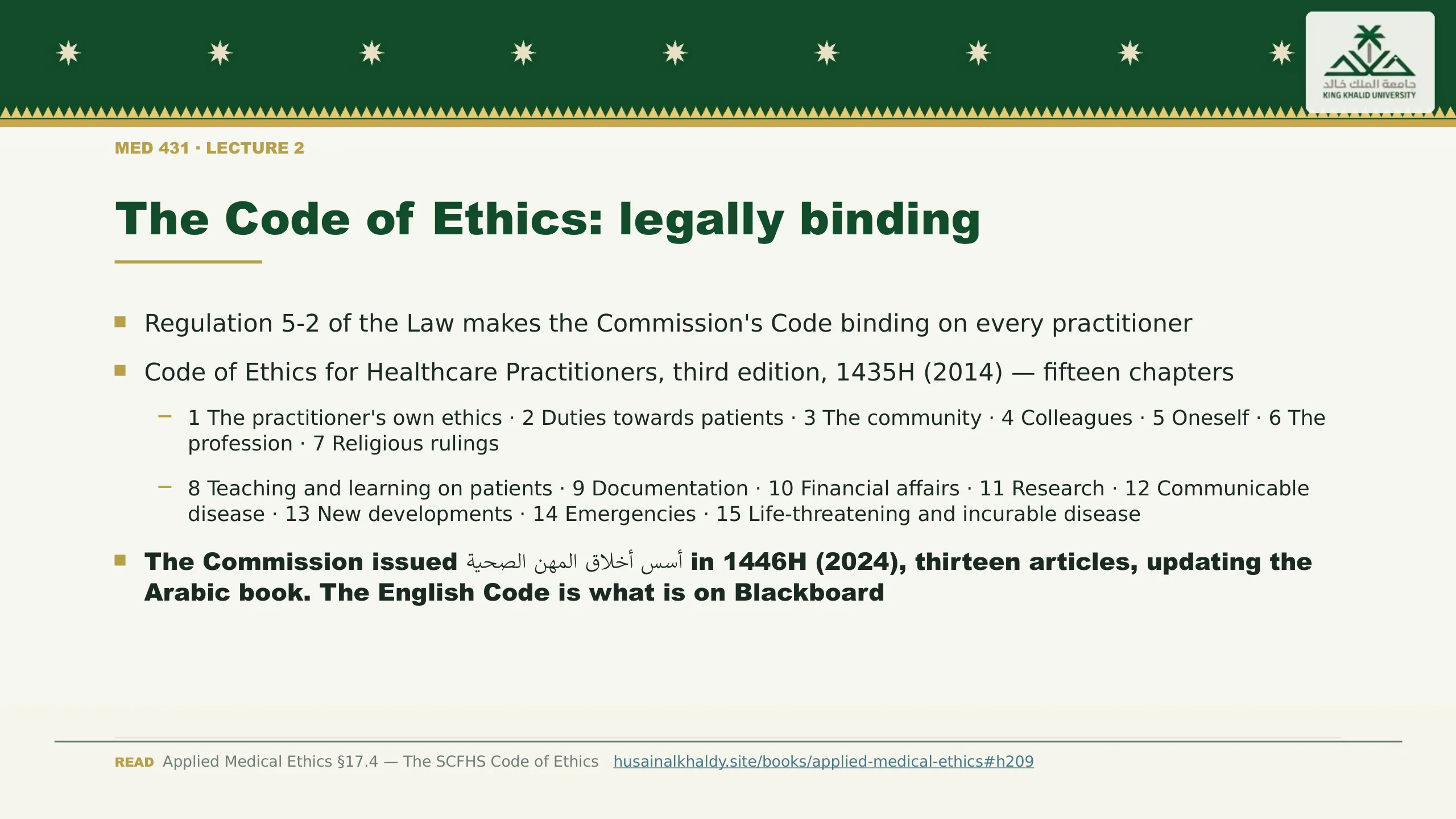
The Code of Ethics for Healthcare Practitioners is the Commission's book, prepared by a committee chaired by Professor Jamal Al-Jarallah and issued in its third edition in 1435H. It is not a code of conduct in the voluntary sense. Regulation 5-2 of the Law provides that “health professions practicing code of ethics and other guides approved by the Commission apply to health practitioners,” and Article 31 makes acting contrary to professional ethics a disciplinary offence. The Code is the content of that offence.
Its fifteen chapters follow the structure the book summarises in §17.4: the practitioner's own ethics; duties towards patients, the community, colleagues, oneself and the profession; the religious rulings on modesty, abortion and the relations between the sexes; and then the applied chapters on teaching, documentation, money, research, communicable disease, new technology, emergencies and the end of life. Several of the course's later weeks are, in effect, single chapters of this book.
One note on editions. In 1446H the Commission issued a short Arabic document of thirteen articles, أسس أخلاق المهن الصحية, which it describes as updating the Arabic book أخلاقيات الممارس الصحي. The English Code on Blackboard remains the one the Commission publishes, and the Arabic track of this course still cites the older Arabic book. When you are asked in an examination what the Code requires, the English Code is the text.
Where the Code begins
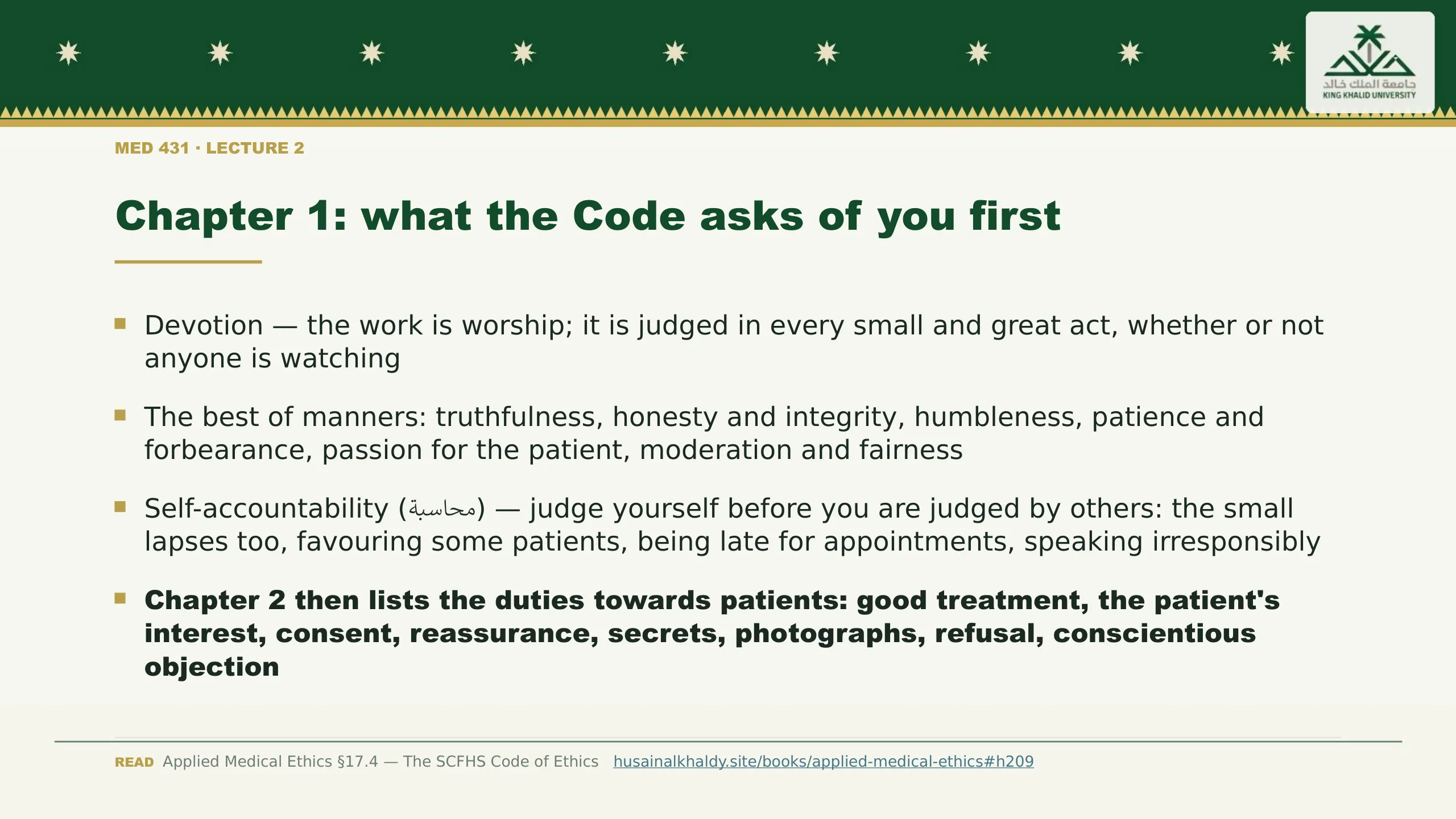
Before the Code says anything about patients it says something about the practitioner. Chapter 1 has three parts, and the book names them: devotion, the best of manners, and self-accountability. Devotion frames the work as worship, which the Code draws out to its consequence: a practitioner who perceives that every deed is judged will hold the standard when no supervisor, no auditor and no patient is watching. That is the Code's answer to the question of how a regulation can reach conduct that no regulator can see.
The manners are listed, and the list is worth knowing because it is what a disciplinary committee means by “professional ethics” under Article 31: truthfulness in intention and deed, honesty and integrity with the bodies entrusted to you, humbleness towards patients whatever their position, patience and forbearance with the difficult patient, passion and gentleness in delivering hard truths, and moderation and fairness in what you order and what you charge. Self-accountability, محاسبة, is the habit of judging yourself before others do, and the Code's examples are deliberately small: favouring some patients, delaying others, being late for appointments, speaking carelessly. Chapter 2 then turns outward to the patient, and its eight headings are the syllabus for the middle of this course.
The chapter behind the second situation
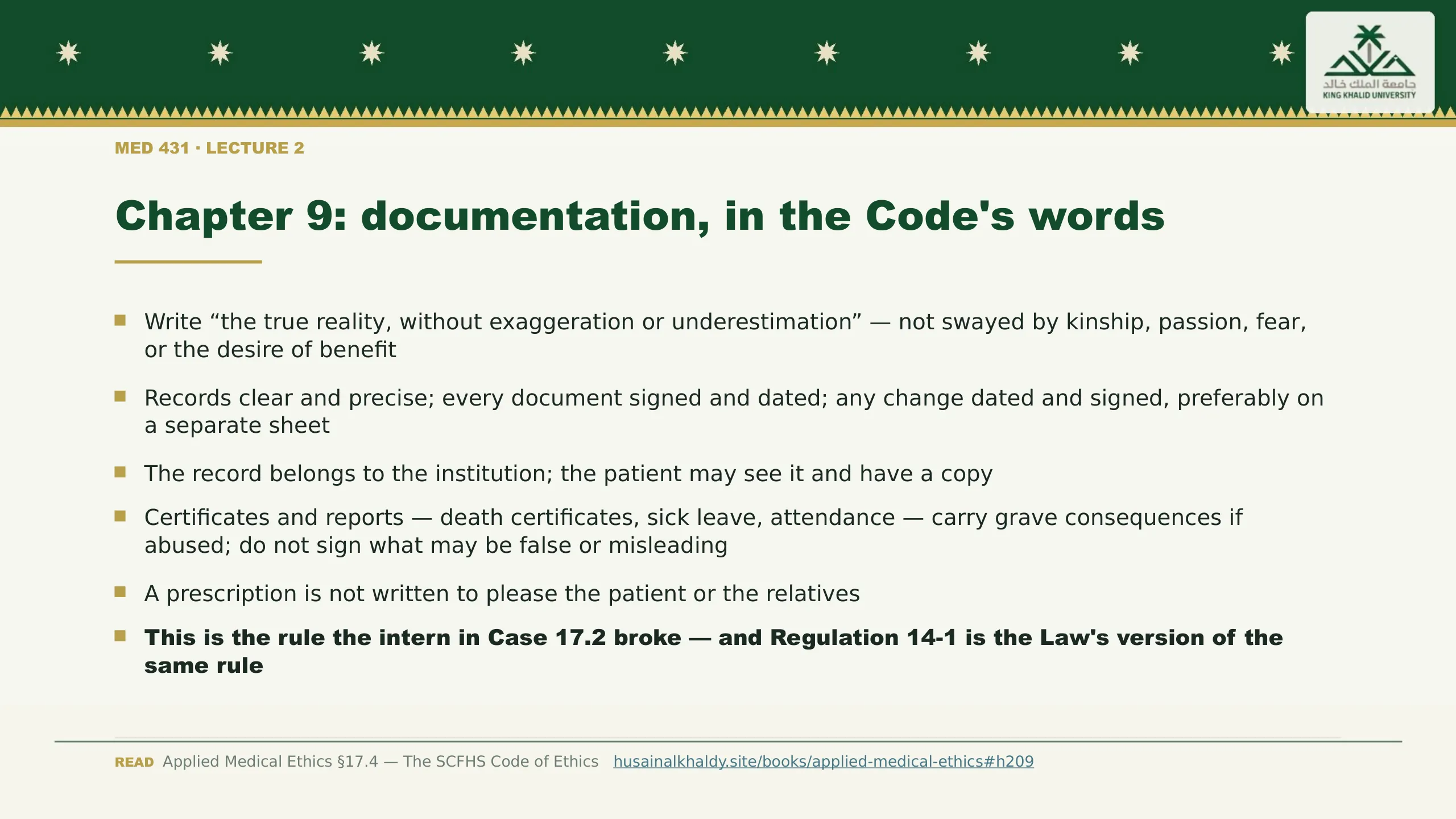
Chapter 9 of the Code is short and exact, and it settles the corridor request in the second of the three opening situations. The practitioner documents each procedure in accurate records and writes “what is the true reality, without exaggeration or underestimation,” not led astray by kinship, passion, fear or the desire of benefit. An examination documented before it is performed is not the true reality, whatever was going to be done later, and the intern who wrote it, and the consultant who asked for it, have both breached the chapter.
The mechanics matter as much as the principle. Records are clear and precise; every document is signed and dated; a change is dated and signed, and preferably made on a separate sheet rather than over the original. The record is the institution's property, but the patient may see it and take a copy. The section on certificates names the documents a doctor's signature makes dangerous, death certificates, medical reports, sick leave and attendance certificates, and instructs the doctor not to sign what may be false or misleading. Regulation 14-1 of the Law says the same about sick leave and health certificates, with Article 29's fine behind it. A prescription, finally, is a clinical document, not a favour, and Chapter 9 forbids writing one merely to please a patient or a relative. That is the first situation again, seen from the Code.
The ethical response to error
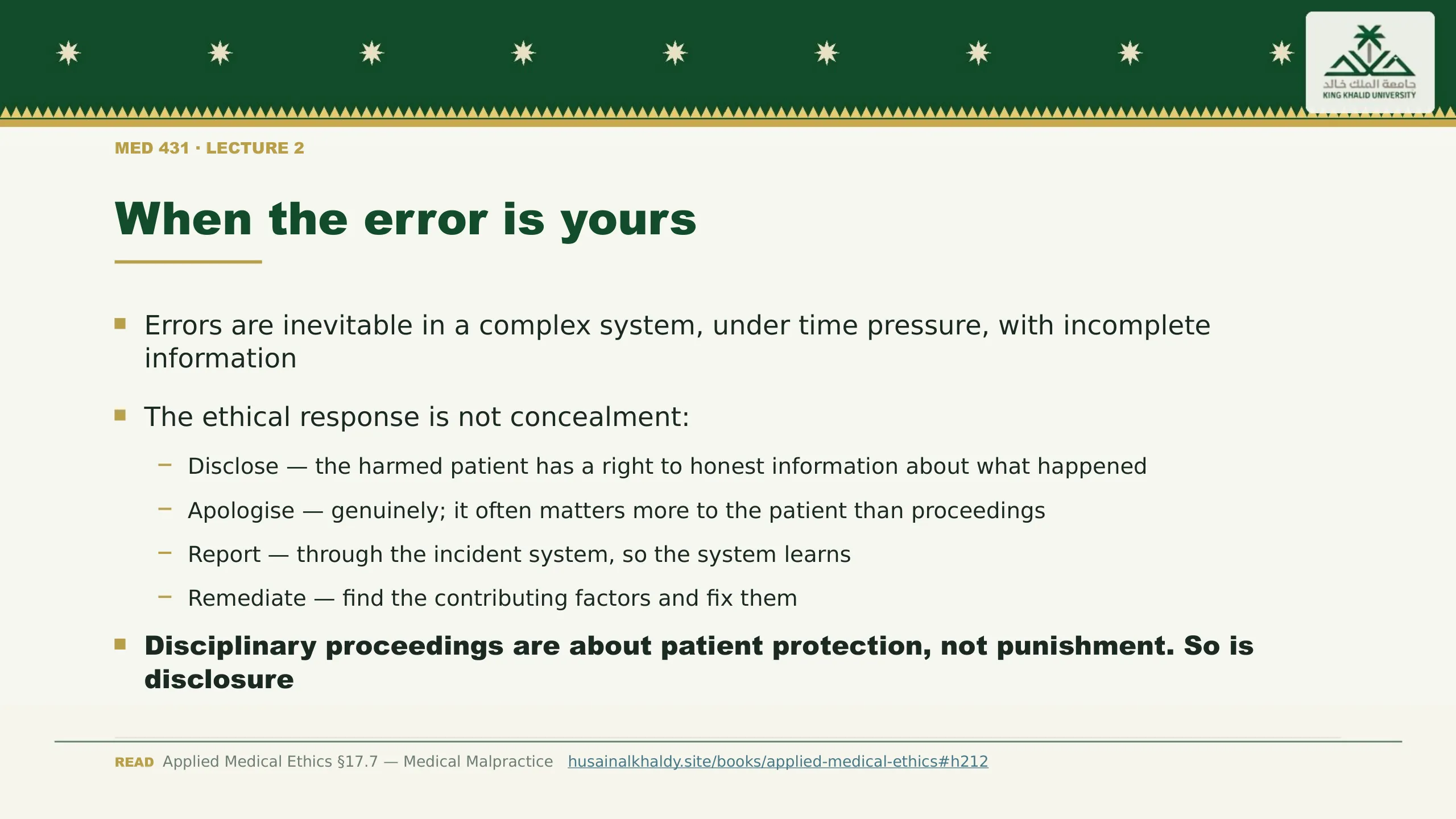
Everything before this slide describes what the system does to a practitioner after harm. This slide is about what the practitioner does first. The book's position is the one every serious patient-safety programme has reached: errors are inevitable in a complex system operating under time pressure with incomplete information, and the ethical question is not whether they happen but what you do when they do. The answer has four parts. Disclose, because a patient harmed by error has a right to honest information about what happened, and because Article 15 and Chapter 9 already require the truth in the record. Apologise, genuinely, because patients repeatedly say that an honest apology mattered more to them than the proceedings that followed. Report through the incident system, because a hospital that does not know cannot learn. Remediate, because the factors that produced the error will produce it again.
The last line ties this back to the Law. The book says of the disciplinary provisions that they are primarily about patient protection, not punishment, and Regulation 40-1's graduated penalties are built on that. Disclosure serves the same end. A practitioner who conceals an error has converted an honest mistake, which the four Ds may or may not call malpractice, into a false record, which Chapter 9 and Regulation 14-1 certainly call a violation.
Back to where we started
Forty slides of articles and regulations can leave the impression that a good doctor is one who has not been suspended. That is the wrong conclusion, and it is the one the book's first chapter warned against. The Law tells you what must not be done and who will act if you do it. It says nothing about the doctor who sits with a frightened patient after the consent form is signed, who tells the family what the scan showed in the words they can bear, who calls a colleague for a second opinion the patient did not know to ask for. None of that is required. All of it is medicine.
The rest of this course is about the space above the floor. Knowing where the floor is lets you stand on it without looking down.
Cases, and next week

Part four
As in Lecture 1, the last part is yours. Two of the four cases at the end of Chapter 17 follow, with the order in which to work them. Bring your answers to the other two next week.
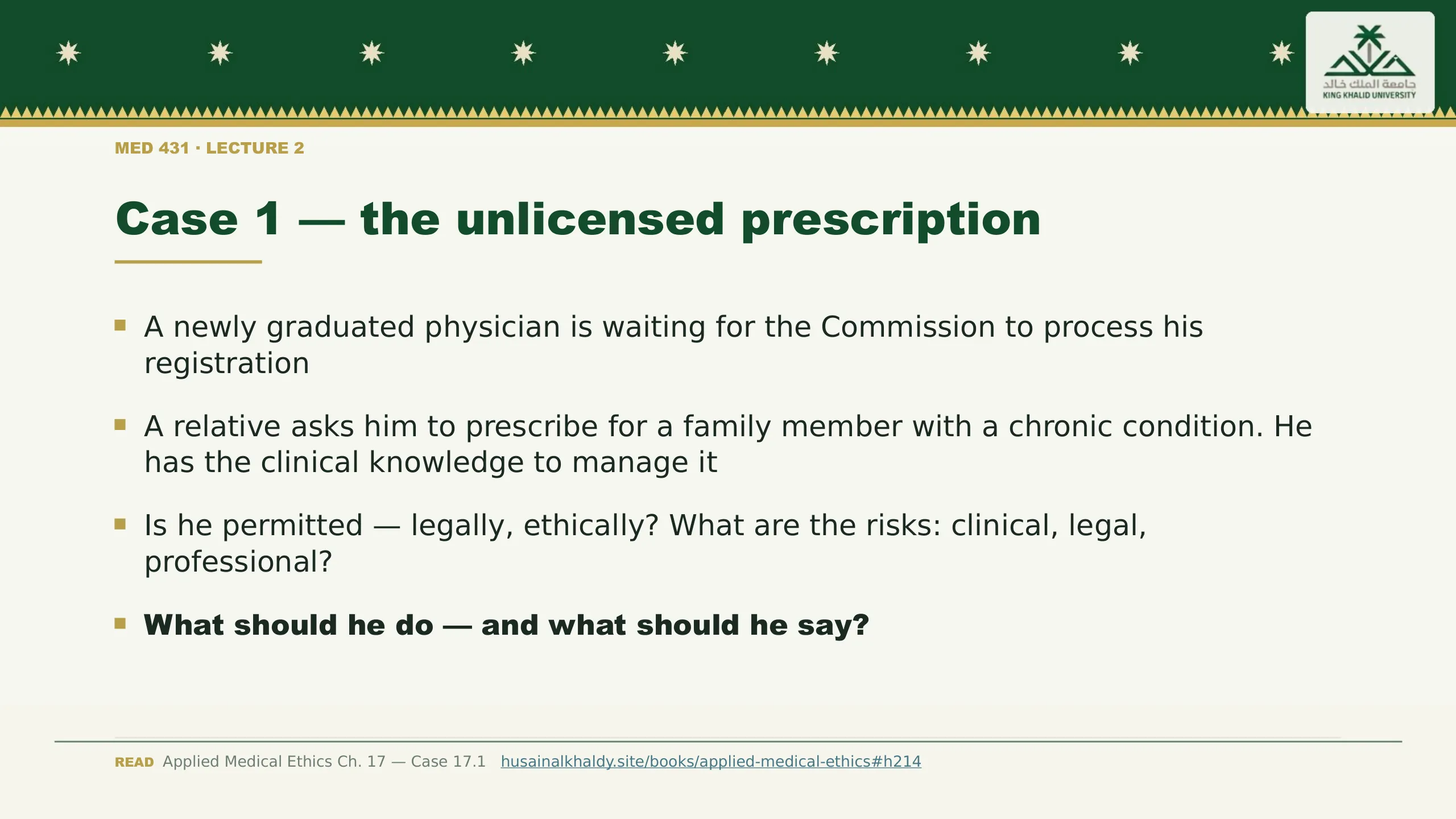
Case 17.1
Start with the rule, not the relationship. Article 2(a) forbids practice without a licence, Article 2(b) makes registration one of its conditions, and Article 28 makes practising without a licence an offence carrying imprisonment and a fine. The graduate is not registered, is not licensed, and a prescription is practice. That settles the legal question before any ethical one is reached, and it is why the statement on slide 3 said these situations are not dilemmas.
Then run the risks the case asks for. Clinical: the family member gets a prescription without a proper consultation, an examination or a record, from someone who cannot arrange follow-up. Legal: Article 28 for the graduate, and, if a pharmacist dispenses it, Article 23's requirement that a prescription come from a physician licensed in the Kingdom. Professional: Article 2(b)(4) and Regulation 2-10 refuse and refuse to renew a licence for a crime against honesty, and a registration that has not yet been granted is the worst possible moment to acquire a record. What he should say is the part students find hardest, and it is where ethics returns: the honest explanation to the relative, and the practical help, an appointment with a licensed colleague, that the relationship actually calls for.
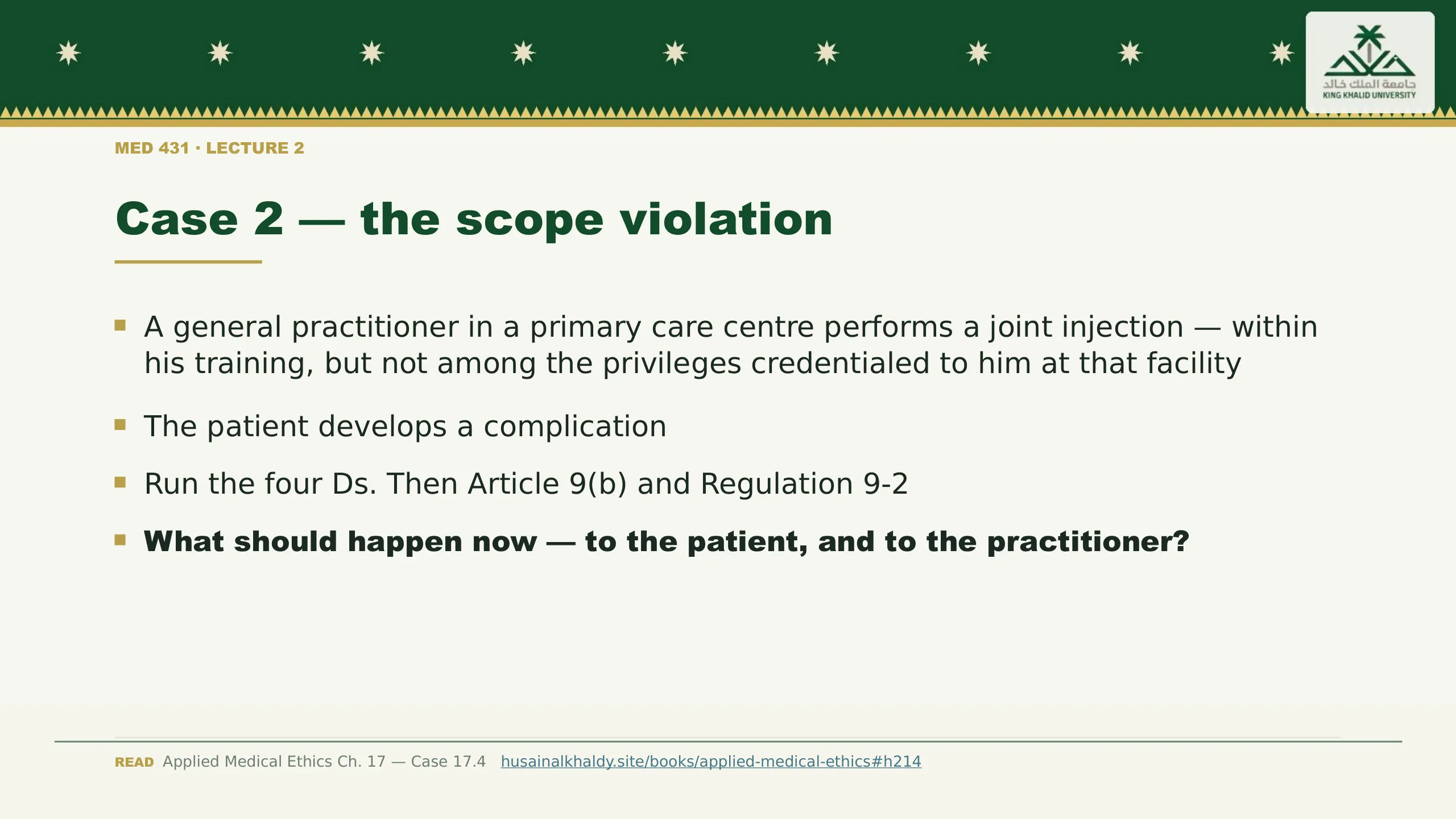
Case 17.4
This case is designed to separate two questions that students run together. The four Ds decide whether there was malpractice. Duty is clear. Deviation asks whether a reasonably competent practitioner with equivalent training would have performed the injection in those circumstances; the fact that he was trained to do it is relevant here, and so is whether it was performed to the standard. Damage is the complication. Direct causation asks whether the complication followed from a deviation or is a recognised risk of a properly performed procedure. It is entirely possible for the four Ds to come out against malpractice.
The second question is separate and comes out differently. Article 9(b) forbids any act beyond one's specialty or capacity except in emergencies, and Regulation 9-2 obliges the practitioner to work within the privileges given to him under the Commission's classification, privileges the employer must set out in writing under Regulation 9-3. Performing a procedure that is not among his credentialed privileges at that facility is a breach of those provisions whether or not the complication was his fault, and Article 31 makes it a disciplinary matter. The answer to “what should happen now” therefore has two tracks: for the patient, disclosure, treatment of the complication and an incident report; for the practitioner, an investigation under Regulation 40, in which the credentialing question and the malpractice question will be asked separately, as you have just asked them.
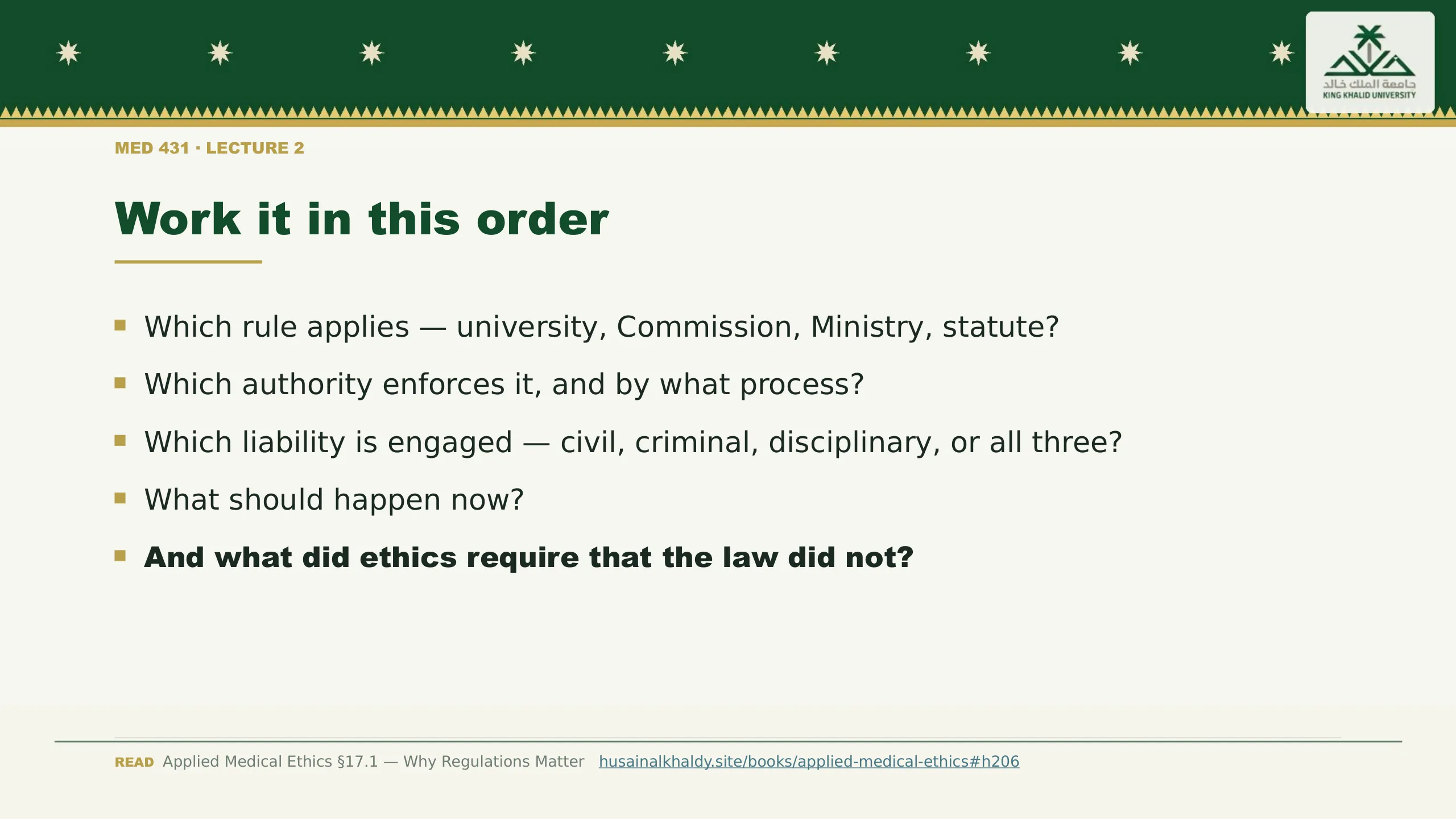
A method for regulatory questions
Lecture 1 gave you an order for ethical dilemmas. This is the order for regulatory questions, and it is also the order an examiner expects. Name the rule first, and name where it lives: a university regulation, a Commission code, a Ministry regulation, or the statute itself. Then name the authority that enforces it and the process it uses, because the answer to “what happens next” is procedural before it is anything else. Then ask which of the three liabilities is engaged, remembering that one act can engage all three and that they are decided separately. Then say what should happen now, for the patient before the practitioner.
The last question is the one that turns a regulatory answer back into an ethical one. In every case in Chapter 17 the law settles something and leaves something open, and the open part is where the four principles, the Code's Chapter 1 and your own judgement do their work. Answer it last, and answer it.
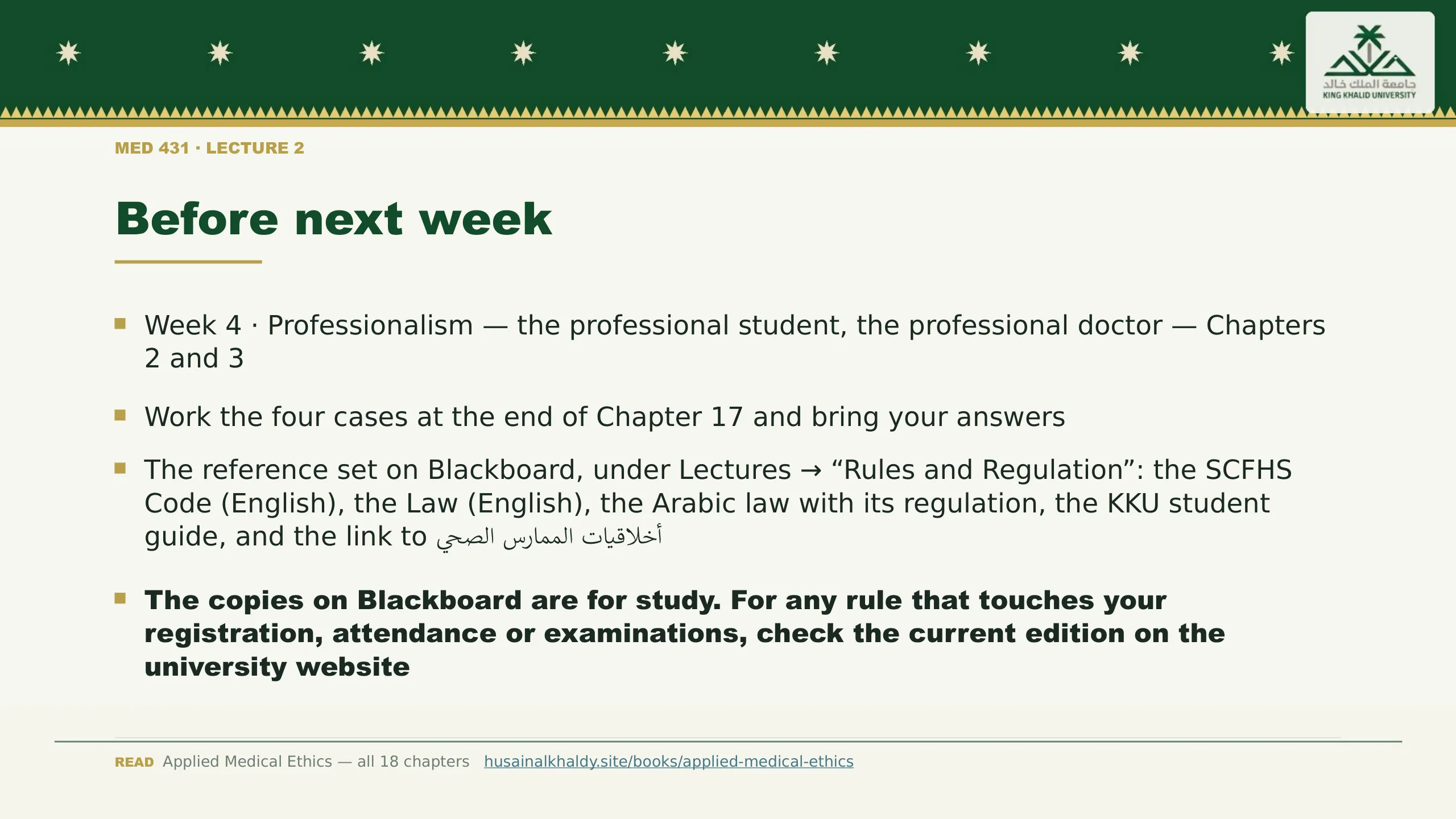
Reading, and the reference set
Next week's lecture is professionalism, and its chapters are 2 and 3. Read them before the lecture, as the course requires of every week, and do the case vignettes at the end. For this week, the four cases at the end of Chapter 17 are the assessment of whether the lecture landed; two were worked today, and the other two, the falsified record and the late-patient complaint, are yours.
The reference set has been on Blackboard since the announcement of 31 August, in the Lectures folder under “Rules and Regulation.” It holds the documents this lecture quoted from: the Commission's Code in English, the Law in English, the Arabic law with its implementing regulation, and the university's student guide, with a link to the Arabic Code. Use them for study, and treat them as study copies. The warning in the announcement stands: regulations are revised, and for anything that affects your registration, your attendance or your examinations, the current edition on the university's website is the one that binds you.

The question, answered
By the university's, until you graduate. By the Commission's, from registration for the rest of your career. By the Ministry's, from the day it licenses you. By the Law's, which stands behind all three. And, the Code would add, by an authority that watches what none of them can see. Next week: professionalism.
Before next week
Every lecture in this course has a chapter behind it. This one was Chapter 17 — Rules, Laws, and Regulations, with §2.5 of Chapter 2 for the student's part. Work the four cases at the end of Chapter 17 and bring your answers. Next week is professionalism: read Chapters 2 and 3 first.
The documents quoted in the lecture — the SCFHS Code of Ethics, the Law of Practicing Healthcare Professions with its implementing regulation, and the university's student regulations — are on Blackboard under Lectures → “Rules and Regulation”. They are study copies; for anything that touches your registration, attendance or examinations, check the current edition on the university website.
The question bank has 113 scenarios with the answers explained, and the Trainee Edition is the shorter version written for the wards.